
BrahMos Missile Upgrade Unveils New Strategic Defense Capabilities
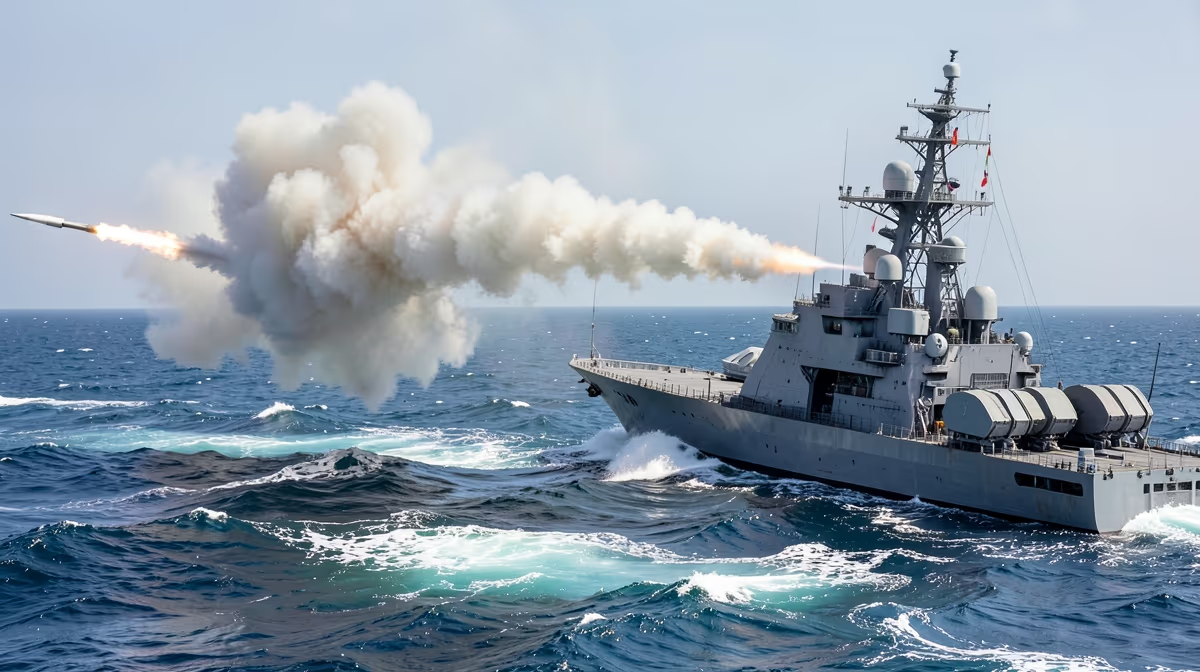
India successfully test-fired an extended-range version of the brahmos supersonic cruise missile from a naval warship in the Bay of Bengal on Tuesday, significantly bolstering the nation's maritime strike capabilities amidst evolving regional security dynamics. As india continues to advance its defense capabilities with the latest updates on the brahmos program, defense analysts and geopolitical strategists are closely examining the broader implications of this high-speed conventional deterrent on global security architecture.
Strategic Evolution and Technical Parameters
The test, conducted by the Indian Navy in coordination with BrahMos Aerospace, achieved all designated mission objectives, successfully hitting a designated bullseye target after traversing an extended trajectory. Officials noted that the upgraded variant extends the operational reach of the missile beyond the standard 290-kilometer limit, providing Indian platforms with enhanced standoff precision strike capabilities.
Developed as a joint venture between India's Defence Research and Development Organisation (DRDO) and Russia's NPO Mashinostroyeniya, the system remains one of the world's fastest supersonic cruise missiles. Operating at a speed of Mach 2.8 to 3.0, the missile utilizes a two-stage propulsion system with a solid propellant rocket for initial acceleration and a liquid ramjet for sustained supersonic cruise. It can be launched from land, ships, submarines, and even aircraft like the Su-30MKI, making it a highly versatile weapon for modern defense. Because it travels at speeds up to three times the speed of sound, it is extremely difficult for enemy radar and defense systems to intercept.
According to a senior defense ministry official speaking on condition of anonymity, the successful engagement of the target at extended ranges demonstrates the continuous technological evolution of our strategic assets and our capability to dominate maritime zones of interest. The original version of the weapon had an operational range of 290 kilometers due to international missile technology control limits. However, with India's entry into the Missile Technology Control Regime, extended-range variants capable of hitting targets up to 450 to 800 kilometers have been successfully developed and tested.
Historical Context and Industrial Foundations
The partnership began in the late 1990s as a joint venture between India's DRDO and Russia's NPO Mashinostroyeniya. The first successful test took place in 2001, and over the years, the missile has undergone multiple upgrades to increase its range, precision, and launching platforms. The name is a combination of two rivers, the Brahmaputra in India and the Moskva in Russia, representing the collaborative defense partnership between the two nations.
This technological progression is driven by the imperative for India to achieve defense self-reliance while countering regional asymmetry through high-speed conventional deterrence. Politically, the program serves as a potent symbol of national pride and technological sovereignty, heavily leveraged by the ruling dispensation to project strength domestically and project influence globally. At the same time, the complex web of intellectual property and legacy Soviet component dependencies complicates third-party export approvals and technology transfer negotiations, drawing a clear historical parallel to Cold War-era military export models that secured geopolitical alignment while subsidizing domestic industrial complexes.
Economic Imperatives and Export Dynamics
High capital expenditure requires massive export scaling to achieve economies of scale, transforming defense manufacturing into a foreign exchange earner and a cornerstone of the Make in India initiative. Defense analysts emphasize that this successful validation reinforces India's defense self-reliance initiative, known as Aatmanirbhar Bharat, while increasing the export viability of the missile system to allied nations. Several friendly foreign countries have already expressed formal interest in acquiring the advanced conventional weapon system for their respective armed forces, highlighted by the historic signing of a $375 million deal for supply to the Philippines.
Geopolitically, these developments redraw the security calculus in the Indo-Pacific and Southeast Asia by offering middle powers an advanced supersonic deterrent, directly challenging traditional Western and Chinese arms monopolies. The expansion into extended-range variants and targeting broader export markets in Southeast Asia, the Middle East, and Latin America establishes India as a reliable global arms supplier, boosting its economy and strengthening strategic alliances.
Operational Outlook and Risk Assessment
Looking at the immediate operational horizon, routine operational updates and bilateral defense discussions regarding missile deployments are expected over the next 24 hours. Within 72 hours, potential announcements concerning export orders, joint development milestones, or tactical readiness drills may emerge from the Ministry of Defence India, BrahMos Aerospace, and the Indian Armed Forces.
Experts predict a continued focus on enhancing the missile's range and maneuverability alongside aggressive marketing to allied nations. In a best-case scenario, successful international contracts will be finalized, boosting defense manufacturing revenue and diplomatic ties. Conversely, a worst-case scenario involves potential supply chain bottlenecks or unexpected technical glitches during testing phases.
Frequently Asked Questions
What is the speed of the BrahMos missile?
The BrahMos is a supersonic cruise missile capable of traveling at speeds of Mach 2.8 to Mach 3.0. This makes it one of the fastest anti-ship cruise missiles in operation worldwide today.
Is BrahMos a joint venture between India and which other country?
BrahMos is a joint venture between India's Defence Research and Development Organisation (DRDO) and Russia's NPO Mashinostroyeniya. The name is a portmanteau formed from two rivers, the Brahmaputra in India and the Moskva in Russia.
What does BrahMos stand for?
The name BrahMos is derived from two major rivers: the Brahmaputra river in India and the Moskva river in Russia. It represents the collaborative defense partnership between the two nations.
Can BrahMos be launched from submarines, ships, aircraft, and land?
Yes, BrahMos is a versatile multi-platform weapon system that can be launched from land-based launchers, warships, submarines, and fighter jets like the Su-30MKI. This makes it a formidable tri-service capability for the Indian Armed Forces.
What is the range of the BrahMos missile?
The original version of the BrahMos missile had an operational range of 290 kilometers due to international missile technology control limits. However, with India's entry into the Missile Technology Control Regime, extended-range variants capable of hitting targets up to 450 to 800 kilometers have been successfully developed and tested.
Is BrahMos a nuclear-capable missile?
While primarily designed as a conventional tactical missile, the BrahMos is capable of carrying a conventional warhead weighing between 200 to 300 kilograms. Its high kinetic energy upon impact also causes massive destructive power without necessarily needing a nuclear payload.
Conclusion
The successful test-firing of the extended-range BrahMos supersonic cruise missile in the Bay of Bengal underscores the ongoing maturation of India's defense technology and military capabilities. With confirmed operational achievements by the Indian Navy and BrahMos Aerospace, the program continues to reinforce national security and domestic manufacturing goals under the Aatmanirbhar Bharat framework. Realistic next steps involve ongoing bilateral defense discussions, potential international export finalizations, and continued technological refinements to enhance range, precision, and multi-platform deployment readiness.


.webp)
