
Chinese Hackers Target Federal Reserve and NASA in Cyber Espionage
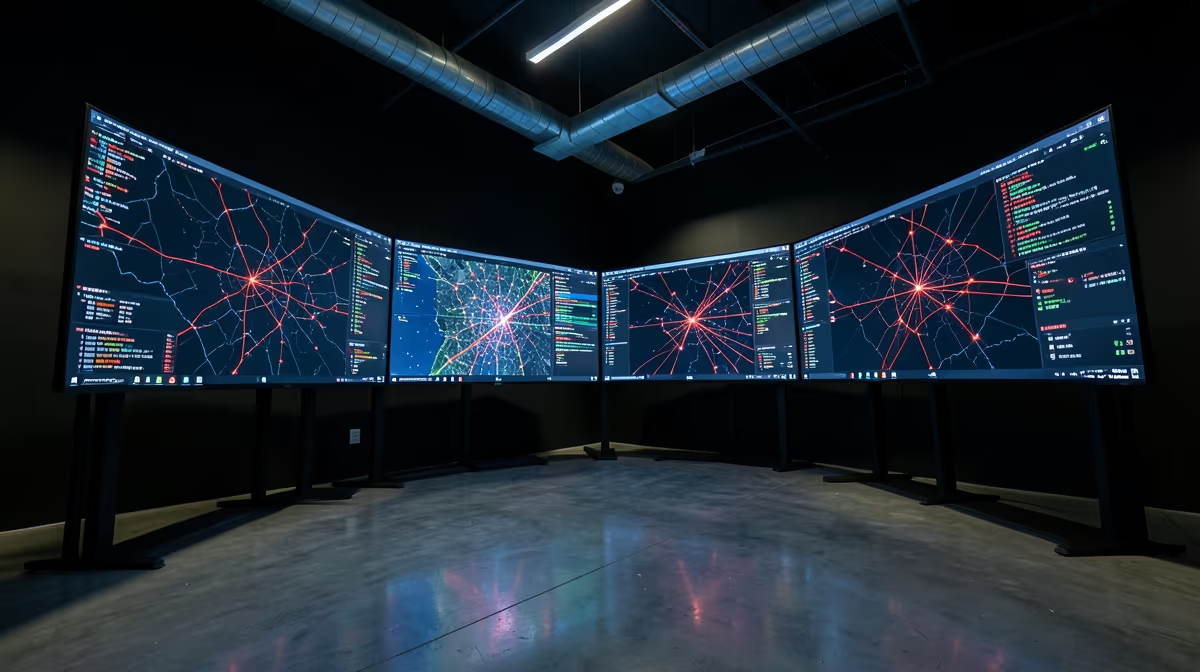
Recent intelligence reports reveal that Chinese hackers NASA DOJ systems have been compromised in a sophisticated state-sponsored cyber espionage operation affecting top US institutions. Court documents reveal that high-profile US government entities including the Federal Reserve, NASA, and the Department of Justice were among the targets of a Chinese state-sponsored hacker group.
Scope of the Infiltrations and Target Selection
Recent disclosures have brought to light a targeted cyber campaign directed by a Chinese state-sponsored hacker group against critical US institutions. According to court documents and reports from multiple news outlets, the intrusions reached deeply into major government and financial bodies. The targets reportedly included the Federal Reserve, NASA, the Department of Justice, the US Senate, and various hospitals and public agencies. Security analysts and investigators are continuing to piece together the full scope of the breach and the methods utilized by the threat actors.
Government agencies and cybersecurity experts are evaluating the extent of the compromised systems and data access. The incident underscores ongoing concerns regarding sophisticated, state-backed cyber operations targeting critical infrastructure and government networks.
- The Federal Reserve, NASA, and the Department of Justice were victims of a cyberattack.
- The attacks were carried out by a Chinese state-sponsored hacker group.
- The breach came to light through recent court documents.
- US officials have reported that other government entities, including the Senate and hospitals, were also targeted.
- Investigations into the full scope and impact of the hacking campaign are ongoing.
Geopolitical and Economic Implications
The root cause of these activities stems from intense strategic and technological competition between the United States and China, manifesting in aggressive state-sponsored cyber espionage aimed at compromising critical government, judicial, and scientific infrastructure. This dynamic generates domestic political pressure in Washington to demonstrate robust defense mechanisms and accountability against foreign intrusions, while holding intelligence and law enforcement agencies like the DOJ and FBI under scrutiny.
Economically, the intrusions threaten the potential compromise of proprietary aerospace research, sensitive financial data from the Federal Reserve, and critical infrastructure, undermining the U.S. technological edge and market confidence. Geopolitically, the campaign heightens tensions between Washington and Beijing, framing cyberspace as a primary theater for persistent gray-zone conflict and espionage without crossing into traditional kinetic warfare. Analysts note a historical parallel to the 2015 Office of Personnel Management data breach, which was also attributed to Chinese state-sponsored actors and exposed millions of sensitive federal background investigation records.
Security Assessment and Threat Intelligence
State-sponsored cyber espionage is a common method used by various nations to collect foreign intelligence, steal intellectual property, or disrupt adversary networks. Governments globally continually invest in cybersecurity defenses to detect and mitigate these sophisticated, persistent threats from foreign hacker groups.
Cyberattacks on high-profile government institutions and critical infrastructure pose significant national security risks. When state-sponsored hackers gain access to organizations like the Federal Reserve, NASA, and the Department of Justice, it raises serious concerns about the safety of sensitive data, economic security, and the overall resilience of government digital systems. The affected population includes US government agencies, federal employees, and citizens relying on the secure operation of institutions like NASA, the Department of Justice, and the Federal Reserve.
Future Outlook and Expected Developments
Over the next 24 hours, further details from court documents regarding the Chinese state-sponsored cyberattacks on major U.S. government agencies like the Fed, NASA, and the DOJ are expected to emerge as officials brief the public and lawmakers. Looking toward the next 72 hours, analysts anticipate increased calls for tightened cybersecurity measures across federal institutions and critical infrastructure, alongside diplomatic or retaliatory statements from Washington regarding state-sponsored hacking activities.
Expert assessment suggests heightened scrutiny on federal cyber defenses and renewed diplomatic tensions between the U.S. and China following the public release of court documents detailing state-sponsored intrusions. In the best-case scenario, the targeted agencies successfully patch all vulnerabilities, confirm no critical data or operational systems were permanently compromised, and reinforce joint defense measures against future cyber threats. In the worst-case scenario, the intrusions are found to have compromised sensitive state data or internal systems on a broader scale than initially reported, leading to deeper security vulnerabilities and escalated geopolitical friction.
Frequently Asked Questions
Which US government agencies were targeted by the Chinese state-sponsored hacker group?
Court documents and US officials revealed that prominent federal organizations, including NASA, the Department of Justice (DOJ), and the US Senate, were among the primary victims of the state-sponsored cyber espionage campaign. The hackers also compromised various other sectors, including hospitals, indicating a broad and coordinated attack.
What happened in the cyber attack involving Chinese state-sponsored hackers?
Court documents uncovered a major cyber espionage operation where Chinese-linked hackers successfully targeted and infiltrated high-profile US government agencies and critical infrastructure. The attacks compromised sensitive networks across organizations like NASA, the DOJ, and the Senate.
Why does the cyber attack on NASA and the DOJ matter?
This incident highlights severe vulnerabilities in critical US government networks and sensitive state infrastructure. Breaches involving agencies like the DOJ and NASA raise serious national security concerns regarding the potential theft of classified data and proprietary research.
Who was affected by the Chinese-linked hacking campaign?
The targeted victims span multiple high-level US government entities, including NASA, the Department of Justice, the US Senate, and various hospitals. The wide range of targets suggests the threat actors sought diverse intelligence across federal, legislative, and public health sectors.
What is the background of the Chinese state-sponsored hacker group attacks?
State-sponsored cyber espionage operations targeting Western government agencies and critical infrastructure have been a persistent geopolitical challenge for years. Recent court documents brought new light to the specific scope of this campaign, detailing how threat actors infiltrated high-value US networks.
What specific details emerged from the court documents regarding the hack?
Newly surfaced court documents provided specific evidence detailing how Chinese-linked hackers breached multiple prominent US targets, such as NASA and the Senate. These filings outline the extensive nature of the intrusions and underscore ongoing concerns about foreign state-backed cyber threats.
Conclusion
Court documents confirm that multiple high-profile US entities, including NASA, the Department of Justice, and the Federal Reserve, were targeted by a Chinese state-sponsored hacking group in a widespread cyber espionage campaign. The full extent of the data compromised during the cyberattacks and any subsequent policy or diplomatic responses from US authorities remain under investigation as federal officials and lawmakers review the newly public filings.
Sources
- NASA is gearing up to launch its next flagship space telescope – combining spy technology with sophisticated infrared detectors — The Conversation
- New NASA photos reveal 16 galaxies from across the cosmos in dazzling detail — Scientific American
- Fed, NASA and DOJ among victims of Chinese state-sponsored hacker group: Court documents — CNBC
- US says Chinese-linked hackers attacked NASA, Senate, and gov’t agencies — Al Jazeera
- U.S. Says Chinese Hackers Targeted Senate, NASA, Hospitals, and More — Time Magazine
- AI searched 100 million possibilities and found a cheaper way to 3D-print a NASA rocket alloy — Science Daily


.webp)