
Demis Hassabis Is Driving an AI Shift That Changes Everything
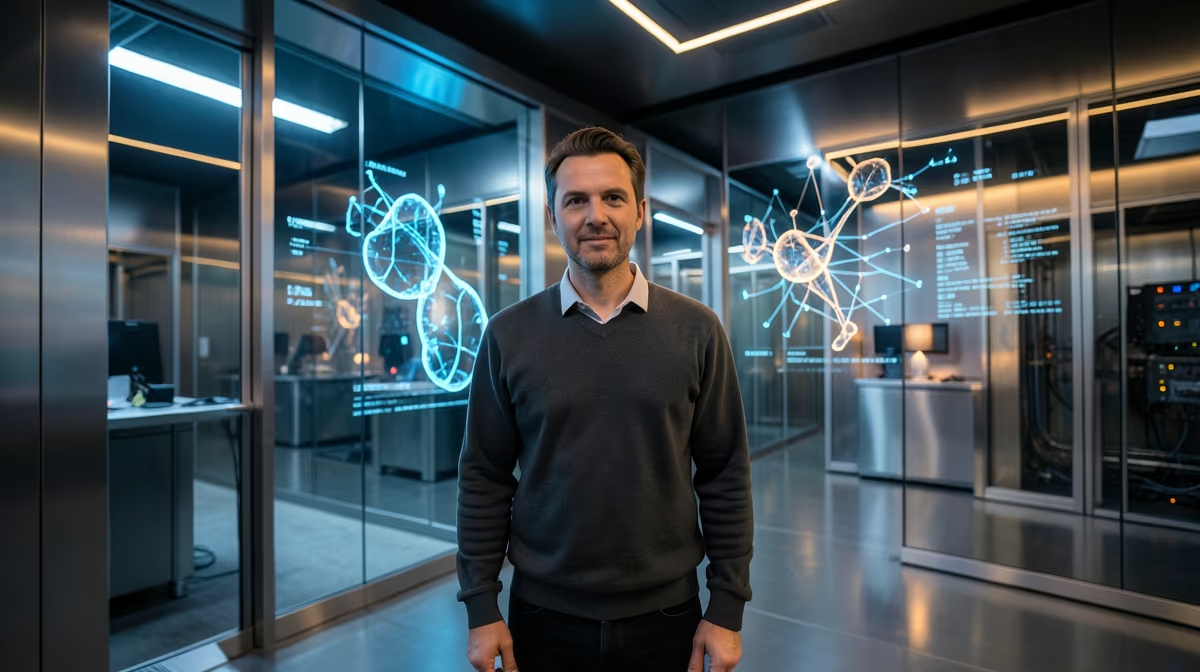
The trajectory of modern science shifted permanently the moment deep learning architectures met biological exploration, a convergence driven forward by demis hassabis. As the co-founder and CEO of google deepmind, hassabis continues to shape the future of technology through google deepmind, leading unprecedented ai breakthroughs and shaping the global agi timeline. This leadership has redefined not only computational intelligence but also the foundational pace of global scientific research, touching sectors from structural biology to international tech policy.
The Blueprint of a Scientific Revolution
The roots of this technological paradigm shift lie in the confluence of neuroscience-inspired deep learning architectures and massive compute scalability pioneered by deepmind. This approach fundamentally shifted the global paradigm of scientific discovery. Beginning his career as a child chess prodigy who attained the master standard at age 13, hassabis transitioned into cognitive neuroscience before graduating from cambridge university with a double first-class honours degree in computer science and earning a phd in cognitive neuroscience from ucl.
In 2010, he co-founded deepmind, combining neuroscience with reinforcement learning to build powerful general-purpose algorithms. Under his leadership, the London-based lab achieved historic milestones, including the creation of alphago in 2016, the first computer program to defeat a world human champion in the complex board game go. This milestone catalyzed global panic and awe regarding artificial general intelligence and sparked the modern generative ai boom. Following deepmind's acquisition by google in 2014 and its subsequent merger with google brain, hassabis has remained at the vanguard of responsible ai development, consistently advocating for stringent safety frameworks, international regulation, and ethical guidelines.
Decoding Life with AlphaFold
The culmination of this computational journey arrived with the 2024 nobel prize in chemistry, awarded jointly to demis hassabis, john jumper, and david baker. Hassabis and his longtime collaborator john jumper revolutionized structural biology by solving the 50-year-old protein folding problem using advanced machine learning models. Their breakthrough tool, alphafold, has mapped the structures of nearly all known proteins, successfully predicting the 3d structures of over 200 million proteins.
Proteins are the building blocks of life, and understanding their shapes is crucial for fighting diseases. By decoding protein structures in minutes instead of decades, this intelligence is revolutionizing medicine, paving the way for new life-saving drugs and treatments that can benefit millions of people globally, including in developing nations like India. The ongoing integration of alphafold 3 capabilities into pharmaceutical pipelines represents a major leap forward for medical researchers, pharmaceutical companies, healthcare patients, and students studying science and technology worldwide.
Geopolitical and Economic Realities
The rapid scaling of these technologies introduces complex economic and geopolitical dimensions across global markets. In emerging tech hubs like India, the rise of advanced autonomous reasoning agents disrupts the multi-billion dollar IT outsourcing and software services industry, forcing domestic conglomerates to pivot to AI infrastructure and proprietary domain data. Indian policymakers must navigate between US tech hegemony and domestic 'Make in India' AI imperatives to avoid technological colonization, especially given the nation's struggle to transition from a massive IT services hub to an indigenous AI sovereign power.
This tension is mirrored by the brain drain of top-tier Indian AI researchers to London and Silicon Valley laboratories like deepmind, contrasting sharply with the Modi administration's nationalist push for domestic technological self-reliance. This dynamic resembles the mid-20th-century nuclear energy race, where developing nations realized that possessing raw scientific intellect was insufficient without mastering capital-intensive foundational infrastructure. Consequently, the Indian Ministry of Electronics and Information Technology faces critical choices regarding data localization and AI copyright issues, which directly influence the deployment timelines of advanced foundational models in the region.
The Outlook and Governance
As computational capabilities scale globally, governance and safety remain paramount. Experts predict that hassabis will continue to advocate for responsible ai development while expanding deepmind's academic partnerships in south asia. In the near term, collaborative research initiatives focusing on healthcare applications in developing markets like india may be formally announced, though heightened scrutiny on data regulations could impact deployment speeds. The best-case scenario involves established partnerships with Indian research institutions to accelerate AI-driven medical diagnostics, whereas heightened regulatory hurdles risk delaying these deployments. Meanwhile, policy discussions around AI safety regulations continue to evolve in response to these rapid technological shifts.
Frequently Asked Questions
Who is Demis Hassabis?
Demis Hassabis is a British computer scientist, artificial intelligence researcher, and entrepreneur. He is the co-founder and CEO of Google DeepMind, leading groundbreaking advancements in artificial general intelligence.
What did Demis Hassabis win the Nobel Prize for?
Demis Hassabis was awarded the 2024 Nobel Prize in Chemistry jointly with John Jumper for their revolutionary work on protein structure prediction using AlphaFold. This discovery solved a 50-year-old grand challenge in biology.
What is Demis Hassabis's educational background?
He was a child chess prodigy who attained the Master standard at age 13. He later graduated from Cambridge University with a double first-class honours degree in Computer Science and earned a PhD in cognitive neuroscience from UCL.
What are Demis Hassabis's major contributions to AI?
Apart from AlphaFold, he led the development of AlphaGo, the first computer program to defeat a world champion in the game of Go. His work bridges neuroscience and machine learning to build powerful general-purpose algorithms.
Is Demis Hassabis a neuroscientist?
Yes, he has a strong background in cognitive neuroscience alongside computer science. His early academic research focused on how human memory and imagination work, which heavily inspired his approach to artificial intelligence.
What is Demis Hassabis's role at Google?
He serves as the CEO and co-founder of Google DeepMind, overseeing Google's primary AI research lab. In this role, he directs the global strategy for safe and beneficial artificial general intelligence development.
Conclusion
Demis Hassabis and the teams at Google DeepMind have fundamentally altered the landscape of scientific discovery through foundational breakthroughs like AlphaFold and AlphaGo. Supported by verified achievements including the 2024 Nobel Prize in Chemistry and extensive protein structure mapping, the organization continues to navigate the intersection of advanced computational capabilities, international regulatory frameworks, and regional policy demands. Realistic next steps involve ongoing academic collaborations, the integration of structural biology tools into global healthcare pipelines, and the continued establishment of robust safety standards for artificial general intelligence.


.webp)

