
Robotaxi Fleets Expansion Sparks Major Safety Clash Across US Cities
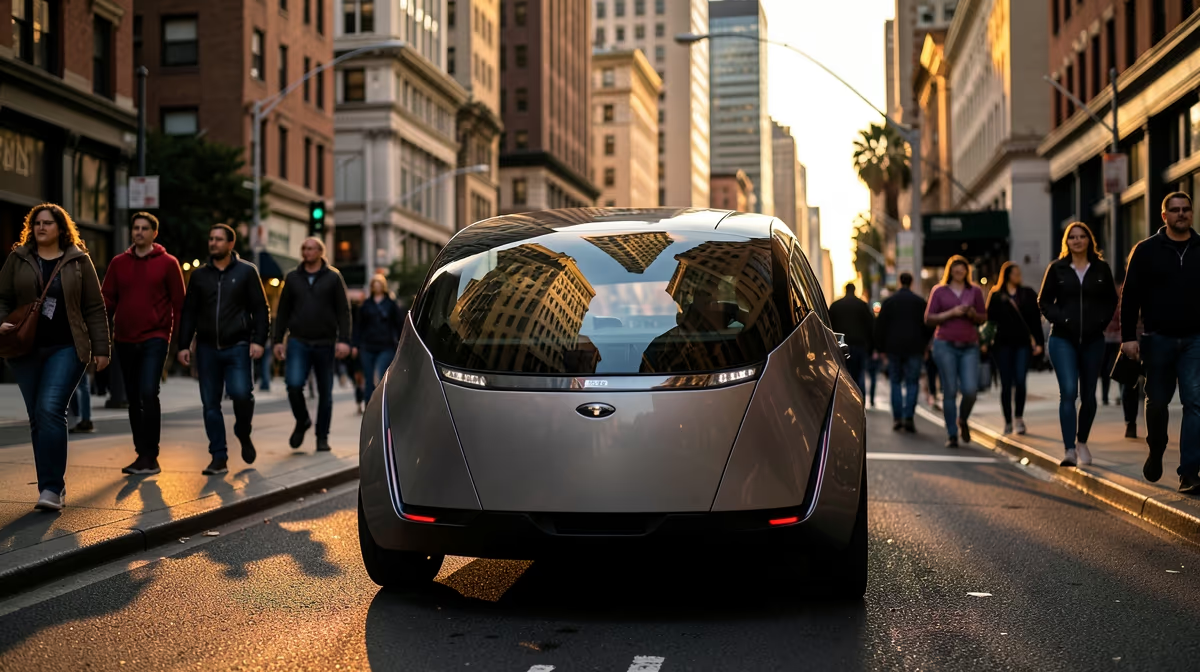
As urban mobility rapidly evolves across the United States, the race for widespread robotaxi deployment is accelerating among major technology and automotive giants. Autonomous vehicle operators expanded driverless commercial services across major metropolitan areas in the United States this week, intensifying competition and regulatory scrutiny over the future of urban mobility.
What Unfolded
Companies including Waymo and Tesla deployed hundreds of additional autonomous vehicles onto public streets in cities such as San Francisco, Phoenix, and Austin. The expansion represents a significant milestone for the commercial robotaxi industry, transitioning from heavily supervised testing phases to widespread public availability. Despite the commercial growth, the deployment has triggered heightened concern from municipal leaders, first responders, and labor unions. Critics cite recurring instances where autonomous vehicles have inadvertently blocked traffic, interfered with emergency response vehicles, and stalled in intersections during adverse weather conditions. Federal and state regulators are currently reviewing safety data submitted by operators following several high-profile incidents. While industry advocates argue that computer-driven vehicles ultimately reduce human-error traffic fatalities, transportation authorities maintain that rigorous oversight is necessary to ensure public safety before broader nationwide scaling is permitted.
How Waymo and Tesla are Shaping the Autonomous Vehicles Industry
Robotaxis are self-driving cars that you can hail like an Uber or Lyft, but without a human driver behind the wheel. Instead of a person, a computer system uses advanced sensors, cameras, and artificial intelligence to navigate city streets, stop for pedestrians, and follow traffic laws. Currently operating in select U.S. cities like San Francisco, Phoenix, and Austin, riders simply use a smartphone app to request a vehicle. The car arrives empty, picks you up, and drives you safely to your destination while you relax, work, or look out the window. Waymo and Tesla currently operate commercial or testing robotaxi fleets in multiple U.S. cities. Federal regulators require autonomous vehicle companies to report collisions involving automated driving systems. First responders in several municipalities have reported operational friction with stalled autonomous vehicles. State-level regulations regarding robotaxis vary significantly across the United States. Commercial robotaxi services are actively operating and expanding passenger-carrying fleets in specific U.S. metropolitan markets under varying state and local permits, while potential new federal safety standards, municipal legislative restrictions, and union-backed labor challenges are actively moving through regulatory and legal channels.
Safety Concerns and Regulations Surrounding Driverless Cars
The relentless pursuit of hyper-scalable software margins applied to the physical transport layer is driven by venture capital's need to eliminate labor costs and capture total urban mobility revenue. Municipal governments are currently caught between powerful corporate tech lobbies promising futuristic efficiency and organized labor unions fighting to protect blue-collar driving jobs, leading to regulatory fragmentation. This shift moves vehicle ownership from a consumer asset to mobility-as-a-service utilities, heavily consolidating transportation capital into the hands of a few tech conglomerates while decimating the traditional automotive dealership and insurance ecosystems. Furthermore, a high-stakes technological race is underway primarily between US and Chinese firms for global algorithmic supremacy in spatial computing, setting the standards for smart city infrastructure and surveillance capabilities worldwide. Beneath fully automated marketing lies an immense, underreported reliance on low-wage human remote operators in developing nations who manually intervene when autonomous systems fail, exposing a hidden global underclass. Historically, this mirrors the rapid mechanization of agriculture in the early 20th century, which dismantled rural labor markets and forced mass urbanization under the banner of industrial progress. The timeline of this transformation traces from the 2010 DARPA Urban Challenge legacies and early academic autonomous vehicle research gaining private backing, through the 2018 initial high-profile commercial robotaxi pilots launching in controlled US sunbelt markets amid massive hype, to the 2023 regulatory hurdles and safety incidents that sparked intense public backlash and federal investigations in cities like San Francisco. Today, the industry operates in a cautious commercial scaling phase defined by intense cost-cutting, data monopoly consolidation, and quiet municipal integration.
Why This Matters
Robotaxis have the potential to drastically reshape daily life by reducing traffic accidents caused by human error, lowering transportation costs, and changing how cities design parking and public transit. However, they also raise important questions about job displacement for human drivers and how emergency responders interact with driverless vehicles. Urban commuters, traditional rideshare and delivery drivers, city planners, public transit systems, and people with disabilities who may gain newfound independence through autonomous travel are directly affected by these changes. According to Dr. Sarah Jenkins, Director of Transportation Safety Research at the National Institute for Automated Mobility, the data demonstrates that our autonomous systems operate with a significantly lower collision rate than human drivers in comparable urban environments. Conversely, San Francisco Supervisor Connie Chan noted that municipal streets are being used as a testing laboratory without adequate guarantees for public safety or emergency response access.
A Shifting Landscape
Regulatory filings and safety data updates from major autonomous vehicle operators will likely be scrutinized following recent minor traffic incidents in dense urban test zones. Municipal transport authorities may announce expanded testing parameters or request additional transparency reports, while companies continue route mapping. Key players in this landscape include Waymo, Tesla, Cruise, and Zoox, with impact concentrated across urban mobility, public safety, municipal regulation, and auto insurance. Expert predictions suggest that incremental geographic expansion will continue cautiously as companies prioritize safety metrics over rapid commercial scaling to appease regulators. The best-case scenario involves seamless scaling in new metropolitan areas with zero critical safety incidents, boosting public trust and accelerating municipal approvals, while the worst-case scenario entails a high-profile traffic obstruction or accident triggering immediate fleet groundings and stricter emergency response oversight.
Frequently Asked Questions
Are robotaxis currently operating in the US?
Yes, fully autonomous robotaxis are currently operating in several major US cities, including San Francisco, Phoenix, Austin, and Los Angeles. Companies like Waymo offer commercial rides to the general public through ride-hailing apps. These vehicles navigate complex urban environments without a human safety driver behind the wheel.
How much do robotaxi rides cost in the US?
Robotaxi fares are generally comparable to traditional ridesharing services like Uber and Lyft. Pricing can vary depending on the city, time of day, and current demand, often featuring dynamic pricing models. Promotional discounts are sometimes offered to encourage new riders to try the autonomous service.
Which companies own and operate robotaxis in the US?
The primary commercial robotaxi operator in the US is Waymo, a subsidiary of Alphabet Inc. Other companies like Zoox, backed by Amazon, are currently testing their vehicles in preparation for commercial launches. General Motors' Cruise has also operated robotaxis in the past and is working toward relaunching its services.
Are robotaxis safe to ride in?
Robotaxis are equipped with advanced sensor suites including LiDAR, radar, and cameras that provide a 360-degree field of view. Safety data released by operators suggests they are involved in fewer injury-causing accidents per mile than human-driven vehicles. However, they can occasionally cause unexpected traffic congestion when encountering unusual road scenarios.
How do you hail a robotaxi?
Hailing a robotaxi is similar to using standard rideshare apps, requiring passengers to download a dedicated application like the Waymo One app. Users input their destination, and the app dispatches a nearby autonomous vehicle to their exact pickup location. Once the car arrives, passengers unlock the doors via the app to begin the trip.
In which US cities can you ride in a robotaxi?
Commercial robotaxi services are currently available to the public in cities such as San Francisco, Phoenix, Los Angeles, and Austin. Testing and limited deployments are also underway in other metropolitan areas like Miami and Atlanta. Expansion to additional US cities is expected as regulatory approvals and technology capabilities grow.
Conclusion
Autonomous vehicle operators have successfully expanded commercial robotaxi services across major metropolitan areas in the United States, transitioning from heavily supervised testing to public availability. While companies like Waymo and Tesla continue to deploy fleets and scale operations, municipal leaders, first responders, and labor unions maintain heightened concerns regarding traffic obstructions, emergency response interference, and safety transparency. Regulatory bodies at both state and federal levels are actively reviewing safety data and incident reports to determine appropriate oversight frameworks. Realistic next steps involve cautious geographic expansion, continued safety data scrutiny, and potential new regulatory standards as companies balance commercial growth with public safety and municipal integration.


.webp)

