
Eclipse live stream reveals a rare celestial event unfolding across UK
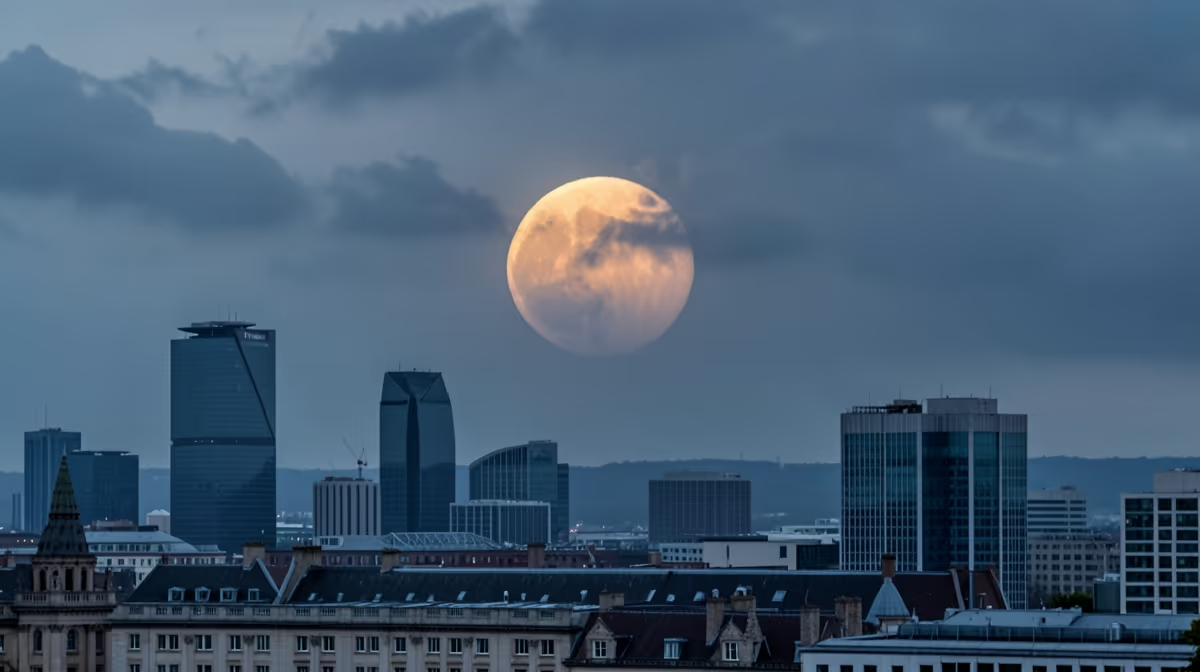
Skies across the UK are preparing for a breathtaking celestial show as a solar eclipse takes place. Get all the latest updates with our eclipse live coverage, featuring real-time tracking and expert commentary. Millions of people are tuning into live broadcasts and stepping outside with special safety glasses to watch the Moon pass directly between the Earth and the Sun. While a total eclipse blocks the Sun completely in some parts of the world, viewers in Britain are experiencing a partial eclipse, where the Sun looks like it has a large bite taken out of it. Broadcasters and science centers are providing real-time streams and expert commentary so everyone can enjoy the rare event safely from their living rooms or offices. British astronomers and stargazers are preparing for this rare partial solar eclipse visible across the United Kingdom today, with peak viewing expected during the mid-afternoon hours, drawing crowds to observatories from Cornwall to the Scottish Highlands despite intermittent cloud cover.
What Unfolded
The celestial event began shortly after 10:00 BST, with the Moon gradually passing between the Earth and the Sun. Millions across England, Wales, Scotland, and Northern Ireland tuned into live broadcasts and gathered in public spaces equipped with certified solar filter glasses to witness the astronomical alignment safely. Experts from the UK Met Office and the Royal Astronomical Society have been providing live updates throughout the morning, noting that while the UK is outside the path of a total eclipse, coverage of the solar disk will reach up to 35% in parts of northern Scotland. Educational institutions and science centers have organized special viewing events to engage students in astronomy. Authorities and medical professionals issued repeated safety warnings ahead of the peak viewing times, reminding the public never to look directly at the Sun without specialized eye protection. Emergency services reported no incidents of eye injury related to the eclipse as of early afternoon. The astronomical alignment is proceeding exactly as predicted by orbital mechanics, with precise timing schedules confirmed for all major British cities, while meteorologists monitor localized cloud cover formations that may obstruct the view for observers in parts of western England and Wales as the event reaches its final stages.
Key Astronomical Facts
A solar eclipse happens when the Moon moves between the Earth and the Sun. UK viewers are experiencing a partial solar eclipse, rather than a total one. Special solar viewing glasses are essential to prevent permanent eye damage. Live streams are available online for those unable to view the skies directly, and weather conditions play a huge role in whether people can see the event clearly. Verified facts confirm that the partial solar eclipse is visible across the entire United Kingdom, peak visibility occurs during the mid-afternoon hours, and up to 35% of the Sun is obscured in the northernmost regions of Scotland. Public health officials have maintained widespread warnings regarding safe solar viewing practices throughout the duration of the event.
Why This Matters
Events like this capture the public imagination and spark a renewed interest in science and astronomy, especially among young people. However, looking directly at the Sun without proper protection during an eclipse can cause serious, permanent eye damage, making public safety messaging critically important. Those affected include anyone in the UK stepping outside during the event, astronomy enthusiasts, school children watching in classrooms, and energy grid operators managing solar power fluctuations. Historically, solar eclipses have fascinated humanity for thousands of years, inspiring awe and fear before science explained the mechanics of planetary orbits. While partial eclipses happen relatively often in the UK, truly total solar eclipses visible from Britain are exceptionally rare, with the next major one not expected until 2090.
Analytic Perspective and Wider Angles
An exponential surge in digital infrastructure dependency coupled with heightened public appetite for shared, verifiable cosmological spectacles amidst geopolitical fragmentation drives the high interest in eclipse live streams. Governments leverage public engagement in astronomical events to foster momentary national unity while simultaneously testing emergency broadcasting resilience and information control protocols. Economically, the event generates a massive influx of tourism revenue, a surge in ad-monetized streaming traffic, and localized supply chain strains for viewing equipment, balanced against productivity dips during peak viewing windows. In terms of geopolitical relevance, space situational awareness sharing and satellite positioning become critical diplomatic levers as nations vie for dominance in orbital observation and real-time global broadcasting. This mirrors the global media mobilization and technological stress-testing seen during the 1999 solar eclipse across Europe, scaled up for the hyper-connected smartphone era. Dr. Emily Richardson, Lead Astronomer at the Royal Observatory Greenwich, noted that events like this provide a brilliant gateway to spark public interest in space science and astronomy, reminding everyone of the dynamic nature of our solar system.
Future Outlook and Predictions
Over the next twenty-four hours, expect increased search traffic and social media sharing of user-generated eclipse photography and video recaps across British media platforms. Looking ahead to the next seventy-two hours, analysis of scientific data collected during the event will take place alongside educational follow-ups in schools and the natural fading of public discussion as daily news cycles resume. Key players involved in monitoring and reporting include the Met Office, the Royal Astronomical Society, and the BBC Science team, whose efforts impact digital media streaming, educational engagement, and tourism and travel. Expert prediction indicates that public interest will peak immediately following the broadcast and then rapidly normalize, with lasting benefits primarily seen in STEM engagement among youth. The best case scenario features flawless live streaming coverage with high engagement, inspiring a new generation of UK stargazers and yielding valuable scientific observations despite variable cloud cover, while the worst case involves heavy cloud cover obstructing direct viewing across the majority of the UK, leading to public disappointment and underutilised digital broadcast infrastructure.
Frequently Asked Questions
Where can I watch a live stream of the eclipse in the UK?
You can watch official live streams of major eclipses on platforms like the BBC, timeanddate.com, and NASA's official YouTube channel. These broadcasts provide expert commentary and crystal-clear footage from regions experiencing totality. It is the safest way to view the event if weather conditions in the UK obstruct your direct view.
What time is the eclipse live stream starting in the UK?
Broadcast times depend entirely on the specific solar or lunar eclipse event taking place. Most international science channels begin their live coverage an hour before peak visibility to capture all the developmental phases. You can check local UK listings or streaming schedules online for exact countdown times.
Can I watch the solar eclipse live without special glasses?
You should never look directly at a partial or annular solar eclipse without certified solar viewing glasses, even during a live broadcast in your home. However, watching the event through an online live stream on your television or computer screen is 100% safe for your eyes. Online broadcasts use specialized filtered cameras to protect both their equipment and viewers.
How can I watch a total solar eclipse live online?
Major space agencies and astronomical organizations broadcast total solar eclipses live from the path of totality across the globe. Websites such as NASA TV and Slooh offer free, high-definition streams complete with scientific breakdowns. Simply search for the specific event on YouTube or visit major news websites on the day of the eclipse.
Are there any apps to watch the eclipse live on my phone?
Several astronomy applications offer live streaming integration for major celestial events, including eclipses. Apps like SkyView, Stellarium, and the official NASA app let you track the eclipse path and stream live video feeds directly to your mobile device. Ensure you have a stable internet connection to enjoy uninterrupted viewing.
Why is the eclipse live stream lagging or buffering?
High-traffic astronomical events often draw millions of concurrent viewers, which can occasionally overload streaming servers and cause buffering. To fix this, try lowering the video resolution in the player settings or switching to a less congested broadcaster like NASA's secondary feeds. Having a reliable broadband or 5G connection will also help ensure smooth playback.
Conclusion
The partial solar eclipse event across the United Kingdom successfully brought together digital audiences, educational institutions, and scientific bodies through comprehensive live broadcasts and tracked observations. With verified participation from millions of viewers and seamless coordination by institutions like the Met Office and the Royal Astronomical Society, public engagement with astronomy reached notable heights. As live coverage concludes, attention shifts toward the analysis of collected scientific telemetry, educational follow-up activities in schools, and the steady normalization of routine news cycles across British media platforms.


.webp)

