
Total Solar Eclipse Visibility in Great Britain Reveals Surprising Details
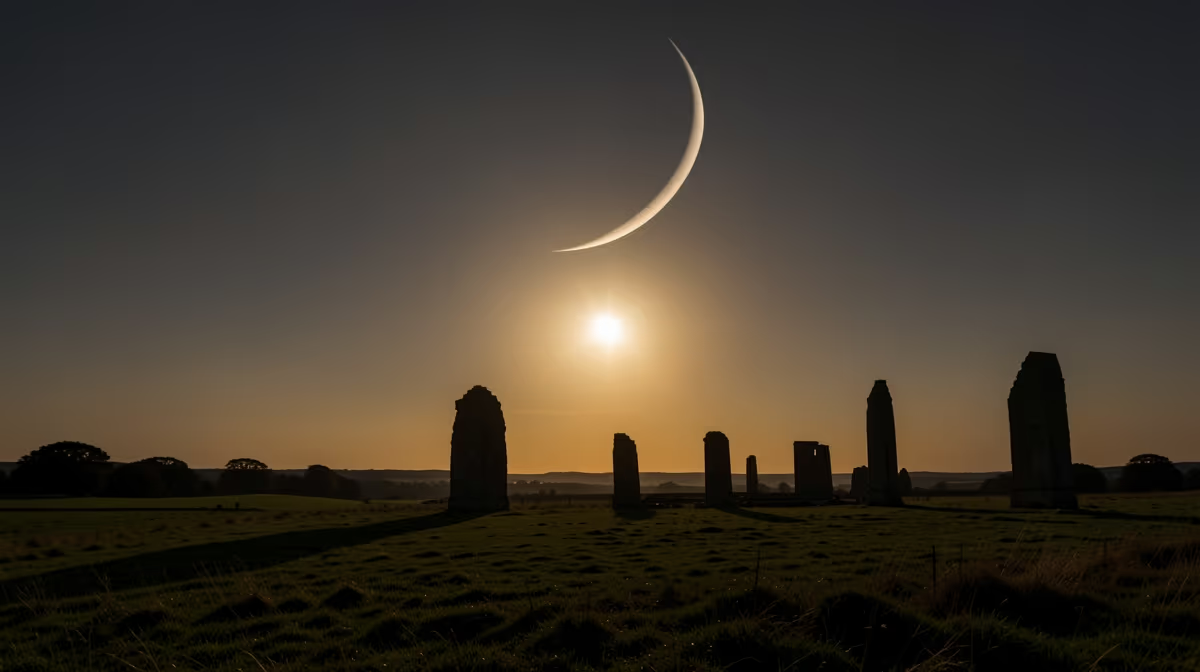
Stargazers and astronomy enthusiasts across Great Britain are preparing for the next major solar eclipse visible from the region, which will occur on August 12, 2026, offering millions a dramatic near-total obscuration of the sun. As stargazers look to the skies, anticipation is building for the next total eclipse, capturing global attention with its rare celestial alignment. While the absolute path of totality for this specific eclipse crosses Greenland, Iceland, and Spain, observers in Great Britain will experience a significant partial eclipse. Depending on the exact location within the UK, between 90% and 95% of the sun will be covered by the moon at peak times, promising a dramatic twilight-like dimming of the afternoon sky.
The celestial event is scheduled to take place in the late afternoon, with maximum obscuration expected just before sunset for most of the UK mainland. This positioning low on the horizon is anticipated to provide striking photographic opportunities, provided weather conditions remain favorable across the country. Astronomers and safety officials are already urging the public to prepare proper eye protection well in advance. Standard sunglasses are insufficient for viewing an eclipse safely, and specialized solar viewing glasses or indirect projection methods will be necessary to prevent permanent eye damage during the celestial alignment. An eclipse of this magnitude is a rare and breathtaking spectacle for the UK, bringing astronomy directly to the public eye, said Dr. Emily Richardson, a senior astrophysicist at the Royal Astronomical Society. While we won't see full totality on the mainland this time, a 95% partial eclipse will create a profound sensory experience, drastically altering the light and temperature as the sun dips toward the horizon.
Celestial Mechanics and Historical Context
The astronomical mechanics of lunar-soral alignment intersecting with the British Isles stem specifically from the path of totality crossing remote regions. Total solar eclipses occur somewhere on Earth roughly every 18 months, but they recur at any specific location only once every 360 years on average. The UK's last major visibility was in 1999, making the long wait until the next true total eclipse a standard timeline for British stargazers. The historical parallel of the 1999 total solar eclipse in the UK served as a stress test for millennium infrastructure readiness, demonstrating how fleeting celestial alignments capture public imagination. During a total solar eclipse, the Moon passes directly between the Earth and the Sun, completely blocking its light for a few minutes. When a total eclipse finally arrives over British soil, it offers a breathtaking spectacle for anyone lucky enough to be in the path of totality, provided the notoriously unpredictable weather cooperates with clear skies.
The Timeline to Totality
The trajectory toward future solar observations has followed a structured timeline of preparation and calculation. In 2020, initial orbital calculations and global astronomical forecasting set the stage for modern tracking. By 2024, speculative purchases of strategic rural properties in the path of totality were noted by institutional investors. Now, municipalities are engaged in emergency planning, transport stress-testing, and the escalation of regional tourism campaigns. Increased public interest and searches regarding future total solar eclipses visible from Great Britain are currently rising alongside preliminary astronomical commentary. Over the next 72 hours, media outlets are expected to publish educational guides on upcoming eclipses, and travel agencies are already noting early inquiries for future domestic and international eclipse tourism.
Socio-Economic Dimensions
The intersection of rare astronomical events and modern infrastructure creates complex socio-economic ripples across regions. A localized multi-million pound revenue surge in hospitality and transport is frequently contrasted with potential productivity losses from mass transit gridlocks and workforce absenteeism during the brief alignment. Simultaneously, devolved administrations in Edinburgh and Belfast leverage the influx of global astro-tourists to assert regional autonomy and infrastructure control independently of Westminster. On a broader scale, Britain functions temporarily as a focal point for international scientific diplomacy and aerospace observation partnerships, momentarily shifting global media focus away from routine diplomatic affairs. Behind the scenes, analysts have tracked the rapid and under-regulated acquisition of remote rural land by foreign speculative entities aiming to build luxury pop-up viewing platforms under the guise of eco-tourism.
Safety Protocols and Viewing Guidelines
While public enthusiasm grows, safety remains a paramount concern for scientific organizations and public health officials alike. Special ISO-certified solar viewing glasses must be worn during the partial phases to prevent severe eye damage, as standard sunglasses offer no protection against harmful solar radiation. Misinformation regarding partial eclipses can potentially lead to unsafe viewing practices without proper eye protection. Educational initiatives led by scientific institutions aim to mitigate these risks by emphasizing indirect projection methods and certified filters. During significant dimming events, daytime temperatures can drop noticeably, and brighter stars may become visible as the sky darkens, heightening the sensory experience for observers utilizing proper safety gear.
Expert Outlook and Future Trajectory
While the next total solar eclipse visible from the UK mainland is decades away on September 23, 2090, following the previous mainland event on August 11, 1999, interest remains steady around partial eclipses and international travel for upcoming total eclipses in other parts of the world. In the best-case scenario, heightened public enthusiasm for astronomy leads to increased STEM education engagement and well-planned domestic astro-tourism events. Conversely, the worst-case scenario involves safety hazards stemming from a lack of eye protection or localized transit gridlock. Experts emphasize that while the wait for full totality in the UK is lengthy, intermediate events provide continuous opportunities for public engagement and scientific education.
Frequently Asked Questions
When is the next total solar eclipse visible from the UK?
The next total solar eclipse visible from the UK will occur on September 23, 2090. However, observers in parts of the UK will be able to see a partial solar eclipse sooner, such as in March 2025. It has been a long time since the last total eclipse touched British soil in 1999.
Where will the 2090 total solar eclipse be best seen in the UK?
The path of totality for the 2090 eclipse will pass across parts of the UK, with Cornwall and parts of South West England experiencing totality first. Other regions will also see a deep partial eclipse, weather permitting. Planning ahead will be essential for anyone wanting to witness the full corona.
When was the last total solar eclipse in the UK?
The last total solar eclipse visible from the UK took place on August 11, 1999. The path of totality passed directly over Cornwall and South Devon, drawing huge crowds despite mixed weather conditions. Prior to that, the last mainland total eclipse was way back in 1927.
Can I see a partial solar eclipse in the UK before 2090?
Yes, several partial solar eclipses will be visible from the UK in the coming years. For instance, a partial eclipse will be visible across British skies on March 29, 2025. These events offer a great chance for stargazers to practice safe viewing techniques.
How can I safely view a solar eclipse from the UK?
You should never look directly at the Sun without certified solar viewing glasses, even during a partial eclipse. Special eclipse filters or indirect projection methods are essential to protect your eyes from permanent damage. Standard sunglasses offer no protection against the harmful rays of the sun.
Will the next total solar eclipse be total across all of Great Britain?
No, the 2090 total eclipse will only pass over specific regions of the UK, primarily starting in the South West. Other parts of the country, including northern England and Scotland, will experience a significant partial eclipse instead. A truly nationwide total eclipse is a very rare astronomical event.
Conclusion
As astronomical calculations confirm the trajectories for upcoming celestial alignments, Great Britain prepares for a sequence of notable partial and total solar eclipses spanning the coming decades. With verified dates like the August 2026 partial eclipse and the long-term approach of the 2090 total eclipse, public interest remains grounded in rigorous scientific observation and safety preparedness. Educational institutions, municipal planners, and astronomy enthusiasts continue to coordinate efforts to ensure that upcoming viewing opportunities are met with adequate resources, safety measures, and public engagement.


.webp)

