
Russia NATO Tensions Escalate Rapidly As New Eastern Defense Pact Unfolds
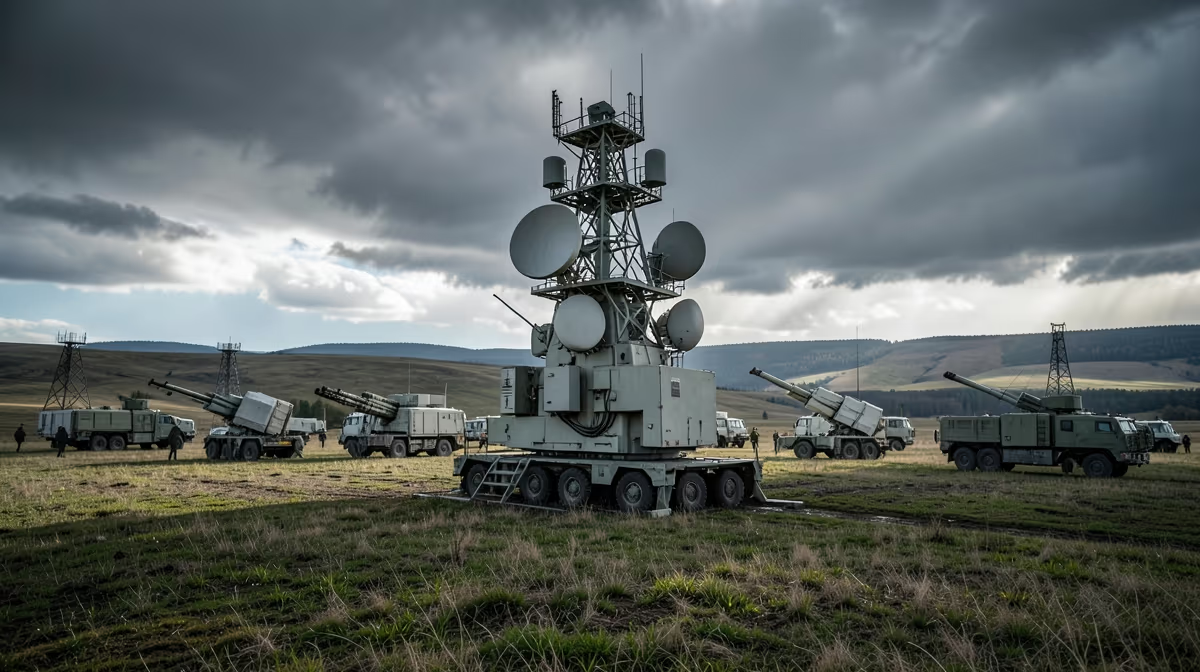
WASHINGTON — The United States and its NATO allies announced a significant reinforcement of Eastern European defenses on Tuesday, deploying additional air defense systems and troops in response to escalating military exercises and aggressive rhetoric from Moscow. This decisive shift comes as developments in russia nato relations have sparked global concern regarding the future of the western defense pact. The physical relocation of additional NATO defensive assets to Eastern Europe and the formal diplomatic protests issued by the Russian government mark a critical juncture in European security, as thousands of citizens, policymakers, and defense analysts monitor the shifting balance of power along the continent's contested frontiers.
Background of the Russia NATO Conflict
The root cause of the current standoff lies in unresolved security architecture disparities stemming from the collapse of the Soviet Union, coupled with NATO's eastward expansion which Moscow perceives as an existential encirclement strategy. NATO, which stands for the North Atlantic Treaty Organization, is a powerful group of 32 countries, including the United States and many European nations, that have agreed to protect each other if anyone attacks them. Russia views this alliance as a major threat, especially because NATO has grown to include countries right on Russia's doorstep. Tensions reached a boiling point when Russia launched a full-scale invasion of neighboring Ukraine in 2022. While Ukraine is not a member of NATO, the alliance has heavily supported Ukraine with weapons, money, and humanitarian aid to help defend itself against Russian forces, bringing the two sides into a dangerous indirect conflict. Historical parallels can be drawn to the pre-WWI Anglo-German naval arms race and rigid alliance systems that turned regional friction in the Balkans into a global catastrophe through automatic escalation. The timeline of this friction includes milestones such as NATO's first post-Cold War eastern enlargement in 1999 incorporating Poland, Hungary, and the Czech Republic, the 2008 Bucharest Summit Declaration promising future NATO membership to Ukraine and Georgia, the 2014 annexation of Crimea and initiation of the Donbas conflict, and the 2022 full-scale Russian invasion of Ukraine that triggered the militarization of the Baltic and Nordic frontier alongside sweeping Western sanctions.
Impact on Global Defense Pact Strategies
The decision to reinforce defenses comes amid heightened tensions following repeated violations of allied airspace by Russian drones and aircraft near the borders of Poland and Romania. Defense officials emphasized that the deployment is entirely defensive in nature, designed to deter further aggression and reassure frontline member states. In Washington, the Pentagon confirmed that specialized logistical units and advanced radar capabilities are already en route to the region. This move underscores the alliance's ongoing commitment to Article 5 of the North Atlantic Treaty, which dictates that an attack on one member is considered an attack on all. Moscow has strongly condemned the buildup, characterizing the NATO actions as provocative and destabilizing to regional security. Russian state media warned that the new Western deployments would inevitably draw a military-technical response from the Kremlin. The ongoing conflict matters because it keeps the world on edge, carrying the constant, underlying risk of escalating into a direct military confrontation between nuclear-armed powers. For people in the US and around the world, it directly impacts the economy through higher energy prices, inflation, and shifting global security alliances that could change the future of international peace. People living in Ukraine, citizens of NATO member countries including the United States, populations across Europe, and eventually the global economy are all affected by these ongoing tensions.
Political and Economic Dimensions
Domestic regime consolidation in Russia via external threat fabrication is mirrored by Western political elites utilizing the Russian menace to forge transatlantic unity and justify defense budget expansions. Economically, the conflict has driven the weaponization of global supply chains, energy decoupling in Europe, skyrocketing defense expenditures, and the fragmentation of the global financial system through sanctions and alternative payment corridors. Geopolitically, these pressures accelerate a multipolar world order, forcing middle powers in the Global South into strategic non-alignment while solidifying a Sino-Russian axis to counter US-led hegemony. Furthermore, a hidden angle of this friction is found in the race for the Arctic seabed and the militarization of the High North, where melting ice opens new shipping routes and resource deposits, intensifying direct great-power friction.
Security Assessment and Near-Term Outlook
Over the next 24 hours, experts anticipate increased diplomatic rhetoric and heightened intelligence monitoring along the NATO eastern flank following recent border airspace incursions. Looking toward the next 72 hours, potential convening of emergency consultations among allied ambassadors under Article 4 mechanisms could occur to coordinate a unified response. Expert prediction suggests that both sides will likely engage in posturing and proportional signaling while actively working behind the scenes to avoid any accidental direct kinetic escalation. The best-case scenario envisions de-escalation through back-channel communications and a joint agreement to reinforce existing military de-confliction protocols. Conversely, the worst-case scenario warns of miscalculation leading to a localized kinetic clash, triggering emergency NATO mobilization and severe retaliatory economic sanctions.
Frequently Asked Questions
Why is Russia opposed to NATO expansion?
Russia views NATO's eastward expansion as a direct threat to its national security and a breach of perceived security guarantees made at the end of the Cold War. Moscow is particularly concerned about the potential inclusion of nations bordering Russia, such as Ukraine, which it believes would place Western military infrastructure too close to its territory. Additionally, Russia seeks to maintain a buffer zone of non-aligned states to preserve its geopolitical influence in Eastern Europe.
Is Ukraine a member of NATO?
Ukraine is not currently a full member of NATO, though it has expressed a strong desire to join the alliance in the future. At the 2008 Bucharest Summit, NATO agreed that Ukraine would eventually become a member, but no definitive timeline or Membership Action Plan has been established. The ongoing conflict with Russia remains a significant obstacle, as NATO members are cautious about admitting a nation actively engaged in a major territorial war.
What does Article 5 of the NATO treaty mean for Russia?
Article 5 is NATO's collective defense clause, which dictates that an armed attack against one member nation is considered an attack against all members. This means that if Russia were to launch a military invasion against a NATO member state, the entire alliance would be obligated to respond. For Russia, this serves as a powerful deterrent against expanding its military aggression beyond non-NATO countries like Ukraine.
When and why was NATO formed in relation to Russia?
NATO was established in 1949 by the United States, Canada, and several Western European nations primarily to provide collective security against the Soviet Union. During the Cold War, the alliance acted as a counterweight to Soviet military power and the rival Warsaw Pact. Even after the dissolution of the Soviet Union in 1991, NATO persisted and eventually incorporated former Soviet bloc countries, keeping Russia as its primary strategic concern.
How has the war in Ukraine affected NATO-Russia relations?
The war in Ukraine has plunged NATO-Russia relations to their lowest point since the Cold War, effectively ending decades of post-Soviet diplomatic cooperation. In response to Russian aggression, NATO has significantly reinforced its eastern flank with additional troops and combat groups. Furthermore, the conflict prompted traditionally neutral countries like Finland and Sweden to abandon their neutrality and officially join the NATO alliance.
Does Russia share a direct border with NATO countries?
Yes, Russia shares direct land borders with several NATO member states in Europe. Following Finland's accession to the alliance in 2023, the length of NATO's border with Russia more than doubled. Additionally, Russia borders NATO members Norway, Estonia, Latvia, Lithuania, and Poland through the Kaliningrad exclave.
Conclusion
The recent escalation in russia nato relations highlights the fragile state of modern European security and the ongoing friction surrounding the Western defense pact. Verified developments confirm that NATO has initiated the physical relocation of additional defensive assets and air defense systems to Eastern Europe in response to recent airspace violations, while Moscow has formally condemned these deployments as provocative. As diplomatic posturing continues, allied nations and Russian officials navigate a complex landscape of deterrence, economic fallout, and strategic competition. Realistic next steps involve heightened intelligence monitoring, potential Article 4 emergency consultations among allied ambassadors, and continued reliance on military de-confliction protocols to prevent accidental direct kinetic escalation.


.webp)
