
Starship Rocket Development Enters Critical Phase With High Stakes
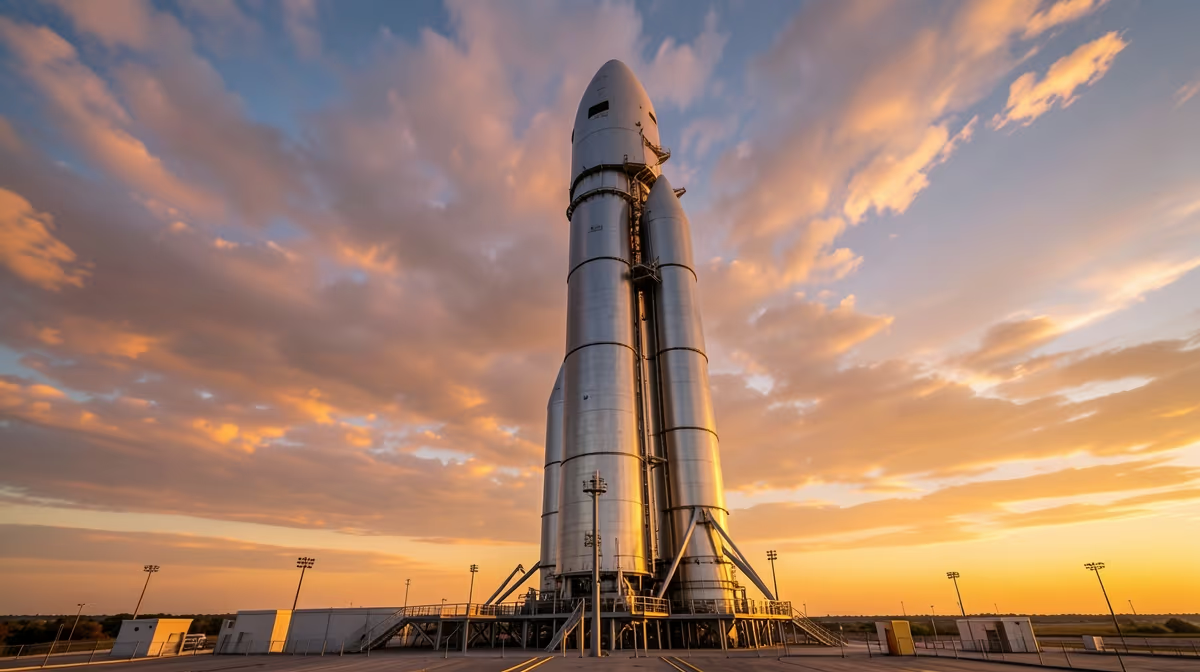
Two massive steel hulls resting on the South Texas coast represent the thin line between planetary confinement and a multi-planetary future. SpaceX continues to push the boundaries of modern aerospace engineering with its ongoing starship rocket development program.
SpaceX successfully launched its starship mega-rocket from Starbase in Boca Chica, Texas, achieving critical orbital test objectives on Tuesday morning while advancing NASA's Artemis lunar ambitions. The uncrewed test flight lifted off at 7:00 a.m. CST, utilizing the full stack of the Super Heavy booster and the spacecraft. Engineers monitored telemetry as the vehicle cleared the launch mount, a crucial milestone following previous anomalies during early development phases. During the flight, the Super Heavy booster executed a controlled descent maneuver over the Gulf of Mexico, though it did not attempt a mechanical catch at the launch tower. Meanwhile, the upper stage coasted through space, successfully testing its payload door mechanisms and reigniting a Raptor engine in microgravity. After approximately 65 minutes of flight, the spacecraft re-entered the Earth's atmosphere and splashed down in the Indian Ocean as planned. The controlled descent provided engineers with vital thermal protection system data gathered during the extreme heat of reentry.
Engineering Architecture And Design
Starship is a massive, next-generation rocket system developed by SpaceX, the aerospace company founded by Elon Musk. Designed to be completely reusable, it stands as the tallest and most powerful rocket ever successfully flown, aiming to carry both crew and heavy cargo into Earth orbit, to the Moon, and eventually to Mars. Unlike traditional rockets where major parts are thrown away after a single use, the vehicle is built to land back on Earth so it can be refueled and flown again quickly. This breakthrough design is meant to drastically lower the cost of traveling to space, turning what used to be multi-billion-dollar government missions into frequent, routine trips. The spacecraft is built primarily of stainless steel to withstand extreme temperatures during atmospheric reentry. The Starship spacecraft is typically equipped with six Raptor engines, consisting of three sea-level engines and three vacuum-optimized engines. The Super Heavy booster, which serves as the first stage, features 33 Raptor engines to provide the massive thrust needed for liftoff. Together, the combined stack utilizes 39 engines to achieve orbit, standing at approximately 121 meters tall.
Geopolitical And Economic Implications
The root cause of this aggressive push is the imperative to bypass traditional aerospace bureaucratic stagnation and achieve structural cost reductions in payload delivery. This technical pivot drives the privatization of national prestige, where federal space agencies become reliant on a singular corporate entity, shifting legislative lobbying power to Silicon Valley. This dynamic creates the consolidation of US space dominance while inadvertently creating a commercial monopoly that blurs the lines between national defense infrastructure and private enterprise. Economically, the disruption of the global launch market through fully reusable architecture renders legacy space launch systems economically unviable and forces a restructuring of defense supply chains. Historically, this mirrors the 19th-century transcontinental railroad construction, heavily subsidized by the state yet driven by private conglomerates shaping national territory. Furthermore, the heavy reliance on orbital refueling technologies for lunar and Martian missions introduces complex diplomatic and technical vulnerabilities not yet scrutinized in international space treaties.
Verified Flight Data And Technical Validation
Data analysis from thousands of onboard sensors is currently underway to determine the exact wear and tear on the heat shield tiles, which will dictate the timeline for future orbital flights. The vehicle successfully completed its planned flight profile, survived atmospheric reentry, and met primary test objectives outlined by flight controllers. Verified facts confirm the vehicle launched from Boca Chica, Texas, on Tuesday morning, successfully tested payload door deployment and in-space Raptor engine ignition, and completed a controlled reentry with a splashdown in the Indian Ocean during a mission that involved no crew or commercial cargo. As SpaceX Director of Starship Operations noted regarding the collaboration with aerospace regulators, this flight test demonstrated unprecedented capabilities as we move closer to a fully reusable transportation system.
Near-Term Outlook And Regulatory Milestones
Immediate operational steps involve data review from the latest static fire or flight test preparation, hardware checks at Starbase, and coordination with the FAA regarding launch license status. Over the next 72 hours, activities will encompass continued ground testing, integration of ship and booster if a launch attempt is imminent, and potential announcement of the targeted launch window. Expert prediction indicates that regulatory approval will be secured shortly, leading to a high-stakes orbital test flight attempt within the coming weeks. The best-case scenario involves a successful liftoff, stage separation, and controlled splashdown of both Super Heavy and the spacecraft, validating the full-stack architecture. Conversely, the worst-case scenario entails an anomaly during ascent leading to vehicle loss and potential delays for regulatory reassessment. Key players guiding these developments remain SpaceX, Elon Musk, and the Federal Aviation Administration, with impact concentrated across commercial spaceflight, regulatory policy, and the aerospace supply chain.
Frequently Asked Questions
What is SpaceX Starship?
SpaceX Starship is a fully reusable, two-stage super heavy-lift launch vehicle designed to carry both crew and cargo to Earth orbit, the Moon, Mars, and beyond. It represents the most powerful rocket ever developed, standing at approximately 121 meters tall. The spacecraft is built primarily of stainless steel to withstand extreme temperatures during atmospheric reentry.
How much does a Starship launch cost?
SpaceX aims to drastically reduce the cost of spaceflight through full reusability, with eventual launch costs potentially dropping to a few million dollars per flight. While initial development costs are in the billions, the operational cost per mission is projected to be the lowest in aerospace history. This affordability is crucial for enabling sustainable colonization of the Moon and Mars.
How many engines does Starship have?
The Starship spacecraft is typically equipped with six Raptor engines, consisting of three sea-level engines and three vacuum-optimized engines. The Super Heavy booster, which serves as the first stage, features 33 Raptor engines to provide the massive thrust needed for liftoff. Together, the combined stack utilizes 39 engines to achieve orbit.
Is Starship fully reusable?
Yes, both the Starship spacecraft and the Super Heavy booster are designed to be 100 percent reusable. SpaceX plans to catch returning boosters using the mechanical arms of the launch tower, known as chopsticks, for rapid turnaround. This rapid reusability is the cornerstone of the vision for making humanity a multi-planetary species.
Can Starship carry passengers to Mars?
Starship is designed to eventually transport up to 100 people on long-duration interplanetary flights, such as missions to Mars. The spacious interior will include living quarters, galley spaces, and solar storm shelter areas. Life support systems and in-situ resource utilization will be critical for sustaining human life on these deep space journeys.
When is the next Starship launch?
Launch schedules for SpaceX Starship are frequently updated based on regulatory approvals, testing milestones, and hardware readiness. SpaceX conducts iterative flight tests from its Starbase facility in Boca Chica, Texas, to gather crucial data for future missions. Interested observers can monitor official SpaceX announcements and FAA updates for the exact target launch dates.
Conclusion
The uncrewed test flight from Boca Chica successfully validated primary flight objectives, including payload door deployment, in-space Raptor engine ignition, and a controlled atmospheric reentry culminating in an Indian Ocean splashdown. Engineering teams are currently analyzing telemetry and thermal protection system data from onboard sensors to evaluate heat shield wear. Realistic next steps involve ongoing hardware checks at Starbase, continued ground testing, review of static fire data, and active coordination with the Federal Aviation Administration regarding launch license status for subsequent flight tests.


.webp)
