
Solar Eclipse 2026 Triggers Major UK Infrastructure and Travel Alarms
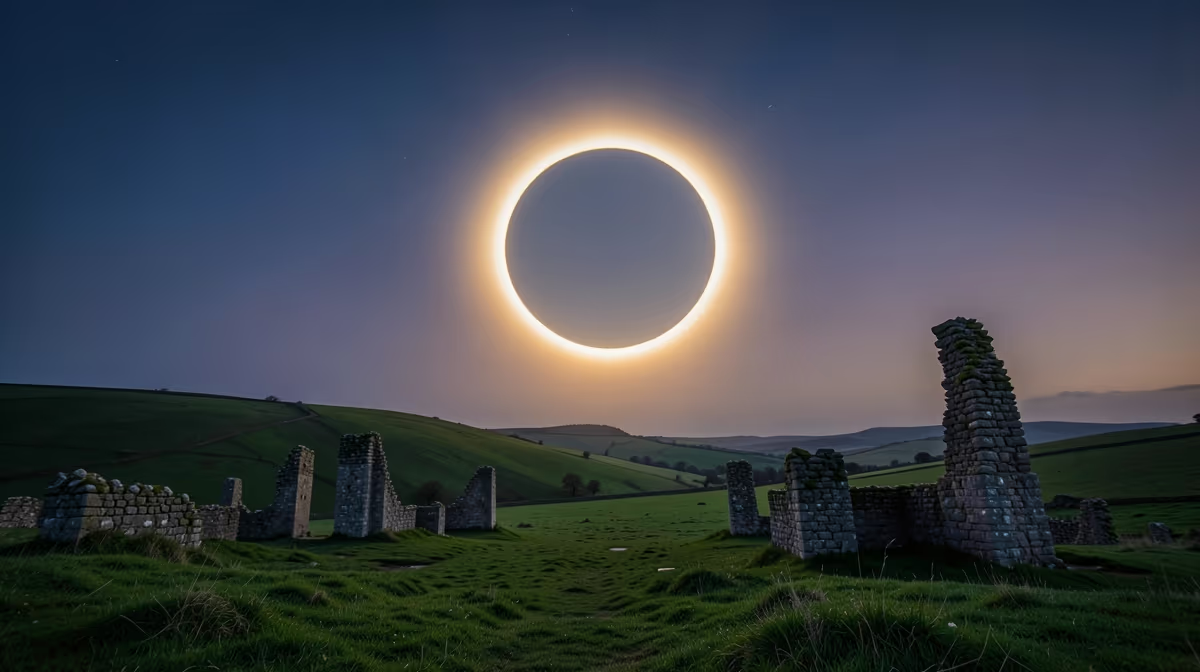
Stargazers and astronomers across Great Britain are preparing for a rare astronomical event as a total and partial solar eclipse is set to sweep across the skies on August 12, 2026, offering the UK its most significant eclipse viewing experience since 1999. As stargazers across the country look ahead to the solar eclipse 2026, preparation is already underway for one of the decade's most anticipated celestial events. This rare cosmic alignment promises to capture the public imagination on a massive scale, turning day into twilight and bringing communities outdoors to look up at the universe.
Get ready for a breathtaking celestial show, because a rare total solar eclipse is heading our way! On August 12, 2026, the Moon will pass directly between the Earth and the Sun, blocking out the sunlight and turning day into twilight for a few magical moments across parts of Europe. While much of the UK will experience a stunning partial eclipse where the Sun looks like a giant glowing crescent, the extreme tip of southwestern England and parts of Europe will get the full, jaw-dropping experience. During a total solar eclipse, the sky darkens dramatically, stars and planets pop out in the middle of the afternoon, and the Sun's ghostly outer atmosphere, called the corona, glows like a halo in the sky. It is a completely surreal experience that makes you feel the true scale of our solar system, happening right above our heads without needing a telescope to enjoy.
What Unfolded
The celestial event will peak in the late afternoon, with observers in the far southwest of England and parts of Wales experiencing the highest obscuration of the sun. Major urban centers, including London, Manchester, and Edinburgh, will witness a dramatic partial eclipse, where the moon will cover a substantial portion of the solar disk, causing a noticeable drop in ambient light and temperature. The exact alignment, timing, and trajectory of the eclipse have been mathematically confirmed by astronomical bodies such as the UK Hydrographic Office and the Royal Astronomical Society. Local council preparedness plans, precise weather forecasts, and organized public viewing events are still unfolding as the date approaches. Tour operators and hospitality businesses in key viewing zones, particularly parts of Scotland and South West England, have begun launching specialized eclipse tourism packages as travel and accommodation bookings see a surge across Great Britain.
The Numbers Behind The Story
The solar eclipse will occur on August 12, 2026, marking the first total solar eclipse visible from parts of Europe since 1999. Total solar eclipses happen somewhere on Earth roughly every 18 months, but they usually occur over oceans or remote wilderness. The UK will mostly see a deep partial eclipse, with the sun heavily obscured, while western parts of the UK, particularly Cornwall and parts of Wales, will have the best viewing angles. Totality itself will be best visible in Spain, Greenland, and parts of the Atlantic Ocean. For British observers, the peak over the UK will take place in the late afternoon, culminating shortly before sunset on August 12, 2026.
Why This Matters
Events like this capture the public imagination like nothing else, bringing communities together outdoors to look up at the universe and inspiring a whole new generation of science enthusiasts. On a practical level, the sudden drop in sunlight will cause a temporary surge and dip in solar power generation across Europe, testing the resilience of modern electrical grids and energy management systems. This rare total solar eclipse intersects high-density European airspace and critical national infrastructure zones, specifically across northern Spain and grazing the UK, colliding with peak summer tourism and post-Brexit energy grid vulnerabilities. The UK government and devolved administrations will face intense scrutiny over emergency preparedness, transport gridlock, and potential communications blackouts, while European cooperation on cross-border energy grid balancing will be tested under extreme stress as interconnected power markets absorb sudden, predictable, yet massive drops in photovoltaic output.
Analyst View
The root cause of the logistical challenge lies in a rare total solar eclipse intersecting high-density European airspace and critical national infrastructure zones, specifically across northern Spain and grazing the UK, colliding with peak summer tourism and post-Brexit energy grid vulnerabilities. Political entities, including the UK government and devolved administrations, will face intense scrutiny over emergency preparedness, transport gridlock, and potential communications blackouts, which could be leveraged to question civil contingency management. Economically, the event triggers massive localized wind and solar power generation drops during peak tourism season, alongside severe transport bottlenecks, hotel price surges, and insurance claims related to transient infrastructure failures and eye safety liabilities. Geopolitically, European cooperation on cross-border energy grid balancing will be tested under extreme stress as interconnected power markets absorb sudden drops in photovoltaic output. Furthermore, extreme strain on satellite communications and GPS navigation systems may occur due to sudden ionospheric disturbances and unprecedented civilian drone usage attempting aerial footage of the eclipse, paralleling the 1999 total solar eclipse over Europe which caused minor grid fluctuations and widespread traffic chaos, but occurring now in an era of hyper-digitized infrastructure, algorithmic energy trading, and reliance on intermittent renewables.
Public Safety And Viewing Guidance
Astronomers emphasize the importance of public safety during the event, urging citizens to acquire certified ISO-compliant solar viewing glasses well in advance. Looking directly at the sun without specialized eye protection can cause severe and permanent retinal damage, even when the sun is largely obscured by the moon. Dr. Robert Massey of the Royal Astronomical Society stated that an eclipse of this magnitude is a breath-taking natural spectacle that reminds us of our place in the cosmos, noting that the public should enjoy it fully while prioritizing safety, as standard sunglasses, no matter how dark, are entirely inadequate for viewing the sun. Specialized ISO-certified eye protection is required to safely view the sun during the eclipse, and standard sunglasses, cameras, or binoculars remain unsafe unless fitted with proper solar filters.
Future Outlook And Predictions
Increased public interest and search traffic regarding the August 2026 total solar eclipse are expected to continue, with travel and accommodation bookings seeing a surge across Great Britain. Tour operators and hospitality businesses in key viewing zones will continue launching specialized packages. Demand for accommodation in prime visibility areas will peak early, putting pressure on local infrastructure and requiring proactive planning from transport authorities such as the UK Civil Aviation Authority, Met Office, Association of British Travel Agents, and the Astronomical Society of Edinburgh. In the best-case scenario, clear skies across the UK allow millions to safely view the partial eclipse, boosting local economies through tourism without major grid or transport disruptions. In the worst-case scenario, severe transport bottlenecks occur in remote viewing regions due to sudden influxes of astro-tourists, compounded by adverse weather leading to widespread disappointment. Preliminary cross-border grid stress-testing by European energy operators began in August 2024, leading toward joint emergency protocols from the UK Department for Transport and National Grid in January 2026, culminating in the event on August 12, 2026.
Frequently Asked Questions
When is the next solar eclipse visible from the UK?
The next total solar eclipse visible from parts of the UK will occur on August 12, 2026. However, most of the UK will experience a partial eclipse rather than totality, with the best views in the far southwest.
Will the 2026 solar eclipse be total in the UK?
Not quite for the vast majority of the country. The path of totality crosses northern Spain and Iceland, meaning mainland UK will only see a partial solar eclipse of around 90% to 95% obscuration.
Where is the best place in the UK to see the 2026 solar eclipse?
The far southwest of England, particularly parts of Cornwall, will offer the highest obscuration of the sun in the UK. Western Wales and parts of Devon will also experience a very deep partial eclipse just before sunset.
What time will the solar eclipse happen in 2026?
The eclipse will take place in the late afternoon of August 12, 2026, culminating shortly before sunset. The exact timing varies slightly depending on your specific location across the British Isles.
How can I safely view the solar eclipse from the UK?
You should never look directly at the sun without certified solar viewing glasses, even during a partial eclipse. Standard sunglasses, cameras, or binoculars are unsafe and can cause permanent eye damage unless fitted with proper solar filters.
Where is the best place in the world to see totality in 2026?
To experience full totality during the August 2026 eclipse, the best locations are Iceland and northern Spain. Thousands of astrotourists are expected to travel to these regions for a clear view of the sun's corona.
Conclusion
Preparations for the August 12, 2026, solar eclipse continue to advance across Great Britain, uniting scientific organizations, transport authorities, and the public in anticipation of a remarkable astronomical milestone. With confirmed trajectories, established safety guidelines, and active infrastructure planning already underway, observers across the UK are encouraged to secure certified eye protection and monitor official local updates as the date approaches. Realizing a successful viewing experience relies on proactive travel coordination, adherence to safety protocols, and resilient management of energy and transport grids.


.webp)

