
Solar Eclipse 2026 Path Across the UK Reveals Unseen Challenges
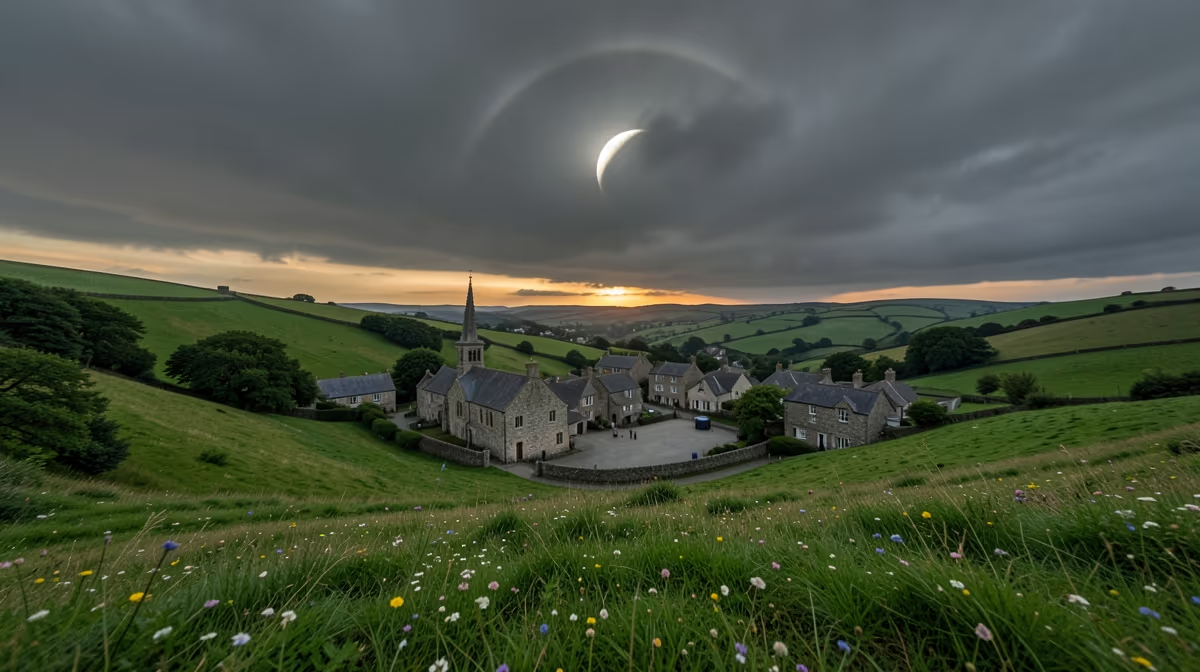
Stargazers and astronomers across Great Britain are preparing for a rare astronomical spectacle on August 12, 2026, when a total solar eclipse will sweep across parts of Europe, offering the UK its most significant eclipse experience since 1999. As skywatchers across the country prepare for the solar eclipse 2026, experts are sharing crucial safety guidelines and viewing times. The celestial event will peak in the late afternoon, with observers in the UK witnessing a substantial partial eclipse ranging from roughly 90% in southern England to over 95% in the far north and west of Scotland. Parts of northern Spain and Iceland will experience totality, but British viewers will still see a dramatic dimming of sunlight as the Moon passes between the Earth and the Sun.
The Science Of The Alignment
The root cause of this upcoming event is the precise alignment of the Earth, Moon, and Sun producing a total solar eclipse over Northern Spain and passing directly through the UK territorial airspace and southwestern approaches, converging with peak summer tourist migration. During this event, the Moon will pass directly between the Sun and the Earth, completely blocking the face of the Sun for a few moments and turning day into twilight. While parts of Greenland, Iceland, and Spain will get the full total experience, people living in the UK are in for a fantastic treat as well. Depending on where you are in Great Britain, you will see a large partial solar eclipse, where a huge chunk of the Sun is covered up by the Moon, creating a dramatic dimming of the daylight. Solar eclipses happen when the Moon aligns perfectly between the Earth and the Sun, casting a shadow on our planet. The last major eclipse visible in the UK was the partial eclipse of 2015 and the total eclipse of 1999, making the 2026 event a rare and highly anticipated astronomical milestone for this generation.
Safety Protocols And Viewing Guidance
Astronomical societies and educational institutions are already ramping up preparations, emphasizing the critical importance of eye safety. Officials are urging the public to acquire certified solar viewing glasses well in advance, warning that looking directly at the sun without proper protection can cause severe and permanent retinal damage. You must never look directly at the sun without certified eye protection, even during a partial eclipse. To view the solar eclipse safely, you should use ISO-certified eclipse glasses or use indirect projection methods like a pinhole projector. Dr. Robert Massey from the Royal Astronomical Society stated that this is a wonderful opportunity to engage the public with science, noting that while the UK will not see totality this time, a deep partial eclipse of this magnitude is still a breathtaking event that reminds us of our place in the solar system.
Infrastructure And Regional Impact
Tourism boards in potential prime viewing locations, particularly in western Scotland and Cornwall, are anticipating an influx of domestic travelers and astrotourism enthusiasts. Hotels and rural accommodations in these regions report early inquiries for mid-August 2026, mirroring the excitement seen nearly three decades ago during the last major UK eclipse. Media outlets in Great Britain are beginning releasing preliminary travel and viewing guides for the August 2026 total solar eclipse, focusing on optimal visibility areas in Scotland and northern England. Hotel bookings and specialized astronomy tourism packages in the path of totality will see a surge in early inquiries, prompting local councils to start preliminary discussions on crowd management. Forecasters anticipate unprecedented domestic travel toward northern Scotland for the 2026 eclipse, requiring coordinated regional infrastructure planning to prevent severe congestion. Key players including the UK Civil Aviation Authority, Met Office, VisitBritain, and the Royal Astronomical Society are monitoring tourism and hospitality, transport infrastructure, public safety, and energy grid management.
Economic And Analytical Perspectives
Events like this capture the collective imagination of the public, bringing communities together to look up at the sky and sparking a renewed interest in science and astronomy. However, because it happens so close to sunset, it also provides a fascinating real-world test for modern solar-powered energy grids, as the sudden drop in sunlight will temporarily reduce solar power generation across the country. The analytical perspective reveals a massive surge in tourism, hospitality bookings, and aviation revenue countered by localized productivity losses, supply chain delays due to gridlocked transport networks, and grid management costs. Infrastructure strain and public service allocation will test the capability of local and devolved governments in Great Britain, leading to partisan blame over emergency preparedness and transportation bottlenecks. Furthermore, the event demonstrates European aerospace and satellite coordination under extreme solar observation demand, alongside security collaboration regarding border control and maritime navigation during the darkened maritime window. Historical parallels point to the 1999 total solar eclipse over the UK and Europe, which similarly caused mass travel disruption, sky-gazing tourism booms, and early digital infrastructure anxiety.
Future Outlook And Scenario Planning
Multi-agency emergency planning for the influx of astro-tourists has evolved through preliminary stress-testing of UK energy grid flexibility against sudden drops in photovoltaic output. Looking toward the event execution, forecasters outline distinct operational possibilities. In the best case, clear weather conditions across the UK allow millions to safely witness the partial and total phases, boosting local economies through astrotourism without major transport bottlenecks. In the worst case, severe transport gridlock in rural northern regions, compounded by overcast weather conditions, leads to widespread public disappointment and logistical strain on local emergency services. Meteorological forecasts for specific viewing locations remain unavailable due to the long-range nature of the event, and local authorities are still developing official public safety and traffic management guidelines.
Frequently Asked Questions
When is the next solar eclipse visible from the UK?
The next total solar eclipse visible from parts of the UK will occur on August 12, 2026. However, most of the UK will experience a significant partial solar eclipse instead of totality.
Will the 2026 solar eclipse be total in the UK?
Totality will only be visible in the UK from the far southwestern tip of England and parts of western Scotland, specifically the Outer Hebrides. For the vast majority of England, Wales, and Northern Ireland, it will be a partial eclipse with around 90% to 95% of the sun obscured.
Where is the best place in Europe to see the 2026 total solar eclipse?
Spain offers some of the best viewing conditions in Europe for the 2026 total solar eclipse. The path of totality crosses northern and eastern Spain, including major cities like Madrid, Zaragoza, and Palma de Mallorca.
What time will the solar eclipse happen on August 12 2026?
The eclipse will take place in the late afternoon and early evening on August 12, 2026. In the UK, maximum obscuration is expected to occur just before sunset, between 7:00 PM and 8:15 PM BST depending on your exact location.
How can I safely view the solar eclipse in 2026?
You must never look directly at the sun without certified eye protection, even during a partial eclipse. To view the 2026 solar eclipse safely, you should use ISO-certified eclipse glasses or use indirect projection methods like a pinhole projector.
When was the last total solar eclipse visible from the UK?
The last total solar eclipse visible from the UK mainland took place on August 11, 1999. Cornwall was the only region on the UK mainland to experience totality during that historic celestial event.
Conclusion
The August 12, 2026 solar eclipse represents a historic celestial milestone for Great Britain, offering millions a striking partial eclipse view alongside unique logistical and scientific challenges. With verified timelines, confirmed observation geometry, and structured preparation underway across transport, energy, and safety sectors, national institutions continue to finalize coordination efforts. Viewers across the country are advised to monitor official updates from meteorological and astronomical authorities while securing certified eye protection well in advance of the late-afternoon event.


.webp)

