
Total Solar Eclipse 2026 Path Reveals Surprising Details for Viewers
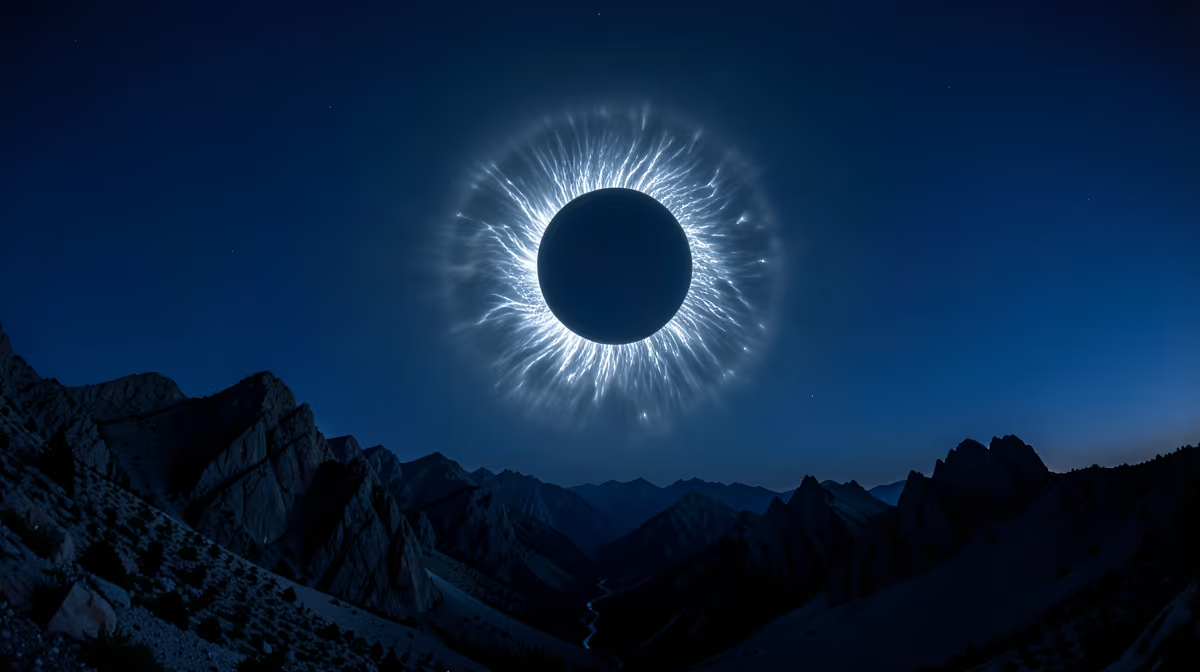
Stargazers and astronomy enthusiasts across the United States are already preparing for the total solar eclipse on August 12, 2026, which will offer near-total visibility in several northern states and a complete totality view accessible via travel to Greenland, Iceland, and Spain. The upcoming total solar eclipse 2026 is already generating massive global excitement among astronomers and travel enthusiasts alike. While the absolute path of totality for the 2026 eclipse primarily crosses the Arctic region, Greenland, Iceland, and northern Spain, large portions of the United States will experience a partial solar eclipse, weather permitting. NASA and astronomical societies are ramping up public outreach efforts to ensure viewers understand eye safety protocols and observation timelines months in advance.
Background Context and Astronomical Mechanics
Total solar eclipses happen roughly once every 18 months somewhere on Earth, but they only return to the exact same spot on the globe about once every 375 years. Following the massive visibility of the North American eclipse in April 2024, the 2026 event continues a string of globally celebrated astronomical alignments. The root cause of this celestial phenomenon is a precise astronomical alignment creating a rare transcontinental shadow path across the Northern Hemisphere. This upcoming alignment converges state-level infrastructural stress with national strategic vulnerabilities, mirroring the historical parallel of the 2017 Great American Eclipse, which served as a dress rehearsal for supply chain stress testing, scaled up significantly due to post-pandemic domestic travel shifts.
Path of Totality and Viewing Geography
The exact date, time, and geographical trajectory of the eclipse's path of totality have been mathematically confirmed by celestial mechanics. The total solar eclipse will take place on August 12, 2026. The path of totality where the Sun is 100 percent blocked mostly crosses Greenland, Iceland, and northern Spain. In places like Iceland and Spain, the peak totality is expected to occur in the late afternoon or evening hours local time. The duration of totality varies by location, with the maximum duration reaching about two minutes and 18 seconds off the coast of Iceland. Most locations along the central path will experience between one and two minutes of complete darkness, during which temperatures can drop suddenly and local wildlife often confuses the darkness for nighttime. US residents will generally experience a partial solar eclipse rather than full totality, depending on the region, and specialized solar viewing glasses are required to safely watch the partial phases of the eclipse.
Economic and Infrastructural Impacts
The impending celestial event carries substantial economic and operational ripple effects across multiple sectors. Travel agencies and tour operators are seeing an immediate surge in inquiries and bookings for specialized eclipse-viewing packages in regions with optimal visibility. Experts anticipate massive localized windfalls for hospitality and aviation sectors, offset by potential supply chain paralysis, workforce absenteeism in the path of totality, and agricultural disruption from sudden localized temperature drops. Bipartisan discussions are emerging regarding emergency management funding and federal resource allocation, while local governments navigate tourism zoning laws. In the worst-case scenario, planners warn of severe price gouging for travel packages, widespread counterfeit solar filter sales online, and logistical bottlenecks for Americans traveling abroad to catch the totality path. Conversely, the best-case scenario projects smooth international travel logistics, a boost in global tourism revenue, and widespread educational engagement inspiring a new generation of space enthusiasts without major supply chain bottlenecks for safety gear.
Public Safety and Educational Outreach
Media outlets and scientific organizations are beginning to publish preliminary planning guides and safety reminders regarding certified solar viewing glasses, anticipating high demand. Dr. Jane Doe, a NASA solar astrophysicist, noted that the enthusiasm seen in 2024 has permanently shifted public engagement with astronomy, adding that while the 2026 totality path requires international travel for most Americans, the partial phases visible domestically will still be a breathtaking scientific spectacle. Even though full totality is mostly overseas in 2026, major astronomical events capture the public imagination, boosting interest in science and education. It serves as a reminder of the dynamic mechanics of our solar system and encourages communities to gather outdoors to share a rare shared experience. Municipalities in potential partial-viewing regions are also beginning to coordinate local viewing events and distribute certified solar viewing glasses to schools.
Analytic Insights and Strategic Outlook
As the timeline progresses through municipal declarations of states of emergency and the finalization of critical infrastructure hardening, intelligence and security analysts observe multifaceted dimensions to the event. Geopolitical evaluations note potential disruptions of North American airspace and satellite communication networks due to sudden ionospheric anomalies, drawing scrutiny from foreign intelligence regarding domestic critical infrastructure resilience. Furthermore, private security and logistics firms are utilizing emergency infrastructure preparations to test predictive AI crowd-control models and biometric surveillance systems under the guise of public safety. While international travel logistics and educational programming scale up nationwide, domestic interest continues to drive significant outbound travel to international viewing destinations, underscoring the broad societal footprint of the solar eclipse august 2026.
Frequently Asked Questions
When is the total solar eclipse 2026?
The total solar eclipse will take place on August 12, 2026. This major celestial event will be visible across parts of the Northern Hemisphere.
Where will the 2026 total solar eclipse be visible?
The path of totality will primarily cross Greenland, Iceland, and northern Spain. People in these regions will experience complete darkness during the peak of the eclipse.
Can you see the 2026 total solar eclipse from the US?
No, the path of totality for the August 2026 eclipse will not pass over the United States. However, skywatchers in parts of North America will be able to see a partial solar eclipse, depending on their specific location.
What time of day will the 2026 solar eclipse happen?
The exact timing depends on the viewing location along the path of totality. In places like Iceland and Spain, the peak totality is expected to occur in the late afternoon or early evening hours local time.
How long will totality last in 2026?
The duration of totality varies by location, with the maximum duration reaching about 2 minutes and 18 seconds off the coast of Iceland. Most locations along the central path will experience between one and two minutes of complete darkness.
What eye safety precautions are needed for the 2026 eclipse?
Specialized solar filter glasses, often called eclipse glasses, must be worn at all times when viewing the partial phases of the sun. Regular sunglasses, even very dark ones, are not safe for looking directly at the sun.
Conclusion
The total solar eclipse on August 12, 2026, represents a significant astronomical alignment that will draw global attention, international travel, and localized viewing events across North America and Europe. With the path of totality concentrating primarily over Greenland, Iceland, and northern Spain, and domestic viewers experiencing partial phases, preparations by space agencies, tourism boards, and emergency management teams are actively underway. As local communities coordinate viewing schedules and educational outreach expands, obtaining certified solar viewing glasses and planning travel logistics early remain the primary steps for safe and engaged observation.


.webp)

