
US-Iran Tensions Escalate as New Sanctions Target Key Networks
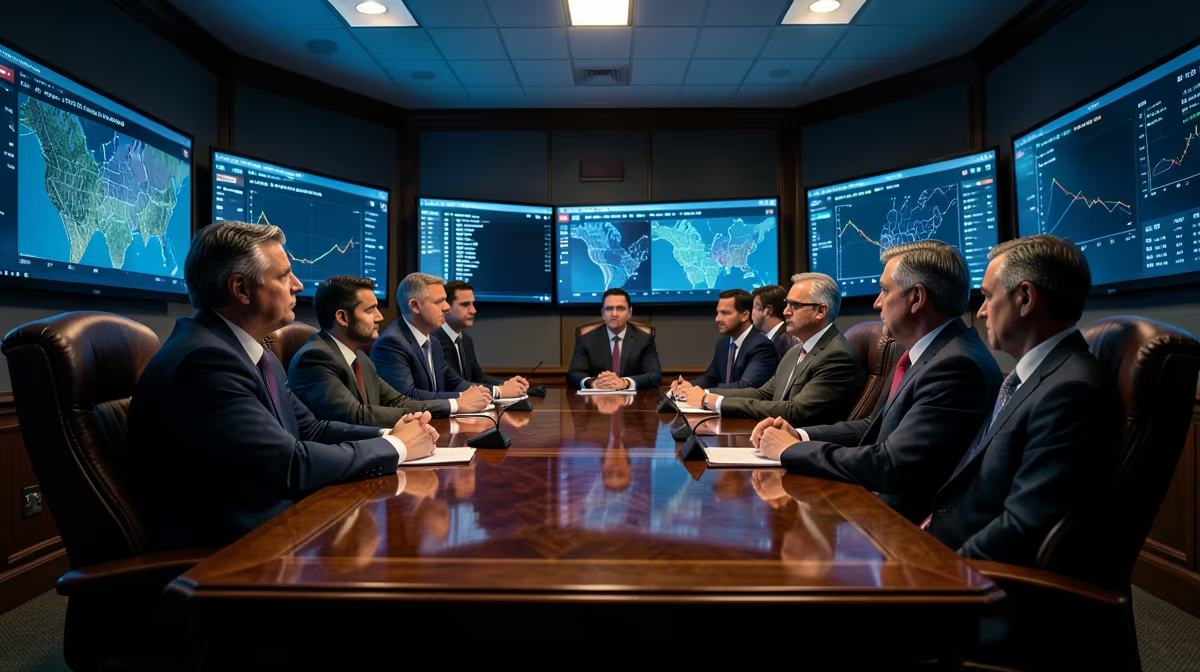
The United States announced new economic sanctions against several Iranian entities on Tuesday, aiming to curb Tehran's advancing nuclear program following the collapse of diplomatic talks in Geneva. Recent developments in us-iran relations have brought renewed focus to global markets, with key figures like Scott Bessent weighing in on the escalating middle east tensions. The Treasury Department targeted multiple shipping networks and front companies allegedly used to finance Iran's Islamic Revolutionary Guard Corps, with officials stating the measures are designed to restrict the flow of revenue sustaining regional proxy groups.
What Unfolded
This latest escalation follows recent International Atomic Energy Agency reports indicating Iran has continued to enrich uranium beyond previous threshold limits. Washington maintains that all options remain on the table to prevent Tehran from acquiring a nuclear weapon. The U.S. Treasury Department officially announced new sanctions on Tuesday targeting Iranian shipping and financial networks. The targeted entities include front companies linked to the Islamic Revolutionary Guard Corps. Diplomatic talks in Geneva aimed at reviving the nuclear deal have currently stalled, leaving international observers monitoring the situation closely. What is confirmed is that new U.S. economic sanctions have been officially implemented against specific Iranian financial and shipping networks, while potential retaliatory measures from Tehran and the exact international enforcement timeline remain ongoing developments.
The Historical Context And Root Cause
Relations between the two countries soured dramatically during the 1979 Iranian Revolution, which overthrew the U.S.-backed Shah and led to the American hostage crisis. Decades of hostility, proxy wars, terrorism designations, and disputes over Iran's pursuit of nuclear technology have kept the two nations at loggerheads ever since. The root cause of this persistent friction lies in the structural incompatibility between Iran's regional hegemony ambitions and the U.S.-led post-WWII security architecture in the Middle East, exacerbated by the 1979 Islamic Revolution and the securitization of energy corridors. Historically, the 1953 Anglo-American orchestrated coup, known as Operation Ajax, and the subsequent U.S. support for the Shah created the foundational grievance and anti-imperialist narrative that continues to drive modern Iranian foreign policy.
Economic And Geopolitical Angles
The political angle involves a bipartisan consensus in Washington regarding Iranian containment, which contrasts sharply with Tehran's internal factional power struggles between hardline Islamic Revolutionary Guard Corps pragmatists and ideological purists, both of which utilize external defiance for domestic legitimacy. Economically, the conflict centers on weaponized interdependence through the U.S. dollar-dominated global financial system, crippling primary sanctions on Iranian oil exports, and the geopolitical positioning of alternative trade routes and currency de-dollarization initiatives like BRICS. Geopolitically, this manifests as a proxy-driven cold war with global repercussions involving great power competition, where external actors deepen strategic ties with Tehran to challenge Western hegemony, while Gulf states navigate a precarious balancing act. The hidden angle involves cyber warfare and cognitive domain operations that bypass conventional deterrence, alongside illicit maritime ship-to-ship transfer networks facilitated by complex dark-fleet corporate shells.
Regional Impact And Market Fallout
Regional analysts warn that the renewed economic pressure could provoke asymmetrical responses in the Middle East, where shipping corridors and U.S. military positions remain on heightened alert as diplomatic channels appear frozen. U.S. Treasury Secretary Janet Yellen emphasized during a morning briefing that the administration remains committed to using every tool at its disposal to deny the Iranian regime the financial resources it needs to advance its dangerous nuclear ambitions. This ongoing hostility directly threatens global stability by risking a wider Middle Eastern war that could disrupt international shipping lanes and send oil prices soaring. For the average person, an escalation in this conflict could mean higher gas prices at the pump, increased threats to global cybersecurity, and heightened economic uncertainty worldwide. Those affected include people living in the Middle East facing direct conflict, U.S. military service members deployed in the region, global consumers impacted by fluctuating oil and gas prices, and international businesses navigating economic sanctions.
Short Term Outlook And Future Projections
In the next 24 hours, diplomatic messaging is expected to intensify via Swiss intermediaries while regional military assets remain on high alert. Looking toward the next 72 hours, potential cyber operations and increased rhetoric may follow recent maritime incidents in the Persian Gulf. Key players monitoring these developments include the US Department of State, the Iran Ministry of Foreign Affairs, US Central Command, and the Islamic Revolutionary Guard Corps, with primary impact felt across energy markets, regional security, and cybersecurity infrastructure. Expert prediction indicates that both nations will maintain a posture of deterrence, avoiding direct kinetic engagement while utilizing proxies and cyber domains for signaling. In a best-case scenario, backchannel negotiations could lead to de-escalation agreements and the resumption of indirect nuclear talks. Conversely, the worst-case scenario warns that a miscalculation in the Strait of Hormuz could trigger localized kinetic strikes, leading to broader regional escalation.
Frequently Asked Questions
Why are US-Iran relations so strained?
Relations have been deeply fractured since the 1979 Iranian Revolution and the subsequent hostage crisis at the US Embassy in Tehran. Decades of subsequent conflicts, including Iran's nuclear program, support for regional militias, and US economic sanctions, have kept tensions high.
Are the US and Iran currently at war?
The US and Iran are not in a state of direct, declared military war, but they have engaged in prolonged shadow war tactics. This includes cyberattacks, economic warfare through heavy sanctions, and periodic clashes involving regional proxy forces.
What is the current status of the Iran nuclear deal?
The 2015 nuclear agreement, known as the JCPOA, effectively collapsed after the US unilaterally withdrew from it in 2018 and reimposed strict sanctions. Subsequent diplomatic efforts to revive the pact have repeatedly stalled due to unresolved disputes over monitoring and enrichment levels.
Why does the US impose sanctions on Iran?
The US uses comprehensive economic sanctions to pressure Iran into abandoning its nuclear ambitions and curbing its support for militant groups across the Middle East. These sanctions target Iran's oil exports, banking sector, and key officials to isolate the nation economically.
Do US citizens need a visa to visit Iran?
US citizens are required to have a visa to enter Iran, and the application process is notoriously rigorous and time-consuming. Additionally, the US State Department strongly advises all US citizens against traveling to Iran due to the very high risk of kidnapping and wrongful detention.
Does the US have an embassy in Iran?
The US does not have a formal diplomatic presence or embassy in Iran, as diplomatic relations were severed following the 1979 revolution. Instead, the Swiss government acts as the protecting power for US interests in Tehran through its embassy.
Conclusion
The implementation of new U.S. economic sanctions against Iranian shipping and financial networks underscores the ongoing friction between Washington and Tehran following the breakdown of diplomatic talks in Geneva. With regional shipping corridors and military assets remaining on high alert amid IAEA reports of continued uranium enrichment, both nations continue to navigate a tense landscape of economic pressure and deterrence. International observers and policymakers will closely monitor diplomatic messaging through intermediaries and potential regional developments as economic and strategic fallout continues to ripple through global markets.


.webp)

