
US-Iran Relations Reach a Critical Turning Point Behind Closed Doors
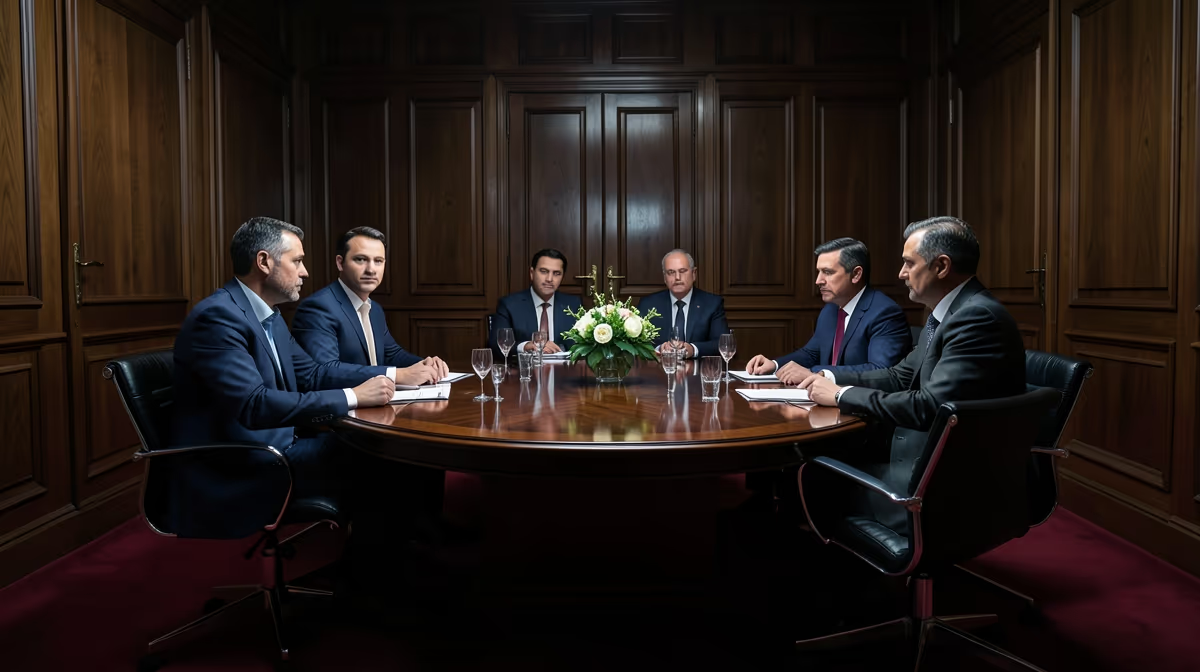
Behind closed doors in Geneva, quiet intermediaries are racing against the clock to prevent a regional catastrophe as us-iran relations remain at the center of global attention amid a deepening diplomatic crisis. Beneath the surface of public pronouncements lies a fragile web of back-channel communications designed to avert a direct military collision in the Persian Gulf.
The United States and Iran concluded indirect talks in Geneva on Thursday mediated by European diplomats, aimed at addressing escalating tensions in the Middle East and reviving discussions over Tehran's nuclear program. This diplomatic engagement marks a rare moment of direct communication through intermediaries following months of heightened naval confrontations in the Persian Gulf and mutual accusations regarding proxy group activities in the region. U.S. officials emphasized that the talks focused primarily on establishing clearer maritime de-escalation channels and addressing international concerns regarding Iran's uranium enrichment levels. Washington has maintained its maximum pressure sanctions regime while simultaneously pursuing backchannel diplomacy to prevent miscalculations that could lead to open conflict. Meanwhile, Iranian state media reported that Tehran is seeking sanctions relief alongside recognition of its civilian nuclear rights as prerequisites for any broader regional security agreements. Regional allies, including Israel and Gulf Cooperation Council states, are closely monitoring the developments, expressing cautious concern over any potential diplomatic shortcuts that might overlook broader ballistic missile proliferation and regional proxy warfare. A senior U.S. State Department official speaking on the condition of anonymity noted that they remain clear-eyed about the challenges and the significant gaps that still exist, but emphasized that diplomacy is the most effective path to ensure Iran never acquires a nuclear weapon.
Historical Roots and Structural Causes
The structural incompatibility between Iran's regional hegemony ambitions and the U.S.-led post-WWII security architecture in the Middle East serves as the root cause of the current friction, further exacerbated by the 1979 Islamic Revolution and the ensuing hostage crisis. Decades of hostility began with the 1979 overthrow of the U.S.-backed Shah and the subsequent U.S. hostage crisis, while foundational grievances trace back even further to the 1953 Anglo-American coup known as Operation Ajax that overthrew democratically elected Prime Minister Mohammad Mossadegh, creating the foundational grievance and historical memory that justifies the current regime's existential distrust of Washington. Tensions deepened significantly in 2018 when the U.S. unilaterally withdrew from the landmark nuclear agreement and reimposed crippling economic sanctions on Iran. Today, the U.S. and Iran have had strained relations for over four decades, during which Iran has continued to enrich uranium, bringing it closer to weapons-grade capability. U.S. military forces and Iran-backed proxy groups have frequently exchanged attacks in the Middle East, while economic sanctions remain the primary tool used by the U.S. to pressure the Iranian government, and diplomatic efforts to revive the 2015 Iran nuclear deal have largely stalled.
Political and Economic Dynamics
A bipartisan consensus in Washington views Iran through a securitized lens, heavily influenced by domestic lobby pressures and electoral vulnerability to appearing soft on the regime, while Tehran uses anti-Americanism as a foundational pillar for domestic regime legitimacy. Economically, a high-stakes sanctions regime is designed to weaponize the global dollar-dominated financial system, forcing international entities to choose between the U.S. market and Iranian energy sectors. This approach has inadvertently driven Iran toward de-dollarization and closer integration with BRICS economies. Comprehensive U.S. sanctions have severely crippled Iran's economy, drastically reducing its oil exports and limiting its access to the global financial system. While Washington aims to curb Iran's nuclear ambitions and regional influence through economic pressure, critics note that these measures have largely harmed ordinary Iranian citizens rather than altering regime behavior. Meanwhile, Iran has increasingly turned to allies like Russia and China to mitigate the economic isolation. Everyday consumers face higher fuel and energy costs, military personnel stationed in the Middle East remain on high alert, populations living in conflict zones across the region face constant instability, and businesses engaged in international trade navigate persistent supply chain anxieties.
Geopolitical Fallout and Security Realities
The conflict manifests as a proxy-centric cold war that destabilizes the Levant and Persian Gulf, accelerating a multipolar shift where Russia and China increasingly back Tehran to counter American primacy, challenging freedom of navigation and global energy supply chains. Operating continuously below the threshold of conventional military conflict are quiet, backdoor intelligence channels and cyber warfare, such as Stuxnet and ongoing infrastructure probes, managed by corporate proxies and shadow networks. Iran exerts significant influence across the Middle East through its support of a network of regional militia groups often referred to as the Axis of Resistance, which includes Hezbollah in Lebanon, the Houthis in Yemen, and various armed factions in Iraq and Syria. These groups frequently target U.S. military personnel and regional allies, leading to periodic retaliatory airstrikes by the United States. This shadow war remains a primary flashpoint for potential direct military escalation between Washington and Tehran. The U.S. Department of State, the Iranian Ministry of Foreign Affairs, and the U.S. Department of Defense remain the key institutional players managing these friction points across energy markets, regional stability, and cybersecurity domains.
Immediate Outlook and Strategic Projections
Over the next 24 hours, observers can anticipate increased intelligence sharing and defensive posture adjustments in the Middle East following recent maritime incidents. Looking ahead to the next 72 hours, diplomatic messaging through intermediaries is expected to continue in an effort to prevent escalation, potentially coupled with economic sanction announcements. Expert prediction indicates that both nations will maintain a state of calculated deterrence, avoiding direct military confrontation while proxy tensions persist. In the best-case scenario, back-channel negotiations lead to a de-escalation of maritime tensions and a temporary freeze on sensitive nuclear activities. Conversely, the worst-case scenario warns that a miscalculation by regional proxy forces could trigger a direct kinetic response from U.S. forces, leading to a broader regional conflict.
Frequently Asked Questions
Why are US-Iran relations so strained?
Relations between the United States and Iran have been deeply hostile since the 1979 Islamic Revolution and the subsequent US hostage crisis. Decades of subsequent proxy conflicts, economic sanctions, and disputes over Iran's nuclear program have further entrenched the geopolitical divide. Both nations view each other as major threats to regional stability in the Middle East.
What is the current status of the Iran nuclear deal?
The Joint Comprehensive Plan of Action (JCPOA), commonly known as the Iran nuclear deal, has been effectively defunct since the US unilaterally withdrew from it in 2018 under the Trump administration. Subsequent efforts by the Biden administration and international partners to revive the agreement have stalled due to ongoing disagreements over uranium enrichment and regional security. Consequently, Iran continues to advance its nuclear capabilities without international oversight.
Are US citizens allowed to travel to Iran?
The U.S. Department of State maintains a strict Level 4: Do Not Travel advisory for Iran due to the high risk of kidnapping and the arbitrary arrest and detention of U.S. citizens. Dual U.S.-Iranian nationals are at particular risk, as Iran does not recognize dual citizenship and may treat them solely as Iranian citizens. Anyone attempting to visit faces severe legal peril with virtually no consular assistance available.
What impact do US sanctions have on Iran?
Comprehensive U.S. sanctions have severely crippled Iran's economy, drastically reducing its oil exports and limiting its access to the global financial system. While Washington aims to curb Iran's nuclear ambitions and regional influence through economic pressure, critics note that these measures have largely harmed ordinary Iranian citizens rather than altering regime behavior. Meanwhile, Iran has increasingly turned to allies like Russia and China to mitigate the economic isolation.
Does the US have diplomatic relations with Iran?
The United States and Iran have not maintained formal diplomatic relations since April 1980, following the 1979 takeover of the U.S. Embassy in Tehran. Currently, diplomatic communications between the two governments are conducted primarily through the Embassy of Switzerland in Tehran, which serves as the protecting power for U.S. interests in Iran. Direct talks occasionally occur at international summits or through third-party intermediaries in neutral nations like Oman or Qatar.
What role does Iran play in Middle East conflicts involving the US?
Iran exerts significant influence across the Middle East through its support of a network of regional militia groups often referred to as the Axis of Resistance, which includes Hezbollah in Lebanon, the Houthis in Yemen, and various armed factions in Iraq and Syria. These groups frequently target U.S. military personnel and regional allies, leading to periodic retaliatory airstrikes by the United States. This shadow war remains a primary flashpoint for potential direct military escalation between Washington and Tehran.
Conclusion
Recent indirect diplomatic engagements in Geneva highlight the delicate balance Washington and Tehran must maintain amidst ongoing maritime confrontations and nuclear program disputes. While European intermediaries facilitate crucial communication channels, economic sanctions remain fully in effect, and regional stakeholders continue to monitor developments closely. Future stability hinges on whether preliminary discussions can effectively establish maritime de-escalation measures and prevent further regional miscalculations.


.webp)

