
Kalshi Stock and Commodity Markets Expansion Is Transforming Wall Street
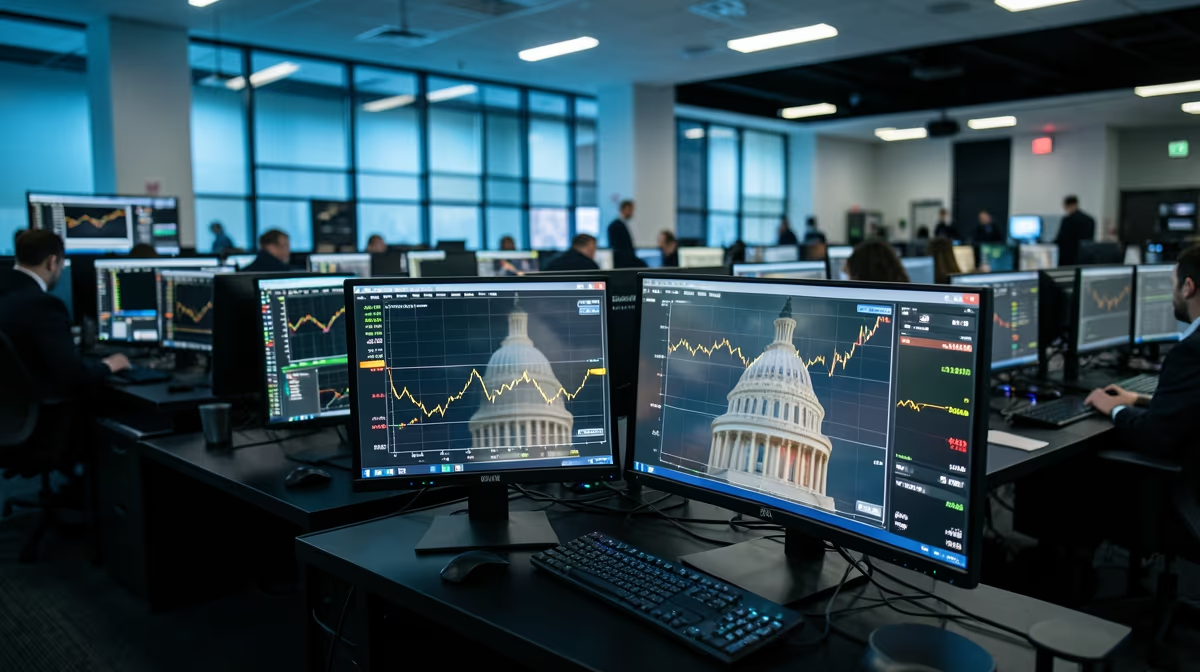
Can a platform built on wagering whether it will rain tomorrow or who will win an election successfully challenge the bedrock of Wall Street? The answer is unfolding in real-time as the Kalshi stock and commodity markets open up, signaling a massive structural shift in how retail investors interact with traditional financial assets. This expansion blurs the line between traditional financial exchanges and alternative prediction platforms, giving retail traders new ways to speculate on gold and silver through simplified interfaces. By branching out into well-known commodities and equities, Kalshi is positioning itself to compete directly with traditional brokerages and mainstream financial exchanges.
The strategic shift of prediction markets entering traditional finance represents a structural challenge to legacy derivatives exchanges, potentially rewriting the rules of retail investment under the watchful eye of federal regulators.
The Strategic Pivot Into Legacy Assets
The traditional boundary between event-based speculation and mainstream asset trading is rapidly dissolving. As platforms originally designed for predicting election outcomes mature, they are shifting focus toward the massive volumes of global financial markets. Understanding how Kalshi is expanding into stock markets requires analyzing their strategic moves to capture mainstream financial trading volume.
Rather than remaining confined to binary event contracts, the platform is building an ecosystem designed to host broader financial assets. This evolution has caught the attention of major outlets like Bloomberg, the Wall Street Journal, and CNBC, highlighting the platform's broader push into traditional US markets.
The cornerstone of this phase is the platform's introduction of perpetual contracts, commonly known as 'perps,' for precious metals, signaling an intent to compete directly with established derivatives exchanges.
- Kalshi is expanding into U.S. stock and commodity markets to diversify its product ecosystem.
- The platform recently launched perpetual contracts for gold and silver following CFTC approval.
- This expansion builds on its rapidly growing universe of event-based and alternative trading options.
- By offering derivatives on traditional assets, the platform directly targets retail investors seeking simplified interfaces.
Tracing the Evolution of Event-Contract Regulation
Transitioning from predicting real-world events to trading financial assets requires navigating a complex regulatory environment. Historically, prediction platforms operated under the Commodity Futures Trading Commission (CFTC), focusing on binary outcomes of events, elections, or economic indicators.
With massive popularity and venture capital backing, these platforms are pushing deeper into mainstream financial instruments, testing regulatory limits. The commodity trading regulation landscape is shifting as regulators attempt to classify these novel contract types.
The timeline below outlines this regulatory journey, showing the pace of financial market innovation:
| Date | Milestone |
|---|---|
| September 2026 | Kalshi secures CFTC approval to expand its futures offerings, launching perpetual contracts for gold and silver. |
| Mid-September 2026 | Media reports highlight Kalshi's broader strategic push into traditional US stock and commodity markets. |
| Ongoing | Regulatory scrutiny and sponsorship discussions across sports and media point to wider mainstream integration. |
This progression shows that the platform's recent regulatory greenlights are part of a calculated, long-term expansion strategy.
The Economic Friction Between Alternative and Legacy Exchanges
The expansion of alternative platforms into mainstream equities and commodities threatens to disrupt legacy retail finance. Rising mainstream acceptance and regulatory clearance of event-driven and prediction-style derivatives platforms has unlocked new avenues for speculative capital, prompting firms like Kalshi to challenge traditional exchanges.
Introducing high-frequency perpetual-style contracts for gold and silver to retail audiences has significant economic implications. Primarily, it risks fragmenting liquidity away from legacy exchanges that historically held a monopoly on derivatives trading.
Furthermore, these simplified trading structures could alter retail trading behavior, increasing systemic exposure to volatile alternative assets. This development prompts serious questions about what Kalshi stock and commodity trading means for US investors weighing alternative platforms against traditional brokerages.
The aggressive push by prediction markets into traditional asset classes may blur the line between gambling and investing to a degree that attracts unforeseen legal challenges from state-level gaming regulators, even as federal derivatives approval is secured.
While federal regulators like the CFTC may grant derivatives exchange status, local state-level gaming commissions may view these simplified, high-frequency event contracts as closer to sports wagering, creating a multi-tiered regulatory challenge.
The Political Dimension and Mainstream Cultural Integration
The intersection of finance, entertainment, and regulation has created a charged political atmosphere. Federal regulators face mounting pressure to balance financial prediction market innovation with consumer protection, turning alternative asset oversight into a major debate.
Simultaneously, prediction platforms are seeking cultural legitimacy to build brand awareness among younger demographics. Riot Games recently discussed potential sponsorships with Polymarket and Kalshi for its esports divisions, showing that these platforms are moving beyond financial circles into mainstream entertainment.
This rapid rise has a notable historical parallel:
- The rapid proliferation of retail options trading and electronic derivatives platforms in the early 1970s.
- This expansion followed the landmark launch of the Chicago Board Options Exchange, which democratized access to derivatives.
- Just as the 1970s marked a structural shift in retail market participation, the current expansion of event-based platforms could redefine modern trading.
Geopolitical and Macroeconomic Sentiment Indicators
Beyond domestic regulatory friction, the growth of these markets carries significant geopolitical weight. As prediction and commodity derivative markets scale globally, they increasingly reflect geopolitical risks and macroeconomic shifts in real-time.
Traditional markets often experience lag times or institutional barriers that delay the pricing of global risk. In contrast, regulated event-based platforms allow participants to react instantly to international developments and macroeconomic data releases.
Consequently, these platforms are positioning themselves as crucial, highly responsive indicators for international financial sentiment, aggregating global perspectives on major macroeconomic trends.
What Lies Ahead: Future Outlook and Market Predictions
As these products enter the market, the financial sector is braced for a period of rapid adjustment.
In the next 24 hours, financial markets and retail trading circles will continue to analyze the strategic implications of Kalshi's expansion into US stock and commodity markets, following recent CFTC approvals and product rollouts like gold and silver 'perps'.
Over the next 72 hours, industry observers and competitors are expected to assess the broader impact of prediction and event-contract platforms moving into traditional asset classes, potentially prompting further regulatory scrutiny.
Analysts expect increased competition in retail trading as prediction platforms successfully diversify their product offerings into traditional asset classes. The ultimate outcome of this expansion will likely fall between two distinct scenarios:
- The Best-Case Scenario: A smooth integration of new stock and commodity derivatives offerings under clear regulatory compliance, providing retail traders with innovative hedging tools and expanding market participation.
- The Worst-Case Scenario: Heightened regulatory pushback or unforeseen volatility risks in these rapidly expanding alternative trading universes could disrupt market operations and damage consumer trust.
Frequently Asked Questions
What is Kalshi's latest expansion announcement?
Kalshi is moving to expand its trading platform beyond its traditional offerings into US stock and commodity markets. This includes launching perpetual contracts, known as perps, for precious metals like gold and silver following CFTC approval.
Why does Kalshi expanding into stocks and commodities matter?
This strategic move represents a significant step for prediction and event-based platforms looking to capture mainstream financial trading volume. By offering derivatives on traditional assets like stocks and commodities, Kalshi is entering a much larger and more competitive segment of the financial markets.
Who is affected by Kalshi's new market offerings?
Retail traders and financial market participants interested in alternative trading venues are directly affected by these new offerings. Additionally, traditional exchanges and brokers may face increased competition as platforms like Kalshi introduce innovative contract types to everyday investors.
What happens next as Kalshi rolls out these new products?
As Kalshi rolls out its expanded product suite, market watchers will be monitoring regulatory oversight and adoption rates among retail traders. The platform's success in commodities like gold and silver could pave the way for even more complex stock and asset offerings in the near future.
What is the background of Kalshi's regulated trading status?
Kalshi operates as a federally regulated financial exchange that has historically gained attention for letting users trade on the outcomes of real-world events, elections, and economic indicators. Recent approvals from regulators like the CFTC have allowed the platform to steadily broaden its financial derivatives portfolio.
Which specific commodities are included in Kalshi's initial perps launch?
Following recent regulatory approvals, Kalshi specifically launched perpetual contracts for gold and silver. These offerings allow participants to trade these popular commodities directly on the platform's expanding futures ecosystem.
Conclusion
The strategic move by Kalshi to expand into US stock and commodity markets signals a transformative moment for prediction platforms and retail derivatives trading. By securing CFTC approval and launching perpetual contracts for gold and silver, the exchange has taken concrete steps to bridge the gap between event-based contracts and traditional financial instruments. While the full line of specific equities and assets remains a developing landscape, the broader trend points toward an increasingly competitive retail investing ecosystem. Regulators, legacy exchanges, and retail participants alike will continue to closely watch how these expanded offerings scale within established legal boundaries.
Sources
- Exclusive | Kalshi Looks to Expand a Rapidly Growing Universe of Risky Trading — WSJ
- Kalshi Moves to Expand Into US Stock and Commodity Markets — Bloomberg.com
- Kalshi launches ‘perps’ for gold and silver following CFTC approval, expanding futures offerings — CNBC
- What Are Kalshi and Polymarket? — The New York Times
- Riot Games Discussed Polymarket, Kalshi Sponsorships for Esports — Bloomberg.com
- How much does it cost to move a midterm prediction market? Not much — CNBC


.webp)


.webp)