
La Verne Lithium-Ion Battery Fire Triggers Major US Safety Shift
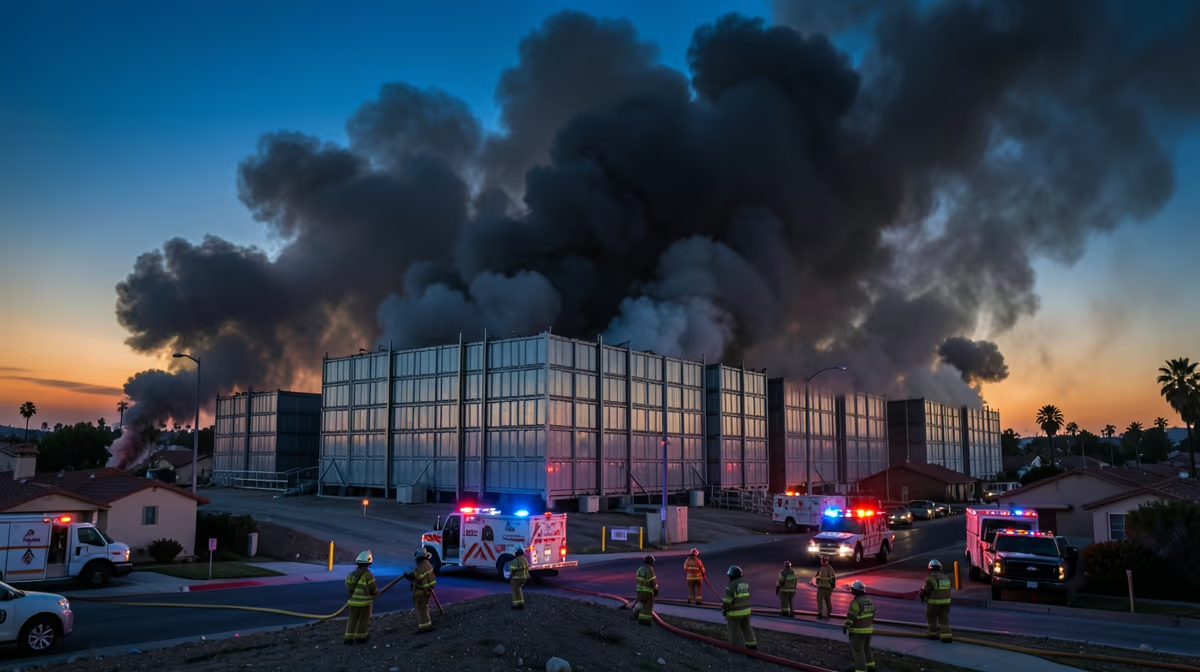
The sky over eastern Los Angeles County darkened not from weather, but from a volatile chemical chain reaction that local containment systems were never fully prepared to stop. Residents near the Metropolitan Water District facility faced mandatory La Verne lithium-ion battery fire evacuations following a dangerous chemical incident that has fundamentally challenged the safety narrative of urban energy storage infrastructure.
This blaze, centered at a critical utility site, triggered an immediate and aggressive emergency response as hazardous smoke plumes drifted toward residential and educational zones. What began as a localized industrial failure rapidly escalated into a regional public health crisis, forcing authorities to weigh the benefits of advanced energy storage against the immediate dangers of toxic chemical exposure in densely populated areas.
The incident highlights the growing safety and logistical challenges local infrastructure faces as large-scale battery storage facilities are integrated into populated regions, often outpacing current localized safety containment protocols.
The Rapid Escalation of the La Verne Fire
The emergency began at a battery storage facility operated by the Metropolitan Water District in La Verne, California. As the fire took hold within the lithium-ion units, the situation transitioned from a standard structural fire to a specialized hazardous materials incident. Local authorities, recognizing the intensity of the blaze and the risk of toxic emissions, issued a stern "leave now" warning for the surrounding neighborhood.
The urgency of the evacuation was driven by the nature of lithium-ion combustion. Unlike traditional fires, these events involve a process known as thermal runaway, a self-heating chain reaction that can lead to intense, persistent blazes that are notoriously difficult to extinguish. Specialized hazardous materials (hazmat) response teams were deployed to the scene, working alongside local fire departments to manage the burning units and monitor air quality for residents remaining on the periphery of the evacuation zone.
Impact on Local Education and Residential Life
The geographic proximity of the Metropolitan Water District facility to residential neighborhoods and schools complicated the emergency response significantly. As the fire spread, the following impacts were observed:
- Nearby schools were forced to implement immediate evacuations to move students to safer locations.
- Some educational institutions were placed under shelter-in-place orders to protect students and staff from potentially toxic fumes and deteriorating air quality.
- Residential areas received mandatory orders to clear the vicinity as smoke plumes drifted across eastern Los Angeles County.
- Local law enforcement coordinated with school districts to ensure the safe transfer and account of students during the height of the crisis.
The disruption to local school operations and the displacement of families underscored the human cost of placing industrial-scale energy projects in the middle of suburban zones.
Understanding the Risks of Battery Energy Storage Systems
The La Verne incident is not an isolated phenomenon but a reflection of the inherent risks associated with Battery Energy Storage Systems (BESS). While these systems are vital for the efficiency of modern water treatment and power grids, they carry unique chemical hazards that traditional firefighting methods are often ill-equipped to handle.
Fires involving lithium-ion batteries are notoriously difficult to extinguish and can release hazardous smoke and toxic chemicals into the surrounding community.
When a battery enters thermal runaway, it produces its own oxygen and heat, making it nearly impossible to suffocate the fire. This results in prolonged combustion periods where the primary goal of emergency services is containment and protection of the surrounding environment rather than immediate extinguishment.
| Event Milestone | Action Taken |
|---|---|
| Initial Thermal Runaway | Emergency services dispatched to Metropolitan Water District facility. |
| Smoke Dispersion | "Leave Now" evacuation orders issued for La Verne neighborhoods. |
| Hazard Escalation | Schools implement shelter-in-place and evacuation protocols. |
| Hazmat Deployment | Specialized teams initiate air quality monitoring and site containment. |
| Incident Review | Regional authorities begin safety protocol and infrastructure assessments. |
The Economic and Political Fallout
The financial and political implications of the La Verne lithium-ion battery fire extend far beyond the city limits. Analysts suggest that the rapid deployment and scaling of energy storage systems have outpaced the development of risk-mitigation frameworks. This gap creates a significant liability for utility operators like the Metropolitan Water District.
Economic Vulnerabilities
Infrastructure disruptions at critical utilities pose immediate operational risks to water treatment and distribution. Beyond the immediate costs of the fire response, there are escalating insurance and liability costs to consider. The financial viability of a rapid clean energy transition is threatened when large-scale battery projects become centers of high-cost emergency incidents.
Political and Regulatory Scrutiny
Local and county officials now face intense scrutiny regarding zoning approvals. The encroachment of industrial-scale green energy infrastructure on residential and educational zones has become a flashpoint for debate.
- Municipal authorities may demand stricter setbacks between facilities and schools.
- Independent safety reviews could become a mandatory prerequisite for future permits.
- Policy debates are expected to intensify regarding the balance between green energy goals and suburban safety standards.
This incident may accelerate regulatory bottlenecks for future projects nationwide, as the "hidden angle" of the crisis suggests that local governments will no longer grant permits without exhaustive evidence of containment capabilities.
Geopolitical and Historical Context
The La Verne fire echoes historical parallels that have shaped safety standards in the past. Analysts point to the 2019 Facility Fire in Arizona, specifically the McMicken battery storage facility explosion. That event similarly forced evacuations and injured first responders, eventually leading to a complete overhaul of the National Fire Protection Association (NFPA) safety standards for stationary energy storage systems.
On a geopolitical level, as critical domestic infrastructure increasingly relies on advanced battery technology—often tied to global mineral supply chains—localized thermal runaway events highlight a distinct domestic vulnerability. These incidents amplify policy debates over supply chain security and the environmental safety standards of the technology being deployed within the United States.
Future Outlook: The Next 72 Hours and Beyond
The immediate future for La Verne depends on the stability of the remaining battery units. Emergency services and hazmat teams are expected to continue monitoring the facility for the next 24 hours to ensure that the neighborhood and schools remain secure until the official evacuation orders are lifted.
Short-Term Expectations
Over the next 72 hours, authorities will focus on three primary objectives: - Investigating the root cause of the battery storage failure. - Assessing the long-term environmental and air quality impacts on the eastern Los Angeles County region. - Overseeing the safe return of evacuated residents and students once air quality metrics have normalized.
Expert Predictions
Energy analysts expect this event to trigger an industry-wide review. Facility operators will likely be forced to reassess their risk mitigation strategies, focusing on advanced suppression systems and early-detection sensors.
In the best-case scenario, the fire is fully contained without any further injuries, allowing residents to return home within a day as air quality metrics normalize. However, the worst-case scenario involves prolonged combustion or a secondary release of hazardous materials, which would complicate firefighting efforts and lead to extended neighborhood evacuations and broader environmental concerns for the region.
Frequently Asked Questions
What happened during the incident in La Verne?
Authorities ordered immediate evacuations after a hazardous lithium-ion battery fire broke out at a facility in La Verne. The emergency response included a significant hazmat team deployment to manage the dangerous situation.
Where did the lithium-ion battery fire take place?
The fire occurred at a battery storage facility operated by the Metropolitan Water District located in La Verne, California. This industrial site necessitated a large-scale emergency response due to the hazardous nature of the materials involved.
Who was affected by the La Verne evacuations?
Nearby residents were ordered to leave the area immediately under urgent 'leave now' warnings. Additionally, local schools in the vicinity were forced to evacuate or implement shelter-in-place orders to protect students and staff from toxic smoke.
Why are lithium-ion battery fires a major concern?
Lithium-ion battery fires are particularly hazardous because they can burn intensely, release toxic gases, and are notoriously difficult to extinguish quickly. These incidents pose serious air quality and safety risks to nearby residential neighborhoods and commercial facilities.
What emergency services responded to the La Verne facility fire?
Local fire departments and specialized hazardous materials (hazmat) response teams rushed to the Metropolitan Water District facility. They worked to secure the area, manage the burning battery storage units, and safely coordinate neighborhood and school evacuations.
What happens next for the evacuated areas in La Verne?
Emergency personnel continue to monitor the site to ensure the fire is completely extinguished and toxic hazards are mitigated. Residents and schools will be permitted to return once officials determine the surrounding air quality and environment are entirely safe.
Conclusion
The hazardous lithium-ion battery fire at the Metropolitan Water District facility in La Verne serves as a critical case study in the risks of modern infrastructure. While the shift toward large-scale energy storage is a pillar of current energy strategy, the resulting mandatory evacuations and school disruptions demonstrate that the safety frameworks for these facilities are still evolving.
Confirmed facts from the Los Angeles Times, ABC7, and other regional outlets verify that the immediate threat was managed through a massive deployment of hazmat resources and "leave now" directives. As the fire is fully extinguished and the cause is investigated, the focus will inevitably shift toward more stringent zoning and safety regulations to prevent similar incidents from threatening suburban communities in the future. For now, the priority remains the safe return of residents and the continued monitoring of air quality in the affected La Verne neighborhoods.
Sources
- ‘LEAVE NOW ‘ — evacuations ordered in La Verne after lithium-ion battery fire — San Gabriel Valley Tribune
- Evacuations issued in La Verne after hazardous lithium-ion fire — CBS News
- Lithium ion battery fire in La Verne spurs neighborhood, school evacuations — Los Angeles Times
- Battery storage fire at Metropolitan Water District facility in La Verne prompts nearby schools to evacuate — ABC7 Los Angeles
- Schools under shelter-in-place order amid fire in eastern LA County — NBC Los Angeles
- Fire at La Verne water treatment plant prompts hazmat response, evacuations — KTLA


.webp)


