
Russia Su-57 and S-500 Offer Puts India in a Tough Strategic Dilemma
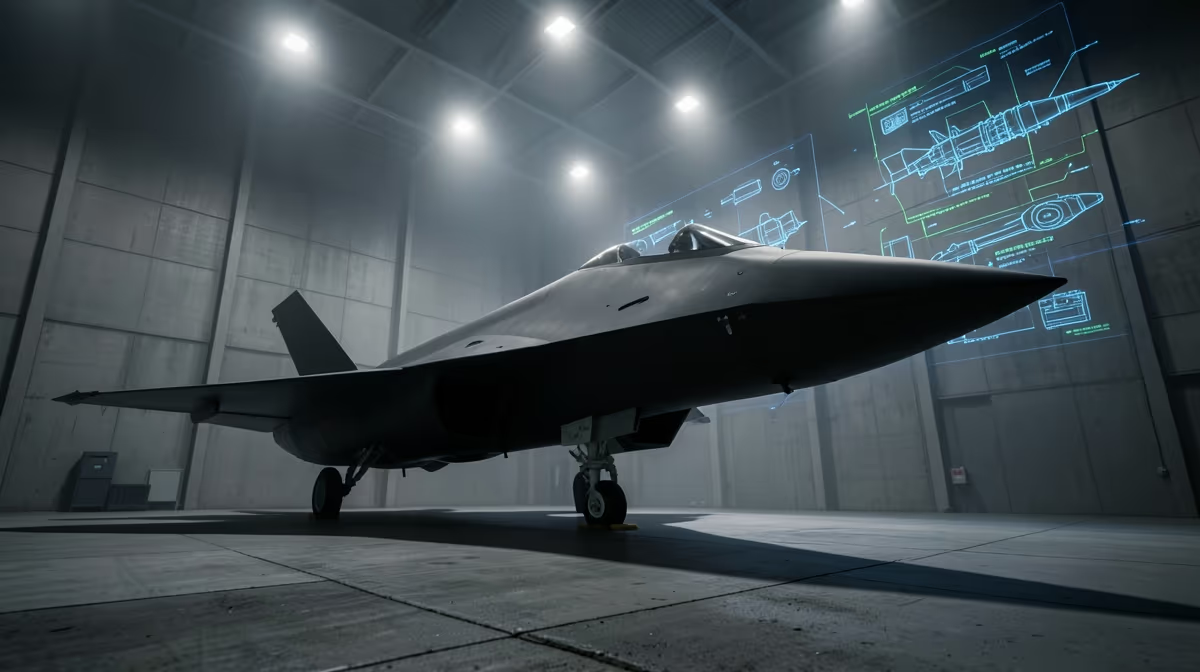
A high-stakes proposal from Moscow has placed New Delhi at a crucial strategic crossroads. In a major strategic push, Russia seeks Indian manufacturing partnerships for its advanced military hardware, highlighting potential deals for the Su 57 and S 500 defense systems. The aggressive pitch aims to expand bilateral defense ties by offering local production frameworks similar to past flagship military collaborations. However, the proposal comes at a time when India is recalibrating its defense procurement strategies to balance external security threats against indigenous technology development.
Russia has proposed local Indian manufacturing for its Su-57 stealth fighter and S-500 air defense system, but the Indian Air Force prefers limited direct purchases to protect its domestic AMCA program.
The Strategic Pitch: Su-57 and S-500
At the heart of Russia's latest diplomatic and military outreach is a comprehensive proposal centered on two of its most sophisticated hardware platforms: the Su-57 fifth-generation stealth fighter jet and the S-500 surface-to-air defense system. Moscow's offer is structured around deep industrial cooperation, urging New Delhi to adopt a local production model similar to the historic Su-30MKI program established in the late 1990s and 2000s. Under that framework, India achieved extensive licensed production, technological absorption, and domestic assembly of Russian aircraft.
By tabling joint manufacturing for both the Su-57 stealth fighter and the S-500 air defense system, Russian defense officials aim to reinforce Moscow's long-standing role as India's premier military technology provider. Proponents of the proposal contend that localized assembly would grant India rapid access to cutting-edge stealth capabilities and advanced high-altitude air defense technologies without starting from scratch.
- Su-57 Stealth Fighter: Russia's flagship fifth-generation multirole aircraft designed to challenge Western air superiority systems.
- S-500 Defense System: An advanced surface-to-air defense platform engineered to intercept complex aerial and ballistic threats.
- Su-30MKI Model Template: A joint manufacturing and technology transfer framework that previously enabled extensive Indian defense production.
The IAF Response: Direct Purchase vs. AMCA Focus
Despite the scale of Moscow's industrial offer, the Indian Air Force is approaching the pitch with notable strategic caution. Rather than committing to full-scale local assembly lines that require extensive capital and long-term industrial realignments, the IAF currently favors a limited direct purchase approach for the Su-57 fighter jet. This cautious stance reflects a deliberate shift in New Delhi's defense planning hierarchy, which prioritizes self-reliance and domestic aerospace development.
Central to India's hesitation is the national commitment to the Advanced Medium Combat Aircraft (AMCA) program. As India's premier indigenous fifth-generation fighter initiative, the AMCA represents the cornerstone of future air power modernization under the broader 'Atmanirbhar Bharat' self-reliance framework. Military planners are concerned that diverting substantial state funding, engineering talent, and industrial capacity toward setting up licensed Su-57 manufacturing lines could inadvertently stall or undermine the progress of the AMCA project.
The Indian Air Force leans toward limited direct procurement of the Su-57 to fulfill immediate tactical needs while safeguarding resources for the domestic AMCA program.
Industrial Realities and Fleet Constraints
Beneath the diplomatic overtures lies a complex set of industrial and structural factors driving Russia's push for joint manufacturing. While Moscow claims that the Su-57 is technologically superior to foreign fifth-generation rivals such as the F-35, the fighter's domestic deployment has been characterized by slow scaling. Russia's active Su-57 fleet size remains relatively small, hampered by production line bottlenecks and international sanctions pressure that restrict access to key components.
- Capital Injection: Partnering with India for joint production provides Moscow with essential foreign capital to scale up its production infrastructure.
- Industrial Scaling: Shared manufacturing frameworks allow Russian defense entities to distribute high manufacturing overhead across dual production centers.
- Market Preservation: Securing a long-term agreement ensures Russia maintains its traditional share of the Indian defense market amidst aggressive competition from Western defense manufacturers.
| Dimension | Russian Manufacturing Offer | IAF Procurement Preference |
|---|---|---|
| **Primary Objective** | Deep industrial localization (Su-30MKI style) | Limited direct purchase of complete units |
| **Industrial Focus** | Joint Su-57 and S-500 production lines | Protection of domestic AMCA development |
| **Strategic Goal** | Long-term defense tie and production scaling | Immediate capability gap fill without long commitments |
Geopolitical Alignment and Regional Counterweights
The defense pitch carries profound geopolitical weight across the South Asian security landscape. Regional air dynamics are shifting rapidly, highlighted by Pakistan's ongoing plans to acquire China-backed J-35 stealth fighters. To counter potential asymmetry in regional air power, introducing a fifth-generation stealth platform like the Su-57 to the Indian inventory is viewed by military analysts as a potent technological counterweight.
However, New Delhi must weigh these security benefits against broader geopolitical considerations. Navigating defense deals with Moscow requires managing diplomatic pressure from Western nations and adhering to global sanctions regimes. While India's historical strategic defense partnership with Russia remains resilient, New Delhi faces a complex political balancing act between honoring traditional alliances, avoiding diplomatic friction with Western partners, and building a fully independent domestic military-industrial complex under Atmanirbhar Bharat.
Evaluating the Path Forward: Scenarios and Predictions
As technical and strategic discussions progress, defense analysts and military officials are actively evaluating the feasibility of Russia's proposal. Over the next 24 hours, defense experts expect continued assessment of the Su-57 and S-500 pitch, measuring operational benefits against existing AMCA timelines. Over the next 72 hours, bilateral discussions are anticipated to hone in on technical feasibility, localization thresholds, and the precise boundaries between direct off-the-shelf acquisitions and deep manufacturing integration.
Potential Strategic Outcomes
Expert predictions indicate prolonged negotiations between Russian defense officials and the Indian Ministry of Defence. Analysts anticipate a multi-stage bargaining process where both nations seek to reconcile competing strategic imperatives.
- Best-Case Scenario: A flexible, mutually beneficial framework is established that combines limited direct purchases of stealth platforms to meet urgent IAF operational requirements with targeted technology transfers that advance India's domestic aerospace manufacturing capabilities without derailing the AMCA.
- Worst-Case Scenario: Disagreements over direct procurement limits versus local production mandates lead to extended operational delays, stalling the defense pitch and risking potential schedule slippages in air force modernization while regional competitors advance their stealth capabilities.
Frequently Asked Questions
What is Russia's recent defence pitch to India involving the Su-57 and S-500?
Russia has proposed expanding bilateral defence ties by seeking Indian manufacturing partnerships for its advanced Su-57 stealth fighter and S-500 air defence systems. This pitch follows a model similar to the previous Su-30MKI production arrangement, aiming to deepen military-industrial cooperation.
Why is Russia seeking Indian manufacturing for the Su-57?
By offering Su-30MKI-style joint manufacturing, Russia hopes to secure a major partner for its flagship fifth-generation platform while addressing production scaling. It also serves as a strategic counter-offer amid evolving regional threats and competing defence acquisitions.
Who is affected by Russia's push for Su-57 and S-500 deals with India?
The primary stakeholders include the Indian Air Force (IAF), domestic Indian defence manufacturers, and regional geopolitical rivals such as Pakistan, which is developing its own China-backed J-35 stealth fighter plans. The potential deals also impact broader defense supply chains between Moscow and New Delhi.
What happens next regarding India's potential acquisition of the Su-57?
While Russia pushes for local manufacturing, the Indian Air Force currently prefers limited direct purchases of the stealth fighter. This hesitation is largely driven by India's primary domestic focus on its indigenous Advanced Medium Combat Aircraft (AMCA) program.
What is the background of Russia's Su-57 stealth fighter fleet?
The Su-57 is Russia's premier fifth-generation stealth fighter designed to challenge Western counterparts like the F-35. However, despite claims of battlefield and technological superiority over foreign rivals, the overall fleet size remains relatively small.
Can the Su-57 effectively counter regional competitors like Pakistan's J-35 plan?
Proponents argue that introducing the Su-57 to the subcontinent would provide a powerful technological counterweight to emerging regional stealth programs backed by China. However, strategic debates persist over whether imported fifth-generation jets align with India's long-term self-reliance goals.
Conclusion
Russia's proposal to establish joint Indian manufacturing for the Su-57 stealth fighter and S-500 air defense system represents a pivotal moment in Indo-Russian military relations. While Moscow seeks to replicate the successful Su-30MKI localized production model to scale its industrial footprint, the Indian Air Force remains firmly focused on safeguarding its indigenous AMCA program through limited direct procurement. As defense officials evaluate technical feasibility, regional security balances, and domestic self-reliance mandates under 'Atmanirbhar Bharat', the coming negotiations will determine whether a middle ground can bridge Moscow's industrial push with New Delhi's long-term aerospace independence.
Sources
- ‘Growing stronger’: India and Russia push to expand defence ties — South China Morning Post
- Russia Seeks Su-30MKI-Style Indian Manufacturing for Su-57, but IAF Prefers Limited Direct Purchase amid AMCA Focus — Defence.in
- S-500, Su-57 At Heart Of Putin's Big India Defence Pitch — NDTV
- Su-57 for India: Can Russia’s stealth fighter counter Pakistan’s China-backed J-35 plan — The Times of India
- Russia Claims Su-57 Stealth Fighter Superior to Foreign Rivals: Is It Right? — Military Watch Magazine
- Russia's Su-57 Is Supposed To Challenge Western 5th-Gen Fighters — So Why Is Its Fleet So Small? — Simple Flying


.webp)


