
DNA and RNA genetic letters in ancient asteroid shock origin theories
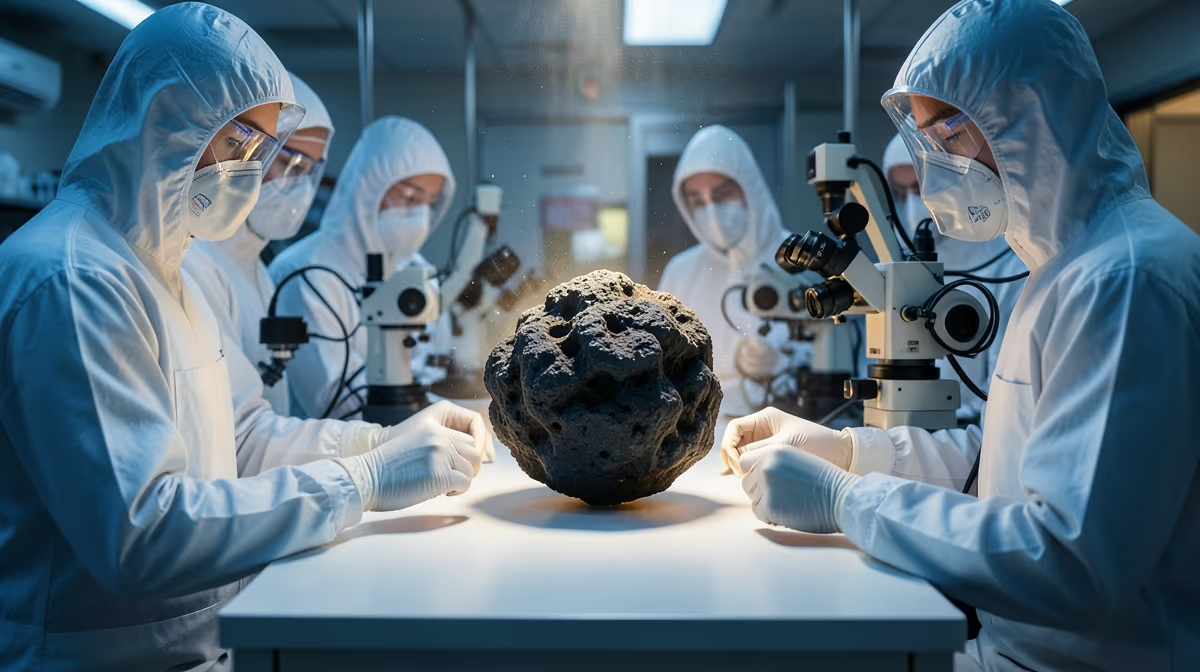
Locked inside a 4.5-billion-year-old cosmic time capsule, the fundamental code of biology has been discovered floating in deep space. The verification of DNA and RNA in ancient asteroid samples confirms that all five primary genetic letters needed to assemble terrestrial life exist naturally within extraterrestrial rock. This landmark discovery provides concrete evidence that the essential chemical hardware for living organisms was already fully formed in space long before Earth developed its first biological structures.
The confirmation of all five genetic nucleobases in a 4.5-billion-year-old asteroid proves that life's essential chemical instructions existed in deep space prior to Earth's formation.
Decoding the Chemical Building Blocks in Extraterrestrial Material
For decades, exobiology research has sought to determine whether the precursor chemicals of life were synthesized entirely on early Earth or forged in the interstellar vacuum. Recent laboratory analyses of pristine space rock samples, including materials returned from carbonaceous chondrites such as the Ryugu asteroid, have provided an unequivocal answer. Researchers have identified all five essential genetic "letters"—the specific organic nucleobases that constitute adenine, guanine, cytosine, thymine, and uracil—within a single ancient asteroid sample dating back 4.5 billion years.
These nitrogenous bases function as the universal alphabet for genetic storage and transmission across all terrestrial organisms. While previous meteorite studies successfully identified select amino acids and isolated nucleobases, detecting the complete quintet within extraterrestrial rock resolves long-standing uncertainties regarding cosmic organic synthesis. Advanced analytical techniques permitted researchers to identify trace concentrations of these fragile organic compounds without damaging the pristine mineral matrices holding them.
Finding the complete set of five genetic letters within pristine extraterrestrial rock confirms that complex prebiotic chemistry was active during the earliest phase of solar system formation.
Resolving Sample Contradictions
The verification of these genetic building blocks comes as planetary scientists solve puzzling analytical contradictions previously encountered in carbonaceous samples like Ryugu. Initial analyses produced contrasting observations regarding how organic molecules endured intense radiation and cosmic exposure over billions of years. By isolating how trace organic compounds interact within microscopic mineral structures, laboratory teams demonstrated that pristine asteroid interiors act as protective shields, preserving delicate nucleobases from cosmic degradation.
Historical Milestones in Cosmic Organic Chemistry
The discovery represents the culmination of more than half a century of research into extraterrestrial organics. To understand the significance of finding asteroid nucleobases today, it is essential to trace how prebiotic astrochemistry evolved from early high-impact meteorite falls to direct space agency sample returns.
| Era / Event | Primary Chemical Discovery | Astrobiological Significance |
|---|---|---|
| 1969 Murchison Meteorite | Extraterrestrial amino acids detected | Catalyzed modern prebiotic chemistry and non-terrestrial organic research |
| Early Asteroid Missions | Trace organic carbon compounds | Confirmed presence of complex carbon molecules across solar system bodies |
| Pristine Sample Return Era | All 5 DNA and RNA genetic letters identified | Proves complete genetic building blocks existed in space 4.5 billion years ago |
When the Murchison meteorite crashed in Australia in 1969, scientists recovered early evidence that amino acids could form beyond Earth. However, questions persisted for decades regarding whether complete genetic sequences—specifically the full suite of pyrimidine and purine nucleobases required for both DNA and RNA—could survive the dynamic history of an ancient asteroid. By confirming all five letters in carbonaceous meteorites, modern biochemistry establishes a direct historical continuum between space-borne organic matter and prebiotic chemistry on Earth.
Panspermia and the Cosmic Delivery Model
The presence of complex genetic components inside space rock lends substantial scientific backing to the panspermia hypothesis and cosmic delivery models. During the early formation of the inner solar system, young Earth underwent an extended epoch of heavy bombardment by comets, asteroids, and planetesimals.
- Asteroids and meteorites carried fully synthesized nucleobases directly to the surface of early Earth.
- Water-rich carbonaceous chondrites shielded organic materials from thermal destruction during transit through space.
- Cosmic collisions deposited high concentrations of genetic precursor molecules into terrestrial prebiotic oceans.
- Interstellar chemistry generated uniform organic building blocks that were available across multiple planetary bodies.
This delivery mechanism suggests that the primordial soup on Earth was heavily enriched by extraterrestrial inputs. Rather than requiring Earth's early environment to construct every genetic component from scratch, meteorite genetics discovery data indicates that planetary impacts continuously seeded the young planet with pre-assembled organic compounds.
Geopolitical Competition and Space Exploration Strategy
Beyond its profound biological implications, the verification of origins of life in space components reshapes the geopolitical and strategic landscape for international space agencies. Global leadership in deep-space sample return missions serves as a crucial indicator of scientific prestige and technological soft power.
- NASA, JAXA, and the European Space Agency (ESA) are adjusting scientific priorities to target organic-rich carbonaceous asteroids.
- Space research consortiums are competing for funding allocations dedicated to advanced sample-containment technologies.
- Astrobiology findings are being integrated into planetary defense and exploration platforms, such as ESA's Hera mission studying battered space rocks like Dimorphos.
- Independent academic groups, such as students at Queen's University Belfast tracking Neptune's Trojan asteroids, continue expanding observational data on outer solar system minor bodies.
Planetary Protection and Regulatory Frameworks
The definitive confirmation of non-terrestrial genetic letters subtly shifts legal and ethical frameworks surrounding planetary protection. As space agencies collect samples from asteroids like Ryugu and Bennu, strict contamination protocols are mandatory to distinguish native extraterrestrial nucleobases from terrestrial biosignatures. Furthermore, as resource utilization and commercial space enterprises target asteroids, international bodies face expanding responsibilities to regulate how pristine organic environments are preserved for scientific inquiry.
Analytical Outlook and Strategic Timeline
Scientific communities, biochemists, and astrobiologists are preparing for an expanded phase of sample analysis. Over the coming days and months, research groups will publish detailed breakdowns assessing the exact chemical pathways through which these five nucleobases synthesized inside primitive solar nebula environments.
- Next 24 Hours: Scientific community debates and initial analytical reviews expected to circulate widely across academic networks.
- Next 72 Hours: Researchers and academic institutions expected to publish deeper breakdowns regarding biogenesis implications.
- Medium-Term Impact: Accelerated capital allocation and agency funding for sample-return missions targeting carbonaceous asteroids.
- Long-Term Shift: Integration of astrobiological preservation rules into international space policy and planetary defense frameworks.
In the near term, analysts predict that this milestone will accelerate capital allocation for direct sample-return architectures targeting carbonaceous space rocks. In the best-case scenario, ongoing structural and isotopic mapping of asteroid samples will conclusively link extraterrestrial organic compounds directly to the earliest biochemical markers found in Earth's geological record. Conversely, the worst-case scenario involves potential contamination debates or analytical ambiguities that could temporarily prolong peer consensus, highlighting the critical need for hyper-clean sample handling facilities.
Frequently Asked Questions
What was discovered in the ancient asteroid?
All five genetic letters of DNA and RNA have been discovered within a 4.5-billion-year-old asteroid. This finding provides critical insights into the organic compounds present in the early solar system.
Why does finding DNA and RNA components in space matter?
Discovering these fundamental building blocks of life in extraterrestrial samples supports the theory that the ingredients for life were delivered to early Earth via meteorite and asteroid impacts. It helps scientists understand how life's precursor molecules may have formed universally.
Who is affected by this space chemistry discovery?
Astrobiologists, planetary scientists, and researchers studying the origins of life are directly impacted by this discovery. The findings reshape our understanding of prebiotic chemistry and how organic molecules are distributed across space.
What happens next in asteroid organic molecule research?
Researchers will continue analyzing samples returned from ancient space rocks, such as those from Ryugu and Bennu, to cross-verify concentrations and search for other complex organic compounds. Future space missions will further investigate asteroid compositions to decode the solar system's history.
What is the background behind finding genetic letters in meteorites?
Scientists have previously detected certain nucleobases and amino acids in meteorites over the years, but finding all five essential genetic letters together in a single pristine asteroid sample marks a significant milestone. Advanced analytical techniques have allowed researchers to detect these trace molecules with unprecedented precision.
How old is the asteroid where the genetic letters were found?
The asteroid analyzed in the study is approximately 4.5 billion years old, dating back to the formation period of our solar system. This age indicates that these vital molecular building blocks existed long before life emerged on Earth.
Conclusion
The identification of all five genetic letters of DNA and RNA within a 4.5-billion-year-old asteroid establishes that life's biochemical foundation was present in the solar system long before Earth existed. By confirming that ancient space rocks carried the complete set of nucleobases required for genetic inheritance, these verified findings transform our understanding of prebiotic chemistry and the cosmic origins of life. As international space agencies expand sample-return missions and refine analytical techniques, research will focus on tracing how these organic molecules survived cosmic radiation and shaped early planetary environments.
Sources
- All 5 genetic “letters” of DNA and RNA discovered in a 4.5-billion-year-old asteroid — Science Daily
- Dimorphos in sight: Europe's Hera probe gets its 1st look at battered space rock (photo) — Space
- Queen's University Belfast students find Neptune's elusive Trojan asteroids — Phys.org
- Improved asteroid deflection model runs faster, reveals more doomsday worries — The Register
- 10 asteroid mysteries that Hera will explore — European Space Agency
- Researchers May Have Solved a Puzzling Contradiction in the Ryugu Sample — Universe Today


