
trump-asked-china-buy-us-arms-ambassador-says
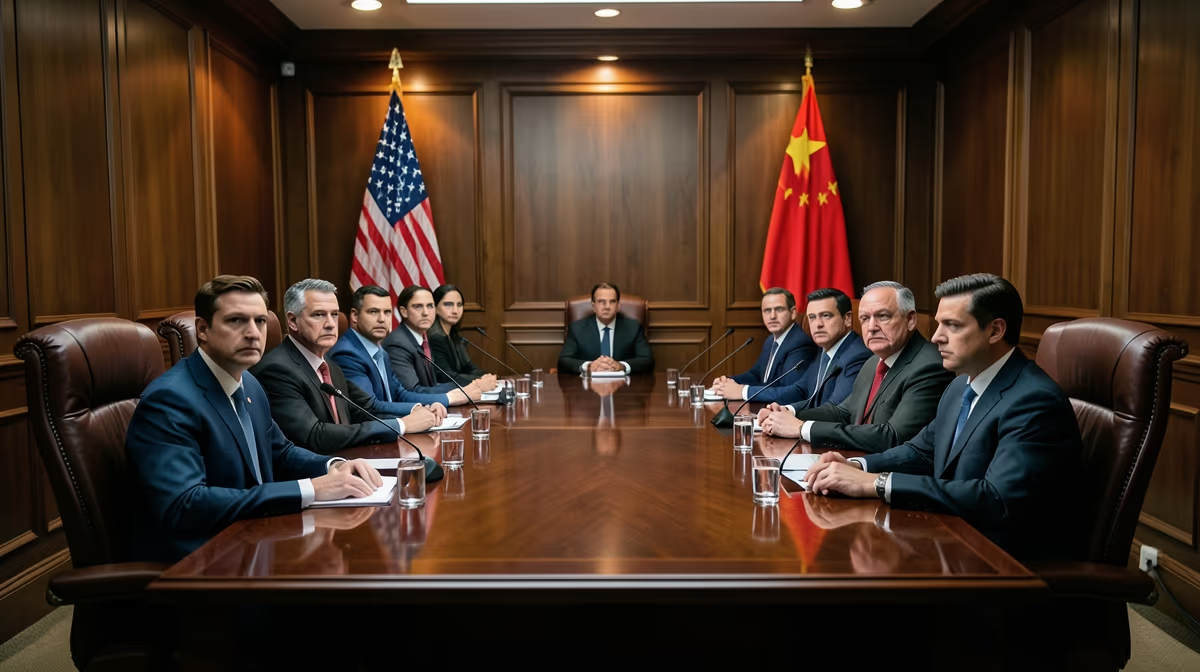
The quiet corridors of high-level diplomacy rarely witness proposals as startling as a direct offer of military hardware between the world’s most significant rivals. Yet, a revelation from a senior U.S. diplomat has pulled back the curtain on a Washington summit that may have redefined the boundaries of international power plays. Recent reports reveal that Trump asked China president to buy US arms during high-level diplomatic discussions, a move that complicates an already intricate web of trade and security negotiations. This unexpected inquiry into defense procurement suggests a radical departure from established foreign policy, blending economic incentives with provocative security overtures in a manner that has left analysts and international observers scrambling for a deeper understanding of the new bilateral status quo.
Discussions involving military hardware between the United States and China represent a sharp departure from standard diplomatic norms, introducing a transactional military element into a relationship traditionally defined by strategic rivalry.
Behind the Scenes at the Trump Xi Summit
The disclosure that Donald Trump asked Chinese President Xi Jinping if China would be interested in purchasing American military equipment emerged through a U.S. ambassador following the high-stakes summit held in Washington. While the public focus of the meeting had been largely centered on resolving persistent trade imbalances and easing the tension of ongoing tariff wars, this specific inquiry into arms sales introduces a new variable into the geopolitical equation. According to the ambassador, the proposal was made directly to President Xi, highlighting an unorthodox approach to bilateral engagement that prioritizes commercial transactions even within the sensitive realm of defense.
This development surfaced alongside a broader analysis of the summit’s outcomes, where the primary goal was to establish a tangible truce between the two superpowers. The revelation has been met with significant attention from global media outlets, including the New York Times and The Guardian, which have noted the stark contrast between this offer and the traditional U.S. posture of restricting advanced military technology to strategic competitors. The inquiry essentially tests the limits of military competition, asking whether the world’s two largest economies can find common ground in the most protected sectors of national industry.
The $30 Billion Tariff Breakthrough
Parallel to the discussions regarding military hardware, the Washington summit yielded a significant economic agreement aimed at de-escalating the long-standing trade conflict. The United States and China reached a formal deal to lower tariffs on $30 billion worth of goods. This agreement is seen as a crucial "carrot" in the diplomatic process, designed to provide immediate relief to markets and demonstrate that the two nations are capable of reaching concrete, beneficial arrangements.
| Date | Key Event |
|---|---|
| September 26, 2026 | US and China strike a deal to lower tariffs on $30 billion in goods. |
| September 27, 2026 | New York Times reports Trump offered to sell arms to China. |
| September 28, 2026 | U.S. Ambassador confirms the proposal during media briefings. |
| September 28, 2026 | Detailed list of products for tariff cuts is released to the public. |
The deal involves a specific list of products agreed upon by both nations, representing a cross-section of industries that have been caught in the crossfire of the trade war. However, analysts emphasize that for this truce to hold, these "tangible outcomes" must be implemented consistently. The lists include agricultural products, industrial machinery, and various consumer goods, though the inclusion of defense-related discussions has cast the commercial agreement in a more complex light.
Strategic Maneuvering and Unorthodox Diplomacy
The root cause of this unusual proposal appears to be a form of strategic maneuvering during high-stakes diplomatic exchanges. By blending economic concessions like the $30 billion tariff cuts with unconventional proposals like the sale of military equipment, the U.S. administration is testing a dual-track strategy. This approach seeks to stabilize the commercial relationship while simultaneously probing Beijing’s strategic intentions and its willingness to integrate into U.S.-led supply chains—even in the defense sector.
The Political Dimension
From a domestic perspective, the offer to sell arms to a primary geopolitical rival showcases a highly transactional approach to foreign policy. It challenges long-held defense posture assumptions that have dictated American policy for decades. For critics and supporters alike, the move represents the "art of the deal" applied to international security, where everything is potentially on the table if the price and the broader trade concessions are right.
The Economic Perspective
Economically, the discussion is inextricably linked to the broader trade negotiations. By floating the idea of defense purchases, the administration may be looking for high-value exports to further reduce the trade deficit with China. While agriculture and technology are standard components of these talks, the scale of military procurement could theoretically offer a massive shift in the balance of payments, provided such a deal was ever to move from a proposal to reality.
Geopolitical Implications and Security Risks
The prospect of U.S.-China arms sale discussions carries immense weight in the international community. The two nations are currently locked in a strategic rivalry that spans the globe, with particular friction in the South China Sea and across the broader Asia-Pacific region. Introducing American military hardware into China’s arsenal would not only change the bilateral relationship but would also fundamentally redefine alliance dynamics in the region.
The proposal may have been floated not as a serious procurement offer, but as a diplomatic probe to test Beijing's willingness to integrate into US-led defense supply chains or to expose limitations in their bilateral military transparency.
This "hidden angle" suggests that the inquiry might have been a tool for transparency. If China were to engage in discussions about purchasing U.S. arms, it would require a level of military-to-military openness that is currently non-existent. Alternatively, it could be seen as a way to expose the limitations of Beijing’s own domestic defense industry or their willingness to rely on Western technology.
Historical Parallels and Future Trajectories
Analysts have begun to draw comparisons between this summit and President Richard Nixon’s 1972 visit to China. Like the 1972 visit, which fundamentally realigned Cold War global power dynamics through unexpected diplomatic outreach, the current proposal to discuss defense trade represents a potential shift in the global order. While the 1972 opening was about containment and balance of power against the Soviet Union, the current overture appears to be focused on a transactional stabilization of a 21st-century rivalry.
The "future-impact" of these discussions is high. If the dialogue continues, it could lead to a redefine security dialogue between Washington and Beijing. However, it also risks alienating traditional allies in the Asia-Pacific who rely on the technological edge of U.S. military equipment to balance China’s growing influence.
Predicting the Diplomatic Fallout
The next 24 to 72 hours are expected to be critical as diplomatic and media reactions process the ambassador’s revelation. International markets are already assessing the broader geopolitical implications, particularly how the defense trade discussions might affect the implementation of the $30 billion tariff cut deal.
Best-Case and Worst-Case Scenarios
In the best-case scenario, the disclosure serves as a catalyst for continued dialogue. It could lead to lowered tensions and a stable implementation of the tariff reduction agreements, with the arms sale proposal remaining a symbolic gesture of a new, more open era of communication.
Conversely, the worst-case scenario suggests that the unexpected disclosure could spark intense political friction. It could complicate ongoing diplomatic or trade negotiations if either side feels the private nature of the summit has been compromised or if the domestic political backlash in Washington or Beijing becomes too severe. Experts predict heightened scrutiny on all bilateral military and economic policies as the outcomes of the Washington summit are further scrutinized by legislative bodies and international watchdogs.
Frequently Asked Questions
Did Donald Trump actually offer to sell weapons to China?
According to a U.S. ambassador, Trump asked President Xi Jinping if China would like to buy U.S. military equipment during the Washington summit.
What was the main economic outcome of the Trump-Xi summit?
The U.S. and China struck a deal to lower tariffs on $30 billion worth of goods across various sectors.
Why is the discussion of arms sales to China significant?
It is highly unusual because the two nations are strategic rivals. Such discussions could impact international security postures and military transparency.
Who is affected by these diplomatic developments?
Global markets, defense manufacturers, international policy analysts, and the citizens of both nations are affected by changes in trade and security policies.
Conclusion
The revelation that the U.S. floated the idea of arms sales to China marks a significant, if unpredictable, milestone in modern diplomacy. While the $30 billion tariff cut provides a necessary economic reprieve and a "tangible outcome" to keep the diplomatic truce alive, the introduction of military hardware into the conversation suggests a much larger, more complex game is being played. As the next several days unfold, the world will be watching to see if this unorthodox proposal leads to a new era of military transparency or if it creates fresh political friction that threatens the fragile trade agreement. For now, the focus remains on the implementation of the tariff deals and the continued assessment of a relationship that remains the most consequential on the global stage.
Sources
- Trump asked China’s president if he wants to buy US arms, ambassador says — thehill.com
- Trump asked Xi Jinping if China would like to buy US weapons, American ambassador says — The Guardian
- Trump Offered to Sell Arms to China, U.S. Ambassador Says — The New York Times
- Trump-Xi summit analysis: 'Tangible outcomes' needed for U.S.-China truce to hold — CNBC
- US, China strike deal to lower tariffs on $30B in goods after Trump-Xi Washington summit — Fox News
- US and China detail list of products agreed under $30 billion tariff cut deal after Trump-Xi meeting — Yahoo Finance


.webp)

