
Trump Federal Spending Cuts Trigger Massive Clash With Congress
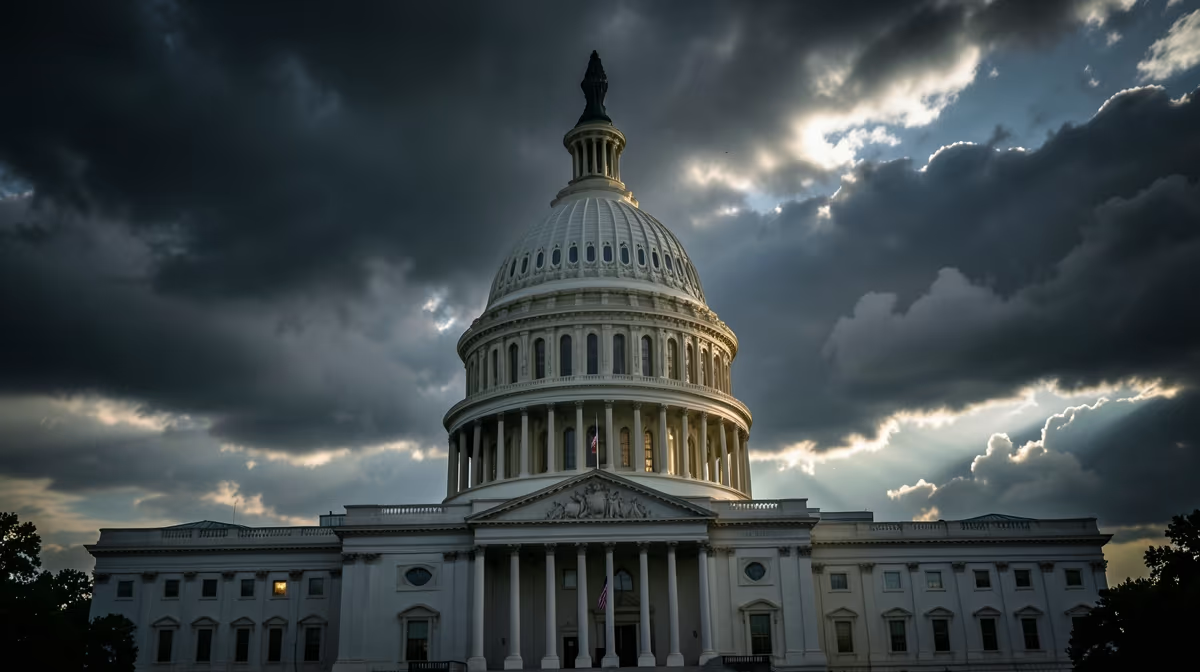
The constitutional architecture of the United States rests on a delicate balance of financial control that has just been tested in a billion-dollar gambit. By unilaterally withdrawing nearly $1 billion in approved funds, the executive branch has initiated a high-stakes standoff over who ultimately holds the strings of the national treasury. President Trump has announced the cancellation of $1 billion in federal spending, sparking a major constitutional battle and intensifying Trump federal spending cuts debates in Washington. This maneuver, which utilizes rare executive authority to bypass Congress, challenges the long-standing separation of powers that grants lawmakers the primary power of the purse.
The sudden rescission of nearly $1 billion in federal funds challenges the constitutional balance of power, potentially disrupting nationwide programs and setting the stage for a major legal showdown between the White House and Congress.
The Executive Maneuver: Bypassing the Legislative Branch
The Trump administration has utilized a rare and aggressive budgetary authority to cancel and rescind nearly $1 billion in federal spending that had previously been enacted into law. Reports from major news outlets, including Politico, The Guardian, and ABC News, indicate that the White House is ordering the clawback of over $800 million to $1 billion in funding. This decision was made without seeking the standard approval from the legislative branch, marking a significant escalation in the ongoing power struggle over financial oversight.
Under the U.S. Constitution, Congress holds the primary authority to allocate and appropriate federal funds. While presidents have historically used mechanisms like rescissions to propose spending cuts, doing so without congressional cooperation often leads to intense legal and political battles. In this instance, the administration's choice to leverage rare statutory mechanisms to claw back funds represents a striking challenge to the traditional control Congress maintains over the federal budget.
A Breakdown of the Funding Clawback
The specific details of the rescission reveal a sweeping attempt to halt federal spending across various sectors. While the exact program-by-program impact is still being reviewed by legal analysts, the verified facts confirm the following:
- Nearly $1 billion in total federal spending has been canceled.
- Over $800 million in specific funds have already been ordered rescinded.
- The authority used is a rare executive power intended to halt the flow of taxpayer dollars already designated for use.
- The action bypasses the standard legislative approval process required for budget changes.
The Constitutional Standoff: Reactions from Capitol Hill
The reaction from lawmakers has been swift and largely critical, with members of both parties expressing concern over the erosion of legislative authority. Senator Collins has been among the most vocal critics, labeling the administration's action a clear violation of the law. This sentiment is echoed across Capitol Hill, where some lawmakers have explicitly called the move illegal.
The political angle of this dispute centers on the "power of the purse." When the executive branch unilaterally cancels funds already appropriated by lawmakers, it disrupts the institutional tug-of-war that defines American governance. This maneuver is not merely a fiscal decision but a direct challenge to the authority of those who write the federal budget. Congressional leaders are now reviewing the limits of executive spending authority, with many preparing for a potential constitutional showdown in the halls of government.
Bypassing congressional approval to claw back these funds undermines the legislative branch's constitutional authority over spending and sets a dangerous precedent.
Economic and Geopolitical Implications
The sudden rescission of nearly $1 billion in federal spending is not without practical consequences. By halting the flow of funds, the administration has injected acute fiscal uncertainty into a wide range of federally funded programs. This disruption forces program administrators and contractors to reassess their financial stability, potentially halting ongoing projects that were relying on those appropriated dollars.
Impacted Stakeholders
The individuals and organizations affected by this move are diverse, ranging from federal agencies to local communities:
- Federal Agencies: Departments must now navigate sudden budget gaps and the cessation of planned initiatives.
- Program Administrators: Those overseeing specific grants and federal projects face immediate uncertainty regarding their ability to fulfill commitments.
- Contractors and Recipients: Entities relying on federal contracts or grants may see projects delayed or canceled entirely.
- Members of Congress: Lawmakers see their legislative work and local funding promises effectively nullified by executive action.
Beyond the domestic economic fallout, there is a significant geopolitical angle to consider. International partners and global observers monitor such aggressive executive actions as signals of potential instability in U.S. governance. When the execution of policy and the commitment of funds become unpredictable due to internal constitutional conflicts, it can affect how the world assesses long-term American commitments and the reliability of its financial execution.
Root Causes and Historical Parallels
The current clash is deeply rooted in the institutional struggle between the executive and legislative branches. Analysts point to the 1974 Impoundment Control Act as a critical historical parallel. This act was originally enacted by Congress to curb the executive withholding of appropriated funds, a practice known as impoundment, following similar conflicts during the Nixon administration.
| Stage of Conflict | Institutional Action |
|---|---|
| Legislative Appropriation | Congress approves and designates federal funding streams for specific programs. |
| Executive Rescission | The White House utilizes rare authority to halt and claw back nearly $1 billion. |
| Institutional Conflict | Lawmakers condemn the action as a violation of law, initiating a legal and political standoff. |
There is also a hidden angle to the administration’s strategy. Some analysts suggest that this maneuver may serve as an administrative stress test. By pushing the boundaries of executive impoundment authority, the administration can evaluate legal limits and lay the groundwork for even broader budgetary showdowns in the future.
Future Outlook: The Next 72 Hours
The situation is expected to evolve rapidly as legal experts and congressional leaders analyze the administration's decision. Over the next 24 hours, further statements are anticipated from congressional leaders as they formulate a unified response to the rescissions. Within the next 72 hours, the debate over the use of rare executive authority is likely to intensify, potentially prompting formal legislative responses or direct legal challenges from affected lawmakers.
Expert predictions suggest that political friction will increase, leading to potential legal confrontations over the limits of rescinding previously approved federal funds. Analysts are watching for two primary scenarios:
- Best Case: A structured dialogue or legal review is established to clarify the bounds of executive spending authority without triggering a prolonged constitutional crisis.
- Worst Case: The dispute escalates into severe legislative gridlock and immediate court challenges over executive overreach and the violation of congressional funding laws.
As the details of the specific programs and departments impacted by the rescissions continue to emerge, the focus remains on whether Congress will mount a formal legal challenge to contest the administration's authority.
Frequently Asked Questions
What did Donald Trump do regarding federal spending approved by Congress?
The Trump administration used rare authority to cancel and rescind nearly $1 billion in federal funding that had previously been approved by Congress. This maneuver represents the latest in a series of ongoing challenges between the executive branch and lawmakers over federal budgeting power.
Why are some lawmakers calling the funding cancellation illegal?
Certain members of Congress have strongly pushed back against the administration's actions, with some labeling the move a clear violation of the law. Critics argue that bypassing congressional approval to claw back these funds undermines the legislative branch's constitutional authority over spending.
What specific authority did the White House use to claw back the money?
The administration utilized a rare budgetary and executive authority to halt and rescind the funds. While past administrations have navigated rescissions carefully, this aggressive maneuver highlights a renewed push to challenge statutory spending limitations.
Who is affected by the cancellation of this federal spending?
The sudden rescission impacts various federal programs and initiatives that were anticipating or relying on these appropriated funds. Consequently, organizations and sectors tied to the cancelled grants and programs now face sudden financial uncertainty.
What is the background of this clash between the White House and Congress?
The dispute centers on the balance of power between the executive branch and the legislature regarding federal appropriations. Tensions have consistently flared whenever the White House attempts to unilaterally block or redirect funds allocated by lawmakers.
What happens next following the administration's decision to rescind the funds?
Lawmakers opposed to the cuts are expected to mount further legal and political challenges to contest the administration's authority. The standoff could potentially trigger judicial reviews or legislative battles over the strict boundaries of executive spending control.
Conclusion
The Trump administration's decision to rescind nearly $1 billion in federal funding marks a significant escalation in the constitutional struggle between the White House and Congress. By utilizing rare executive authority to bypass the legislative branch, the administration has challenged the established "power of the purse" and triggered a wave of accusations regarding the legality of the move. As federal programs face sudden fiscal uncertainty and lawmakers like Senator Collins decry the action as a clear violation of the law, the stage is set for a major institutional showdown. The coming days will determine whether this conflict leads to a clarifying legal review or a period of severe legislative gridlock and judicial intervention. For now, the balance of power remains in a state of high-stakes flux, with the future of federal spending control hanging in the balance.
Sources
- Trump cancels nearly $1bn in funding approved by Congress — The Guardian
- Trump cancels $1B in federal spending in latest challenge to Congress — Politico
- Trump administration uses rare authority to claw back nearly $1B in spending approved by Congress — STAT
- Trump cancels nearly $1 billion in spending approved by Congress, a move some lawmakers called illegal — CBS News
- Trump rescinds nearly $1B in federal funding, bypassing congressional approval — The Hill
- White House orders over $800M in funds rescinded; Collins calls it 'clear violation' of law — ABC News - Breaking News, Latest News and Videos


.webp)

