
Trump Federal Spending Cuts Trigger Massive Power Clash With Congress
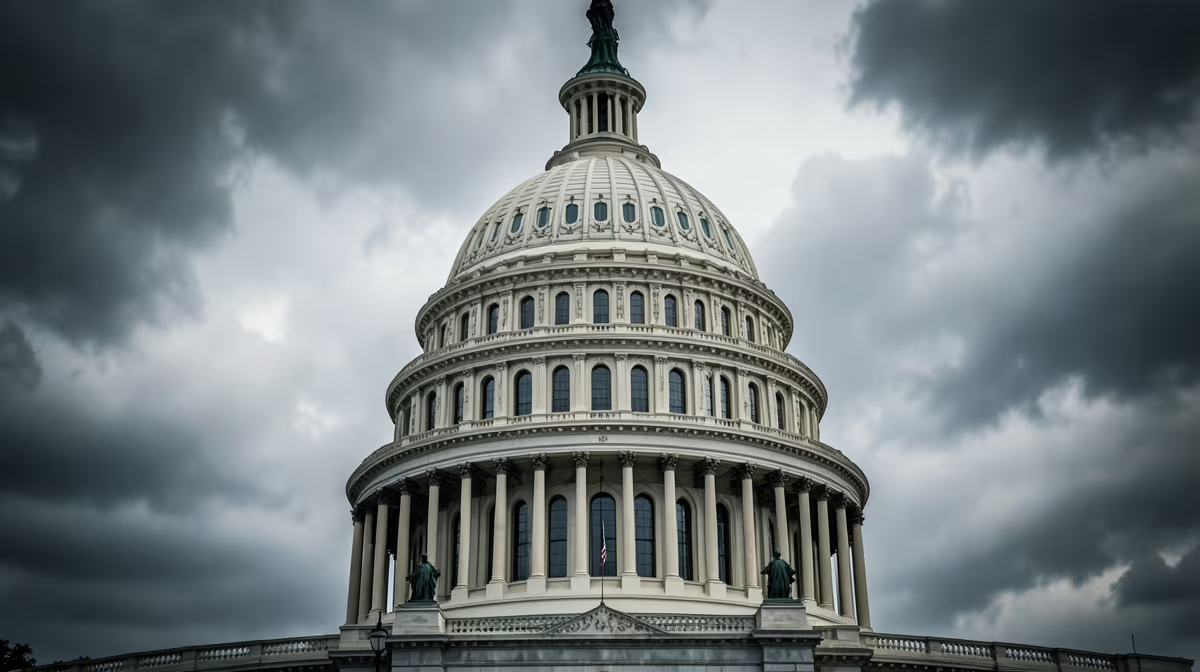
The constitutional blueprint of the United States hinges on the specific division of fiscal control, a boundary now being tested to its limits. In a move that has ignited a fierce political battle, Trump cancels 1 billion federal spending previously approved by lawmakers, signaling a profound shift in executive-legislative relations and the legal limits of presidential power.
The move tests the constitutional boundaries of the separation of powers, prompting swift accusations from lawmakers who argue that bypassing congressional approval for spending cancellations is illegal and executive overreach.
This sudden action has bypassed the standard legislative process, utilizing a rare authority to claw back funds that had already been allocated through the rigorous congressional appropriations process. The decision has sparked an immediate and intense political backlash, as policy watchers and political analysts weigh the long-term impact of the White House Congress budget clash. While the administration defends its right to manage federal resources, the move represents a direct challenge to the "power of the purse" traditionally held by the legislative branch.
The Mechanics of the Rescission Authority
The Trump administration has officially moved to rescind nearly $1 billion in federal funding, an action that relies on specialized executive mechanisms designed for rare circumstances. Under the U.S. Constitution, Congress is primarily responsible for passing laws that allocate and authorize federal spending. While presidents have historically possessed mechanisms to propose spending cuts or delays—such as deferrals—the ability to unilaterally claw back funds approved by law is heavily regulated.
The current dispute centers on the administration’s use of rare authority to bypass congressional approval for these specific cancellations. By invoking these powers, the executive branch is attempting to pull back previously appropriated money under specific conditions, a process known as rescission. This mechanism effectively freezes the funds, preventing federal agencies and grant-dependent organizations from accessing the capital they were promised by law.
Affected Sectors and Stakeholders
While specific program details continue to emerge across reports from major news outlets, the scope of the nearly $1 billion cancellation is broad. The impact areas identified include:
- Federal agencies awaiting budget execution.
- Organizations dependent on government grants for long-term projects.
- Members of Congress whose legislative priorities have been effectively nullified.
- State-level programs that rely on federal backing for policy execution.
A Timeline of the Budgetary Standoff
The current escalation follows a series of maneuvers regarding federal funding. To understand the gravity of the current situation, it is necessary to view the progression from legislative approval to executive cancellation.
| Phase | Action Taken | Legal/Political Status |
|---|---|---|
| Appropriation | Congress approves and allocates nearly $1 billion in federal spending. | Legally authorized by law. |
| Executive Intervention | Trump administration utilizes rare authority to rescind and cancel the funding. | Contested by lawmakers as illegal. |
| Congressional Response | Lawmakers challenge the legality of the move as executive overreach. | Potential for judicial review. |
| Funding Status | Federal spending freezes and cancellations take effect immediately. | Developing uncertainty for funded programs. |
Earlier in 2026, the Health Department had rescinded a freeze on $10 billion for five Democratic states, a move that highlighted the administration's active use of funding freezes as a policy tool. However, this latest $1 billion cancellation is seen as a more aggressive step because it bypasses the need for new congressional approval entirely.
Constitutional Friction and the Power of the Purse
The political fallout from the White House budget clash is rooted in the fundamental struggle over control of federal purse strings. Lawmakers from across the spectrum have expressed concern that this move erodes the separation of powers.
This move highlights a fundamental struggle over power and control of the federal purse strings between the executive branch and the legislative branch.
When a president bypasses Congress to cancel approved spending, it raises major constitutional questions regarding the legal limits of executive authority. Various lawmakers have condemned the cancellation, with some members of Congress openly labeling the unilateral rescission of congressionally approved funds as illegal. This sets the stage for a significant separation-of-powers clash in Washington that could take months or years to resolve in the courts.
The Historical Parallel of Impoundment
Analysts point to a historical precedent for this level of executive-legislative friction: The Impoundment Control Act of 1974. This legislation was originally enacted by Congress to curb the executive branch's ability to unilaterally withhold appropriated funds following aggressive use of the practice by President Richard Nixon. The current administration's use of rare authority to claw back funds is being viewed by some as a modern-day challenge to the restrictions established by that act.
Economic Uncertainty and Strategic Stress Tests
Beyond the legal arguments, the economic angle of this decision is significant. The sudden cancellation of nearly $1 billion in federal spending introduces fiscal uncertainty for funded programs. This affects long-planned budget allocations and triggers a debate on government efficiency versus legislative intent.
From a geopolitical perspective, while primarily a domestic dispute, aggressive unilateral executive actions on federal spending signal to international observers potential shifts in U.S. governance stability. It suggests a move toward a more executive-centric domestic policy execution model.
The "Hidden Angle" of Executive Power
There is a growing theory among political analysts that this targeted rescission may serve as a strategic stress test for broader executive impoundment powers. By successfully canceling $1 billion, the administration could potentially set a legal and procedural precedent for future administrations to reshape federal spending priorities without congressional sign-off. This would fundamentally alter the balance of power in Washington, making the executive branch the final arbiter of how and when money is spent, regardless of what is passed into law.
Future Trajectory: The Next 72 Hours
The immediate future of this dispute is likely to be defined by rapid legal and legislative maneuvers. In the next 24 hours, lawmakers are expected to issue further statements and detailed legal assessments. Following this, the next 72 hours will likely see an intensification of the debate over executive authority versus congressional power of the purse.
Expert Predictions and Possible Outcomes
Experts expect increased political friction and potential court challenges regarding the limits of executive authority to claw back congressional appropriations. The potential outcomes include:
- Best-case scenario: A measured legal and political compromise is reached that clarifies the boundaries of executive rescission authority without causing major disruption to federal programs.
- Worst-case scenario: The dispute escalates into a protracted constitutional crisis involving lawsuits, congressional retaliation, and prolonged uncertainty over federal funding allocations.
Lawmakers are currently weighing whether to pursue formal legislative remedies or judicial challenges to contest the blocked funds. Whether Congress will take formal legal action to reinstate the nearly $1 billion remains the central question as the administration maintains its stance on managing federal spending.
Frequently Asked Questions
Why did Trump cancel nearly $1 billion in federal spending?
The Trump administration used a rare authority to claw back nearly $1 billion in funding that had previously been approved by Congress. This move represents a direct challenge to congressional spending authority and bypasses standard legislative processes.
Is it legal for the president to cancel congressional spending?
The decision has sparked immediate controversy, with some lawmakers explicitly calling the move illegal. Critics argue that rescinding funds already approved by Congress infringes upon the legislative branch's constitutional power of the purse.
What authority did the Trump administration use to claw back the funds?
The administration utilized a rare statutory authority to rescind the federal funding. This mechanism allows the executive branch to attempt to pull back previously appropriated money under specific conditions.
What type of funding or programs are affected by the $1 billion cancellation?
While specific program details continue to emerge across reports from major news outlets, the cancellation impacts nearly $1 billion in federal spending previously greenlit by lawmakers. Lawmakers and stakeholders are currently assessing the exact sectors and projects losing their financial backing.
What are lawmakers saying about the cancellation of federal funds?
Several lawmakers have strongly condemned the action, labeling the cancellation as illegal and an overreach of executive power. The move has heightened tensions between Capitol Hill and the executive branch over budgetary control.
What happens next following the rescission of federal spending?
The controversial decision sets up potential legal and political battles between Congress and the administration over the limits of executive authority. Lawmakers may pursue legislative or judicial remedies to challenge the blocked funds.
Conclusion
The Trump administration's decision to rescind nearly $1 billion in federal funding marks a significant and controversial escalation in the ongoing power struggle between the White House and Congress. By utilizing a rare authority to bypass the traditional legislative approval process, the executive branch has sparked a constitutional debate over the "power of the purse" and the legality of unilateral fund clawbacks. While the administration frames the move as an exercise of management authority, lawmakers have countered with allegations of illegal overreach. As the situation develops, the focus shifts to the courts and the potential for a protracted legal battle that will define the boundaries of presidential power for years to come. In the immediate term, federal agencies and grant recipients face a period of deep fiscal uncertainty as the spending freezes take hold.
Sources
- Trump cancels nearly $1bn in funding approved by Congress — The Guardian
- Trump cancels $1B in federal spending in latest challenge to Congress — politico.com
- Trump administration uses rare authority to claw back nearly $1B in spending approved by Congress — statnews.com
- Trump cancels nearly $1 billion in spending approved by Congress, a move some lawmakers called illegal — CBS News
- Trump rescinds nearly $1B in federal funding, bypassing congressional approval — The Hill
- Health Dept. Rescinds Freeze on $10 Billion for 5 Democratic States — The New York Times


.webp)

