
Green Party Zionism Motion Sparks Watchdog Move That Rattles UK
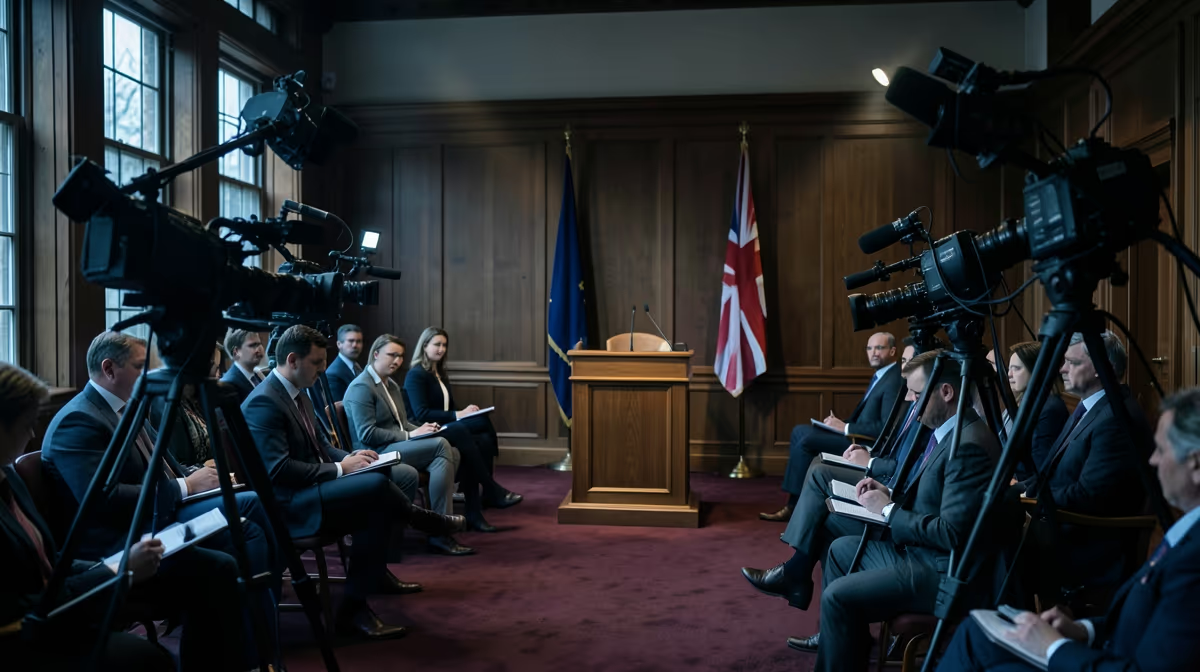
Internal party debates rarely trigger immediate regulatory intervention, yet a single conference resolution has now drawn national scrutiny and fractured municipal alliances across the United Kingdom. Britain’s equality watchdog has officially written to the Green Party leadership following the passage of an internal motion that defines Zionism as racism, igniting fierce political friction and exposing deep ideological divides within the organization.
The controversial Green Party Zionism motion has generated severe national fallout, testing the boundaries between internal democratic resolutions, protected speech, and institutional equality standards. At the center of the dispute is an escalating confrontation between party leadership, external regulators, and political partners in local government.
The intervention by Britain's equality watchdog underscores how internal conference motions can trigger severe regulatory scrutiny and dismantle local government coalitions.
Watchdog Scrutiny and the Roots of the Dispute
The formal correspondence from the Equality and Human Rights Commission marks a decisive escalation in the dispute surrounding the Green Party conference resolution. By initiating direct contact with party officials, the equality watchdog has focused national attention on whether the organization's policy positions comply with legal and ethical standards governing discrimination and antisemitism.
The controversy originated from an internal conference motion that categorized Zionism as racism. This characterization immediately drew sharp rebukes from political opponents, civil liberties observers, and equality monitors. The primary root cause of the confrontation lies in escalating ideological polarization within British political organizations over how Zionism and Middle Eastern foreign policy should be defined in party rulebooks. When conference delegates adopted the language as formal party stance, they set off an immediate conflict with national equality overseers who monitor political bodies for compliance with discrimination standards.
For the Green Party, the intervention presents a complex governance challenge. The watchdog’s letter demands institutional clarity regarding how such motions are formulated, how minority groups are protected from discriminatory rhetoric, and how the party intends to address accusations of prejudice within its membership structures.
Internal Defiance and Zack Polanski’s Stance
Despite the formal intervention from the equality watchdog and mounting public pressure, key figures within the Green Party have signaled an uncompromising defense of the conference decision. Zack Polanski, a prominent senior figure within the party, has publicly insisted that the policy will remain entirely intact.
During a widely monitored broadcast appearance with Laura Kuenssberg, Polanski confirmed that the party's "Zionism is racism" motion will not be overturned. Addressing the escalating row directly, Polanski maintained that democratic decisions approved by conference delegates represent party policy and cannot simply be discarded due to external pushback.
The Green Party's controversial motion will not be overturned despite external pressure, Zack Polanski confirmed in national broadcast remarks.
This refusal to rescind the resolution has carried severe political repercussions for Polanski himself. Recent survey data indicates that Zack Polanski’s poll approval ratings have plummeted to a new low as the controversy dominates headlines. The leadership's resolute defense has positioned the Greens in direct opposition to mainstream regulatory guidance and amplified accusations that the party is failing to grasp the gravity of the watchdog's inquiries.
Safety Concerns and Threats Against Party Members
Beyond the high-level policy exchanges and polling downturns, the controversy has exacted a direct personal toll on party members involved in the debate. Reports have confirmed that the Green Party member responsible for introducing the anti-Zionism motion has received death threats.
The emergence of violent threats highlights the intense hostility surrounding public discourse on foreign policy and Middle Eastern affairs within UK politics. The debate has rapidly shifted from internal party procedural rooms to an environment marked by genuine safety risks for individual political actors.
Party officials have been forced to confront both the security implications for their members and the toxic environment that has developed since the motion's adoption. As law enforcement and party security teams assess the threats directed at the motion's proposer, the episode demonstrates the perilous personal fallout that can accompany polarising foreign policy debates inside British political parties.
Municipal Fractures: Labour Councils Issue Ultimatums
The national dispute has produced immediate, tangible consequences for local administration throughout the United Kingdom. Labour councils across the country have been instructed to terminate cooperative working agreements with Green Party representatives who refuse to publicly condemn the "Zionism is racism" resolution.
In numerous local authorities, joint governance arrangements and informal pacts between Labour and the Greens have provided working majorities to pass local legislation, balance municipal budgets, and oversee public services. Those agreements are now actively collapsing under national party directives.
- Labour council leaders have received explicit instructions to break alliances with any Green councilor backing the motion.
- Green Party representatives face strict ultimatums to explicitly disavow the conference resolution or lose committee posts and council partnerships.
- Administrative friction at the local council level threatens policy continuity, potentially disrupting localized funding decisions and cross-party economic cooperation.
The fracturing of these relationships illustrates how foreign policy resolutions can destabilize domestic local governance. The ultimatum issued to Labour council groups places immense strain on individual Green councilors, who find themselves caught between defending internal conference resolutions and safeguarding their governing roles within their local communities.
Ideological Polarization and the Historical Context
The current row over the Green Party Zionism motion reflects deeper, recurring fissures within British politics. Tensions between progressive political activism, international solidarity movements, and official definitions of antisemitism have previously destabilized major political parties across the UK.
Analysts have drawn direct historical parallels between the current Green Party crisis and the intense disciplinary and ideological battles faced by British political parties during the late 2010s regarding the adoption of the International Holocaust Remembrance Alliance working definition of antisemitism. Similar to those earlier episodes, the current debate revolves around whether harsh institutional characterizations of Zionism bleed into discrimination against Jewish communities.
Furthermore, domestic battles over Middle Eastern policy flashpoints frequently generate political exploitation. Analysts note that opposing political forces are actively leveraging the Green Party’s internal ideological divides to break up fragile local governing coalitions and consolidate distinct voter blocs ahead of upcoming electoral contests. What began as a delegate vote on international policy has transformed into a strategic weapon in domestic electoral warfare.
Projected Developments and Governance Fallout
As the Green Party confronts simultaneous regulatory, political, and security pressures, the trajectory of the crisis points toward sustained instability across multiple fronts.
Over the coming 24 hours, media commentary and political debate are expected to remain focused on Zack Polanski’s categorical refusal to overturn the motion, alongside continuing fallout from his declining approval ratings. Across the next 72 hours, attention will center on local authority chambers as Labour councils systematically review and potentially dismantle formal agreements with local Green politicians who decline to denounce the measure.
Expert predictions suggest heightened political friction between Green Party leadership and local authorities, accompanied by deepening scrutiny from equality regulators investigating the party's internal governance.
In a best-case scenario, constructive engagement between the equality watchdog and Green Party officials could yield clear policy guidance, de-escalate tensions across municipal bodies, and establish robust protection measures for threatened members. Conversely, the worst-case scenario points toward widespread breakdown of local council alliances, protracted regulatory confrontation, further deterioration of public approval ratings, and heightened physical danger for individuals at the center of the dispute.
Frequently Asked Questions
Why did the equality watchdog write to the Green Party?
The equality watchdog intervened after the Green Party adopted a controversial internal conference motion characterizing Zionism as racism, prompting scrutiny over how the organization handles discrimination and equality standards.
What happened to the Green Party member behind the anti-Zionism motion?
The Green Party member responsible for drafting and introducing the anti-Zionism motion has reportedly received death threats amid the escalating political backlash.
How has Zack Polanski's approval rating been affected by the row?
Zack Polanski’s poll approval ratings dropped to a new low following the public controversy and his defense of the conference motion.
Will the Green Party's 'Zionism is racism' motion be overturned?
Zack Polanski confirmed during a national television interview that the Green Party's "Zionism is racism" motion will not be overturned.
How are Labour councils responding to the Green Party's policy?
Labour councils have been instructed to end joint working agreements and political pacts with Green representatives who refuse to condemn the policy.
What are the broader political consequences of the Green Party motion?
The motion has triggered local council coalition collapses, regulatory inquiries from the equality watchdog, declining public approval for party leaders, and severe personal security risks for members.
Conclusion
The intervention by Britain's equality watchdog has elevated an internal Green Party resolution into a national political crisis. With Zack Polanski confirming that the "Zionism is racism" motion will not be rescinded, the party faces a protracted standoff with regulatory authorities and political counterparts.
As Labour councils proceed with dissolving collaborative agreements and security concerns persist for targeted members, the Green Party must navigate deep internal polarization while attempting to stabilize its broader role in British governance.
Sources
- Equality watchdog writes to Greens over 'Zionism is racism' motion — BBC
- UK Green member behind anti-Zionism motion ‘receives death threats’ — Al Jazeera
- Zack Polanski’s poll approval ratings hit new low amid ‘Zionism is racism’ row — The Independent
- Burnham is Attacking Local Councils to Defend Israel — Tribunemag.co.uk
- Green Party's 'Zionism is racism' motion will not be overturned, Zack Polanski tells Kuenssberg — BBC
- Labour councils told to end agreements with Greens who do not condemn ‘Zionism is racism’ policy — The Guardian


.webp)