
Nobel Prize in Chemistry Awarded to Henri Kagan and Kenso Soai for a Groundbreaking Discovery
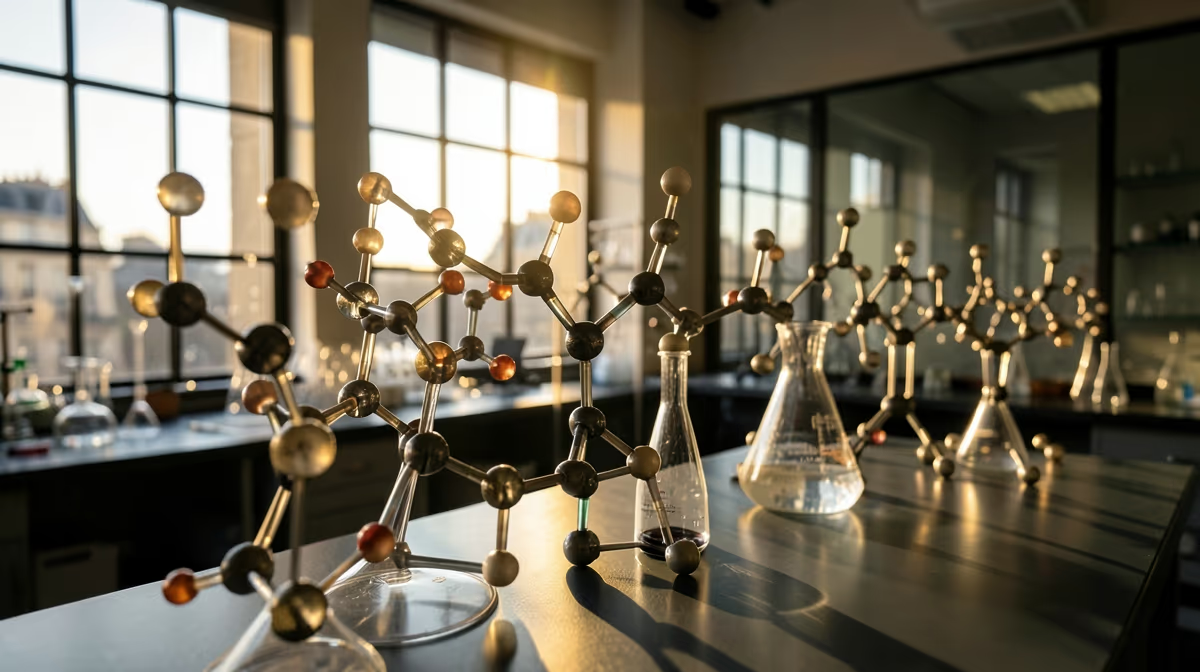
The ability to mirror the building blocks of life with surgical precision has long been one of chemistry's most elusive challenges. On October 7, 2026, the scientific world paused as the ultimate recognition was bestowed upon two individuals who mastered this molecular mirror-image dance. The prestigious Nobel Prize in Chemistry Henri Kagan Kenso Soai announcement has captured global attention, highlighting decades of dedication to molecular science and the complex world of asymmetry. This award recognizes the monumental contributions of France’s Henri Kagan and Japan’s Kenso Soai, whose work has fundamentally changed how scientists approach chemical synthesis, helping shape modern chemical research for the future.
By providing researchers around the world with powerful new tools to build complex molecules safely, efficiently, and with high precision, Kagan and Soai have addressed the critical importance of creating specific molecular structures. Their discoveries are not merely academic; they are the foundation upon which modern drug safety and advanced material science are built. As the global scientific community celebrates this announcement, the focus remains on how these two pioneers turned the abstract concept of chirality into a transformative industrial reality.
The 2026 Nobel Prize in Chemistry honors Henri Kagan and Kenso Soai for pioneering foundational breakthroughs in asymmetric catalysis and chiral amplification, enabling the selective synthesis of single-enantiomer molecules that have revolutionized the global pharmaceutical and chemical industries.
Pioneering Contributions of Henri Kagan and Kenso Soai
The foundational breakthroughs in asymmetric catalysis achieved by Henri Kagan and Kenso Soai enabled the selective synthesis of single-enantiomer molecules, revolutionizing molecular science and industrial chemical production. At the heart of their work is the concept of molecular chirality—the idea that certain molecules exist in two forms that are mirror images of each other, much like a left and right hand. In many cases, only one of these "hands" is beneficial in medicine, while the other can be inactive or even harmful.
Henri Kagan, representing France, and Kenso Soai, representing Japan, share this year's high honor for their pioneering work that spans several decades. Kagan is widely recognized for his early research on asymmetric catalysis, which allowed chemists to favor the production of one mirror-image molecule over another. Kenso Soai further expanded the field through his discovery of chiral amplification, a process where a small amount of a chiral substance can act as a catalyst to produce much larger quantities of itself, effectively "amplifying" the desired molecular structure.
The Impact of Asymmetric Synthesis on Modern Chemistry
The research conducted by these two laureates has provided the bedrock for modern stereochemistry. Asymmetric synthesis forms the essential framework of modern pharmaceutical manufacturing, allowing companies to produce purer drugs with higher efficacy and fewer side effects. This shift has significantly altered global healthcare economics by streamlining the production of complex treatments.
- Catalytic Asymmetric Reactions: These allow for the creation of specific molecular versions without producing unwanted byproducts.
- Molecular Chirality: Understanding the "handedness" of molecules is vital for ensuring biological compatibility in new treatments.
- Chiral Amplification: Soai’s work demonstrated how molecular structures could essentially self-replicate their asymmetry, a discovery with deep implications for the origins of life.
The Global and Economic Implications
Beyond the laboratory, the commercial scaling of catalytic asymmetry heavily influences agrochemical development and advanced material sciences. It quietly dictates supply chain efficiencies in high-value manufacturing sectors, where the precision of a molecule can determine the success of a product. The Nobel Prize remains one of the highest accolades in science, celebrating achievements that fundamentally alter our understanding of chemical processes.
The announcement was widely covered by global media organizations on October 7, 2026, including The New York Times, DW.com, France 24, and NBC News. The recognition of these two scientists underscores a shifting landscape in scientific achievement, where long-term dedication to fundamental research eventually yields massive industrial and economic dividends.
Economic and Industrial Transformation
The economic angle of this discovery is profound. By allowing for the production of single-enantiomer molecules, the pharmaceutical industry has been able to move away from "racemic mixtures"—products containing both mirror-image versions of a molecule—which often required higher dosages and carried higher risks of side effects.
| Impact Area | Specific Contribution of Kagan and Soai |
|---|---|
| **Pharmaceuticals** | Production of purer, more effective drugs with reduced side effects. |
| **Agrochemicals** | Development of targeted pesticides and fertilizers with higher precision. |
| **Material Science** | Creation of advanced materials with specific molecular orientations. |
| **Manufacturing** | Increased supply chain efficiency through reduced waste in synthesis. |
Geopolitical Soft Power and National Prestige
The 2026 award highlights a significant distribution of high-tech soft power between Western Europe and East Asia. Scientific funding and national prestige take center stage as France and Japan celebrate their respective laureates, reinforcing the importance of long-term state support for fundamental research.
This year's prize highlights the critical importance of creating specific molecular structures in chemistry, providing researchers with the tools to build complex molecules safely and efficiently.
The collaboration and mutual influence between Kagan’s Western European research traditions and Soai’s East Asian breakthroughs emphasize the strength of collaborative global scientific networks. This recognition is expected to trigger a surge in public interest and a focus on funding directed toward asymmetric synthesis and chiral technology fields pioneered by the laureates.
Historical Parallel: From Pasteur to the Modern Era
The work of Kagan and Soai follows a prestigious lineage of scientific discovery. Analysts point to the historical parallel of the establishment of modern stereochemistry by Louis Pasteur. While Pasteur identified the existence of molecular asymmetry, it was the subsequent development of catalytic methods—culminating in the work of Kagan and Soai—that allowed scientists to control and manipulate that asymmetry for human benefit.
- Pioneering research on asymmetric catalysis conducted by Kagan and Soai over past decades.
- Global adoption of catalytic asymmetry methodologies across pharmaceutical and industrial synthesis.
- Henri Kagan and Kenso Soai officially awarded the Nobel Prize in Chemistry in October 2026.
Future Outlook and Expert Predictions
Analysts and experts expect extensive media coverage and international recognition to continue following the announcement. In the next 24 to 72 hours, academic institutions, scientific communities, and national leaders from France and Japan are expected to release formal congratulatory statements and organize celebratory events recognizing the laureates.
The expert prediction for the field suggests a renewed global attention on fundamental chemical research, which may inspire a new generation of scientists. In the best-case scenario, this recognition will accelerate international funding for stereochemistry projects and further the translation of laboratory discoveries into industrial applications. However, there is a minor risk that the announcement remains largely confined to academic circles with minimal broader public engagement beyond the initial news cycle.
What to Expect Next
The scientific community is now looking toward the upcoming award ceremonies. Following the announcement, Henri Kagan and Kenso Soai will participate in official Nobel Prize ceremonies later in the year. Their recognition is expected to further inspire research and innovation in chemical synthesis worldwide, particularly in the fields of medicine and materials.
- Next 24 Hours: Continued global media coverage and initial statements from the Nobel Foundation.
- Next 72 Hours: Official diplomatic and academic celebrations in Paris and Tokyo.
- Long-term: Potential increases in university enrollment for chemical synthesis programs and a spike in chiral technology patents.
Frequently Asked Questions
Who won the 2026 Nobel Prize in Chemistry?
The 2026 Nobel Prize in Chemistry was jointly awarded to Henri Kagan and Kenso Soai. The announcement recognized their monumental contributions to the field of chemical research.
What did Henri Kagan and Kenso Soai win the Nobel Prize for?
Henri Kagan and Kenso Soai were awarded the Nobel Prize for their pioneering work in chemistry. Their research has significantly advanced our understanding of chemical processes and molecular structures.
Why is the research by Henri Kagan and Kenso Soai important?
Their groundbreaking discoveries matter because they lay the foundation for modern asymmetric synthesis and catalysis. This work has wide-ranging applications in the pharmaceutical industry and the creation of complex molecules.
Which countries are the Nobel laureates Henri Kagan and Kenso Soai from?
Henri Kagan is from France, and Kenso Soai is from Japan. Their joint award highlights international collaboration and the global impact of their scientific achievements.
What is the background of the work done by Henri Kagan and Kenso Soai?
Both scientists spent decades conducting foundational research in stereochemistry and chiral amplification. Their decades-long dedication ultimately transformed how chemists approach molecular asymmetry today.
What happens next following the award of the Nobel Prize in Chemistry?
Following the announcement, Henri Kagan and Kenso Soai will participate in official Nobel Prize ceremonies later in the year. Their recognition is expected to further inspire research and innovation in chemical synthesis worldwide.
Conclusion
The awarding of the 2026 Nobel Prize in Chemistry to Henri B. Kagan and Kenso Soai marks a definitive moment for the field of asymmetric synthesis. By bridging the gap between theoretical molecular asymmetry and practical industrial application, these two laureates have provided the tools necessary for the next generation of medical and material breakthroughs. From the laboratories of France to the research institutions of Japan, their work exemplifies the power of long-term scientific inquiry. As the world moves forward, the impact of their discoveries will continue to be felt in every pharmacy, manufacturing plant, and research center that relies on the precise construction of the molecular world. The coming months will see celebratory events and a likely surge in research funding, ensuring that the legacy of Kagan and Soai continues to drive technological and scientific progress.
Sources
- Nobel Prize in Chemistry Is Awarded to Henri Kagan and Kenso Soai — The New York Times
- Breaking | Nobel Chemistry Prize awarded to Henri B. Kagan and Kenso Soai — South China Morning Post
- Nobel Prize in chemistry awarded to Henri Kagan and Kenso Soai — NBC News
- Nobel Prize in Chemistry goes to Henri B. Kagan and Kenso Soai — DW.com
- Henri B. Kagan and Kenso Soai win Nobel Prize in chemistry — The Times of Israel
- Nobel Prize in chemistry jointly awarded to France's Henri Kagan, Japan's Kenso Soai — France 24


.webp)
