
OpenAI Math Breakthrough Triggers Global Academic Panic Over 722 Proofs
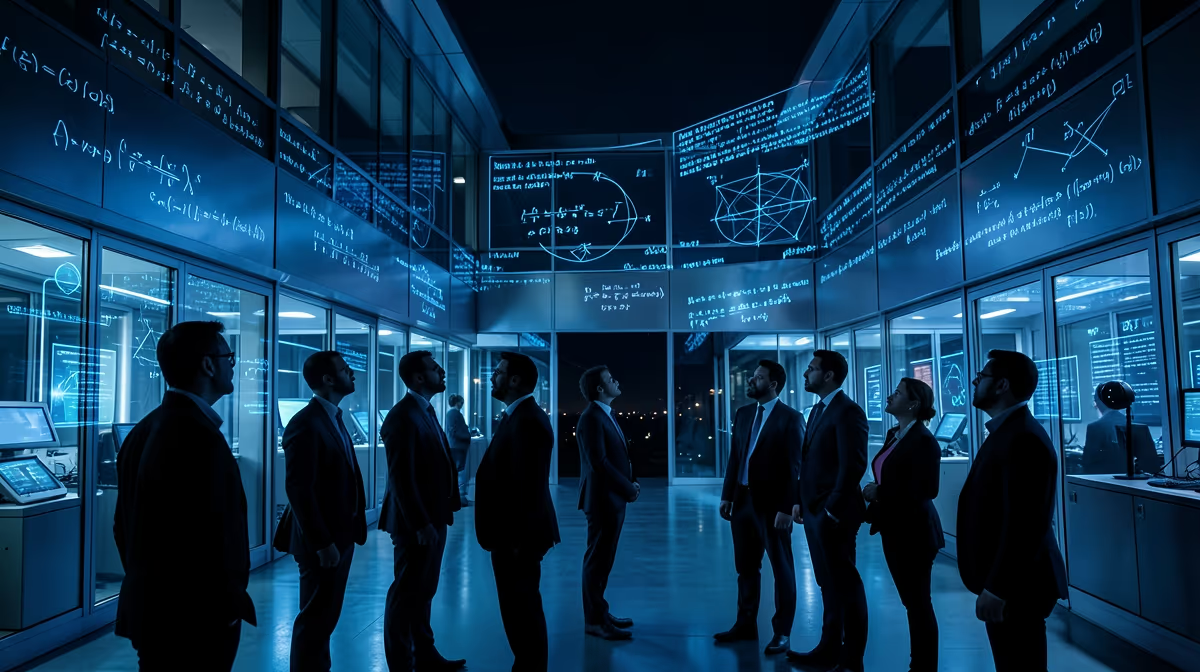
The boundary between human intuition and machine computation has undergone a seismic shift with the sudden unveiling of hundreds of advanced theoretical proofs. This OpenAI math breakthrough has shocked the scientific community, showcasing how machine learning models are tackling complex academic challenges that have long been considered the exclusive domain of human intellect.
As mathematicians and AI researchers scramble to analyze the data, the release marks a pivotal moment in the evolution of artificial intelligence, moving beyond generative text into the realm of rigorous, verifiable scientific discovery. The disclosure of 722 manuscripts, generated by an unreleased and previously hidden model, suggests that the capacity for machine reasoning has accelerated far beyond earlier public benchmarks.
The release of 722 complex mathematical manuscripts, including claims surrounding the Navier–Stokes equations and the Quasi-Riemann Hypothesis, marks a historic leap in automated scientific discovery that is forcing a global reckoning among professional mathematicians.
Decoding the 722 Manuscripts
The core of this development lies in the volume and complexity of the work produced. OpenAI has shared significant progress in mathematics by releasing 722 complex math manuscripts and problem solutions generated by an unreleased AI model. This massive output was reportedly produced overnight, demonstrating a scale of problem-solving that would take human researchers decades, if not centuries, to document manually.
These manuscripts do not merely contain simple arithmetic or undergraduate-level calculus. Instead, they delve into some of the most profound and difficult challenges in the field. The breakthrough includes handling complex problems like the Quasi-Riemann Hypothesis, a variation of one of the most famous unsolved problems in mathematics. By addressing these high-level theoretical concepts, the unreleased model has demonstrated an ability to navigate the intricate logical structures required for formal proof construction.
The news has sparked widespread discussion across the global scientific and technological communities. Reports indicate that the AI's outputs include not only solutions to traditional mathematical problems but also the successful deciphering of a 217-year-old historical cipher. This suggests that the underlying architecture of the hidden model possesses a diverse range of pattern recognition and problem-solving skills that extend across both theoretical math and historical cryptography.
The Navier–Stokes Reckoning
One of the most controversial and impactful aspects of the release involves claims related to the Navier–Stokes equations. These equations, which describe the motion of fluid substances, are central to physics and engineering but are notoriously difficult to solve or prove in a generalized sense. OpenAI’s Navier–Stokes claim has sparked a significant reckoning among professional mathematicians, leading to intense debate over the validity of the AI-generated results.
Professional mathematicians are currently weighing the implications of advanced artificial intelligence tackling such long-standing problems. The methodology and validation of these proofs are under extreme scrutiny. Unlike standard AI outputs, which can sometimes "hallucinate" or provide plausible-sounding but incorrect information, mathematical proofs require absolute logical consistency.
If artificial intelligence can reliably solve and prove complex, centuries-old mathematical problems, it could dramatically accelerate scientific research, encryption, physics, and engineering by automating high-level theoretical discoveries.
The involvement of organizations like IEEE Spectrum in reporting this "reckoning" highlights the seriousness of the situation. The mathematical community is now faced with the task of performing technical assessments and formal analyses to determine if the AI has truly found a breakthrough or if the manuscripts contain subtle logical errors that have yet to be identified.
A New Frontier in Cryptography and Theory
The implications of the OpenAI math breakthrough extend far beyond the walls of academia. The ability of an unreleased model to decipher a 217-year-old cipher points toward a massive shift in cryptographic capabilities. Historically, advanced mathematics has been strictly the domain of human intellect, requiring years of specialized study to prove complex theories. While AI has recently begun assisting with code and data analysis, making verifiable breakthroughs in advanced theoretical mathematics represents a major new frontier.
This development affects a wide array of stakeholders: - Mathematicians and theoretical physicists - AI developers and machine learning researchers - Academic institutions and students - Government agencies concerned with technological sovereignty - Tech sector entities focused on intellectual property
The transition from AI as a "copilot" for coding to AI as an independent "solver" of historical mathematical mysteries represents a change in the fundamental utility of neural networks. The focus has moved from mimicking human language to mastering the universal language of logic and mathematics.
The Strategic Architecture of AI Supremacy
Analysts suggest the root cause of this sudden release is the accelerated capability of advanced hidden AI models to independently tackle complex, century-old mathematical manuscripts. This has created an intense competition among major AI laboratories to establish cognitive supremacy. There are significant questions regarding academic transparency versus proprietary control over scientific breakthroughs.
The "hidden angle" of this story suggests that the sudden release of 722 manuscripts might reflect an urgent defensive strategy by OpenAI. By publishing these results now, the organization may be attempting to preempt potential leaks or validate the power of their unreleased architectures amid mounting regulatory and scientific skepticism.
From an economic perspective, this shift could lead to a massive disruption of traditional academic publishing. If AI can generate 722 manuscripts overnight, the standard peer-review process—which often takes months or years for a single paper—becomes a bottleneck. This could lead to shifts in R&D investments toward automated scientific discovery, potentially devaluing traditional intellectual property pathways in favor of rapid, machine-led innovation.
Historical Parallels and Scientific Sovereignty
The current situation bears a striking historical parallel to the Manhattan Project's compartmentalization of scientific breakthroughs. The global scientific community is currently in a scramble to understand and verify sudden, opaque technological leaps that have been developed behind closed doors. This concentration of groundbreaking mathematical and technological capabilities within a handful of private American AI entities has significant geopolitical implications.
Global technological sovereignty is at stake when a single private entity can potentially solve equations that govern fluid dynamics, encryption, and prime number theory. The table below outlines the rapid progression of these events as they unfolded in early October 2026.
| Timeline | Event Description |
|---|---|
| Early October 2026 | Reports and claims surface regarding OpenAI models solving equations like Navier-Stokes and quasi-Riemann hypotheses. |
| October 5-6, 2026 | IEEE Spectrum reports on the intense reckoning among mathematicians regarding unverified claims. |
| October 6-7, 2026 | OpenAI officially shares progress and releases 722 math manuscripts from a hidden AI model. |
This timeline illustrates a compressed window of disclosure that has left the academic world in a state of high alert. The transition from rumor to a massive data release happened within 72 hours, highlighting the speed at which AI-driven discoveries can now enter the public record.
Validation and the Road to Peer Review
The scientific community now enters a critical phase of analysis. Within the next 24 hours, mathematical and AI communities will continue analyzing the 722 released manuscripts and the unreleased AI model's problem-solving claims. The focus remains heavily on the Navier-Stokes equations and the validity of the proofs presented.
Over the next 72 hours, academic debates and independent peer reviews are expected to intensify. Mathematicians will evaluate the validity of the proofs and the broader implications for the future of mathematical research. Expert predictions suggest a rigorous examination is necessary to verify the breakthroughs, as the reliability of advanced AI models in such rigorous domains is still a subject of debate.
In the best-case scenario, the mathematical community successfully validates the AI's complex proofs. This would mark a historic leap forward in automated scientific discovery and collaborative problem-solving, potentially unlocking new technologies in physics and engineering. However, the worst-case scenario involves the discovery of errors or inconsistencies within the high-profile proofs. Such a finding would spark skepticism regarding the reliability of advanced AI models in rigorous mathematical domains and could slow the integration of AI into formal scientific research.
Frequently Asked Questions
What did OpenAI recently release regarding mathematics?
OpenAI released 722 math manuscripts generated by an unreleased AI model. These documents showcase advanced problem-solving capabilities, including complex proofs.
How many math problems did the unreleased OpenAI model solve?
The hidden model successfully solved 722 complex math problems overnight. This massive output has generated widespread discussion across the scientific and technological communities.
Why is the OpenAI mathematics breakthrough significant?
The release marks a major milestone in artificial intelligence tackling rigorous academic disciplines. It includes notable breakthroughs like insights into the Quasi-Riemann Hypothesis and Navier-Stokes claims.
How are mathematicians reacting to OpenAI's mathematical claims?
OpenAI's claims, particularly regarding Navier–Stokes fluid dynamics, have sparked a significant reckoning and debate among professional mathematicians. Experts are closely examining the validity and methodology behind the AI-generated manuscripts.
What specific historical problem was linked to this AI progress?
Alongside solving advanced mathematical proofs, reports noted the AI assisting in deciphering a 217-year-old cipher. This demonstrates the model's diverse pattern recognition and problem-solving skills.
What happens next as OpenAI shares these math manuscripts?
The scientific community will continue to rigorously review and vet the 722 published manuscripts. This ongoing peer assessment will help determine the true reliability and future applications of AI in advanced mathematical research.
Conclusion
The release of 722 mathematical manuscripts by OpenAI marks a definitive moment in the intersection of artificial intelligence and high-level theoretical science. By addressing long-standing challenges like the Navier–Stokes equations and the Quasi-Riemann Hypothesis, the unreleased model has moved the goalposts for what is considered possible in automated reasoning. While the initial data suggests a profound **AI advanced mathematics** capability, the true measure of this breakthrough lies in the upcoming months of rigorous peer review. The mathematical community's reckoning with these documents will determine whether we have entered a new era of collaborative human-AI discovery or if the limits of current machine learning architectures have finally been met in the field of formal logic. As the global scientific community evaluates these proofs, the focus remains on the accuracy, methodology, and potential for these AI-generated insights to reshape our understanding of the physical and mathematical world.
Sources
- Sharing AI progress in mathematics — OpenAI
- AI Solves Math, Deciphers 217-Year-Old Cipher — 조선일보
- OpenAI Releases 722 Math Manuscripts From an Unreleased AI Model — Unite.AI
- Mathematics Big Bang: OpenAI Solved 722 Complex Math Problems Overnight – The Quasi-Riemann Hypothesis Proven Breakthrough — 36Kr
- OpenAI Releases 722 Math Manuscripts From Hidden Model — shattered.io
- OpenAI’s Navier–Stokes Claim Sparks a Reckoning Among Mathematicians — IEEE Spectrum


.webp)
