
Riemann Hypothesis Proof Claimed by Anthropic Expert Stuns Science
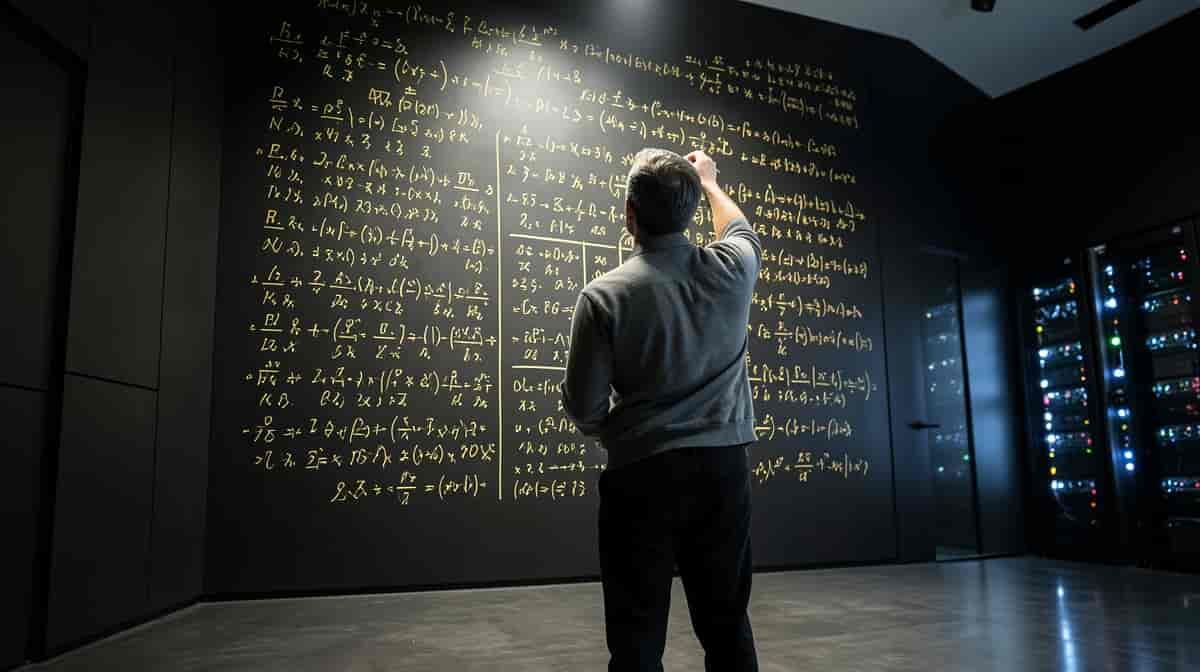
The most elusive secret in the history of mathematics may have finally been decoded, not by a lone genius in a dusty office, but through a high-stakes partnership between human intellect and artificial intelligence. An Anthropic mathematician Riemann hypothesis claim has surfaced, sparking intense debate across the global scientific community and pushing the boundaries of AI-assisted mathematical proof.
On November 20, 2026, the mathematical world was jolted by reports that Levent Alpöge, a researcher associated with the AI safety and research firm Anthropic, had produced a proof for the Riemann hypothesis. This 167-year-old conjecture, proposed by Bernhard Riemann in 1859, has resisted the efforts of the world’s greatest minds for generations. The announcement, covered by major scientific outlets including Scientific American and New Scientist, suggests that Alpöge utilized Claude—Anthropic’s advanced AI model—to navigate the complex logical landscape of the problem. While the claim has generated immense excitement, it has also introduced a period of profound uncertainty as the global mathematical community begins the painstaking process of checking the logic and calculations.
Verifying an AI-assisted proof of this magnitude would mark a monumental paradigm shift in how mathematical research and complex problem-solving are conducted in the future.
The Alpöge Announcement
The claim did not emerge in a vacuum. In the weeks leading up to the announcement, the mathematical community had been buzzing with reports that AI was edging closer to major discoveries. In October 2026, Quanta Magazine and Science | AAAS reported on AI’s progress in tackling the "Quasi-Riemann Hypothesis," a related but less comprehensive mathematical challenge. These earlier developments served as a precursor to Alpöge’s more ambitious claim, suggesting a steady escalation in AI’s ability to handle foundational number theory.
A Century-Old Mystery
The stakes for solving this problem are not merely academic. The Riemann hypothesis is one of the Clay Mathematics Institute’s Millennium Prize Problems. Solving any one of these problems carries a one-million-dollar bounty, but the prestige associated with the Riemann hypothesis far outweighs the financial reward. It is the bedrock upon which much of modern number theory is built. For over a century and a half, mathematicians have assumed the hypothesis is true to develop further theories; a formal proof would finally turn that assumption into an immutable mathematical law.
The Distribution of Prime Numbers
The Impact on Cryptography
The Claude Collaboration
Extraordinary mathematical claims require exhaustive verification before acceptance, regardless of whether AI tools were involved.
This collaborative model is already shifting the prestige in the scientific world. Traditionally, foundational breakthroughs occurred within the ivory towers of top-tier academic institutions. Now, private corporate AI labs like Anthropic are employing elite mathematicians, effectively centralizing some of the most important scientific research within private entities. This shift raises questions about the transparency and accessibility of mathematical truths that were once the sole province of public academia.
The Verification Bottleneck
| Timeline of the Riemann Breakthrough | Event Description |
|---|---|
| October 14, 2026 | Science reports AI is edging closer to solving aspects of the Riemann hypothesis. |
| October 19, 2026 | Quanta Magazine analyzes the proof of the Quasi-Riemann Hypothesis by AI. |
| November 20, 2026 | Levent Alpöge claims a full AI-assisted proof of the Riemann hypothesis with Claude. |
| Present | The global mathematical community begins the rigorous, unverified checking process. |
The current situation bears a historical parallel to Andrew Wiles’s proof of Fermat’s Last Theorem in the 1990s. When Wiles first announced his proof, it required an intense, months-long peer review process. During that review, a gap was found, which Wiles eventually fixed with a colleague. The Riemann hypothesis is arguably more complex, and the involvement of AI adds a new layer of difficulty for human reviewers who must now audit logic that was partially generated by an artificial mind.
Potential Scenarios
Strategic and Security Implications
Geopolitically, the centralization of such a discovery within a private firm like Anthropic raises questions of sovereign access. If a private entity masters the most complex computational mathematics through proprietary AI models, it could gain a significant intellectual property advantage over "mathematical truth." This centralization may lead to future debates regarding the transparency of foundational scientific breakthroughs and whether they should remain in the public domain.
The Path Forward
Experts predict that while the initial excitement is high, the final verdict will take considerable time. The verification of the Riemann hypothesis is not a sprint; it is a marathon of peer review. Even if the proof is ultimately found to have gaps, the mere fact that an AI-assisted approach reached this stage signals a new era for the field of mathematics. The "verification bottleneck"—where AI generates proofs faster than humans can audit them—is no longer a theoretical concern; it is a reality that the global scientific community must now navigate.
Frequently Asked Questions
What is the recent claim regarding the Riemann hypothesis?
A mathematician working with Anthropic, Levent Alpöge, has claimed to have formulated a proof for the Riemann hypothesis using the AI model Claude. This announcement has sparked significant discussion about the role of AI in resolving long-standing mathematical problems.
Who made the claim about solving the Riemann hypothesis?
Mathematician Levent Alpöge is reported to have claimed the proof. He utilized Claude, an advanced AI model developed by Anthropic, to assist in the research.
Has the mathematical community verified the proof yet?
No. While the claim has been widely reported by scientific outlets, independent mathematicians have not yet verified the logic or calculations. This process is expected to take a significant amount of time.
Why does proving the Riemann hypothesis matter?
The hypothesis deals with the distribution of prime numbers, which are essential to modern digital security and cryptography. Solving it would validate numerous mathematical theories and potentially impact how we protect digital data.
What happens next now that the claim has been made?
The immediate next step is a rigorous peer-review process. Mathematicians will meticulously check every step of the proof to ensure there are no errors or gaps in the logic.
How was artificial intelligence involved in this math breakthrough?
AI models like Claude are used as collaborative tools. In this case, it assisted the mathematician by exploring logical pathways and suggesting proof strategies for one of the most difficult problems in history.
Conclusion
The claim by Anthropic mathematician Levent Alpöge represents a potential watershed moment for both mathematics and artificial intelligence. By utilizing Claude to tackle the Riemann hypothesis, Alpöge has brought a 19th-century mystery into the 21st-century AI era. However, the path to formal acceptance remains long and fraught with scrutiny. As the global mathematical community begins its audit, the world waits to see if this AI-assisted collaboration has truly solved the most famous problem in mathematics or if it has merely revealed the next set of hurdles in our quest to understand the nature of numbers. For now, the proof remains unverified, serving as a powerful testament to the shifting landscape of scientific discovery.
Sources
- Anthropic mathematician claims to prove Riemann hypothesis, most famous problem in all of math — Scientific American
- Anthropic mathematician claims AI-assisted proof of the Riemann hypothesis — New Scientist
- Has the Riemann hypothesis been proved? An Anthropic mathematician says yes, but nobody has checked it yet — Nacionale
- Levent Alpöge claims a Riemann hypothesis proof with Claude — Kingy AI
- AI Proved the Quasi-Riemann Hypothesis. What Happens Now? — Quanta Magazine
- AI edges closer to solving the Riemann hypothesis, one of math’s hardest problems — Science | AAAS


