
M5 Closure Triggers Major Travel Chaos Across the South West
Introduction
The structural integrity of the nation's primary arterial routes is once again under the microscope as a significant event halts transit across the South West of England. Drivers are facing significant delays following an m5 closure, with live updates tracking the impact on local infrastructure resilience and exposing the fragility of a network stretched to its capacity.
What Happened
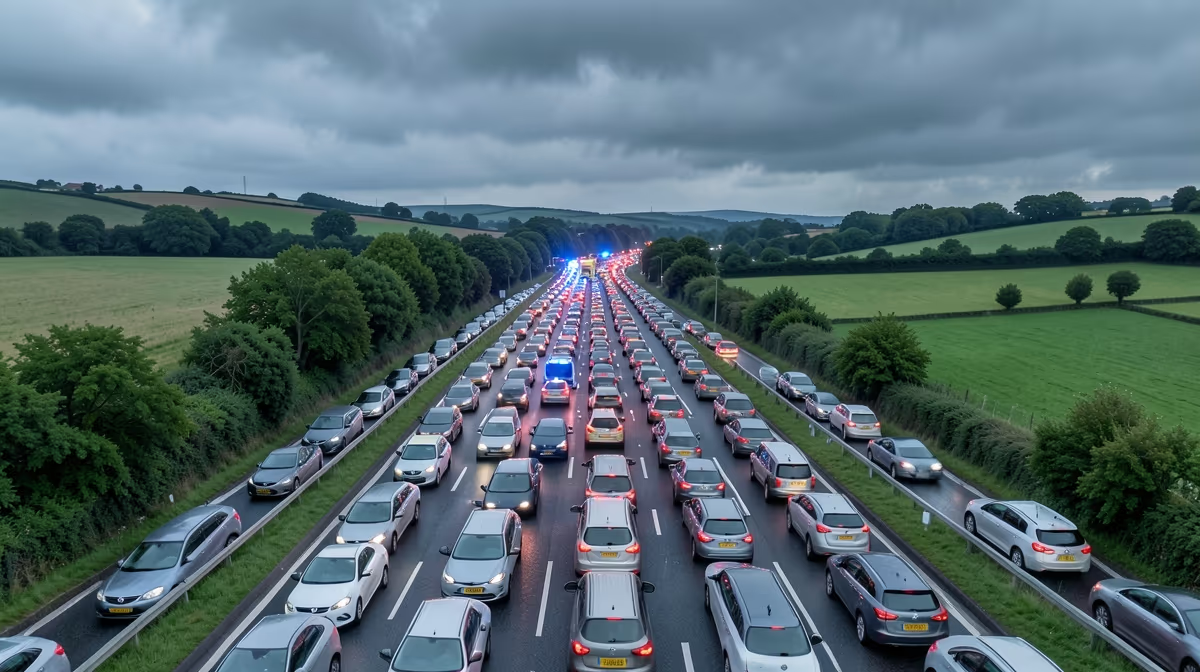
A serious collision has forced the full closure of the M5 motorway in both directions between Junction 11 at Cheltenham and Junction 12 at Gloucester, causing significant travel disruption for commuters this morning. National Highways confirmed that emergency services, including police and paramedics, were called to the scene shortly after 6:00 am following reports of a major multi-vehicle incident. Traffic officers are currently managing the scene while accident investigators examine the road surface and wreckage.
Commuters are being advised to avoid the area entirely, as local diversion routes are becoming heavily congested. The closure is expected to remain in place throughout the morning peak period, with motorists warned to expect delays of at least 60 minutes on the approaches to the incident. Public transport services and heavy goods vehicles are being redirected via the A38, though local authorities report that these secondary routes are struggling to cope with the sudden influx of diverted traffic. A spokesperson for Gloucestershire Police stated that they are currently working to clear the carriageway and establish the circumstances surrounding the collision, while urging drivers to follow the clearly signed diversions and thanking the public for their patience while crews work in difficult conditions.
Key Facts
The M5 is closed in both directions between key junctions following a serious incident. Emergency services, including police and paramedics, are currently on-site. National Highways has implemented official diversion routes for stranded motorists, directing traffic to local secondary roads. Significant travel delays are expected throughout the day as traffic spills into local areas, and drivers are urged to check live traffic updates before setting off. Confirmed verified facts currently include the full closure between J11 and J12, the presence of emergency investigation teams, and severe congestion reported on surrounding A-roads.
Why It Matters
The M5 serves as the primary gateway to the South West, meaning any closure causes a domino effect that disrupts logistics, public transport, and local business deliveries. For thousands of commuters and holidaymakers, this means lost time and increased frustration, while the sudden influx of diverted heavy traffic can bring smaller towns and villages near the motorway to a standstill. The incident highlights the vulnerability of the region, where logistical chains for perishable goods and the tourism sector are highly dependent on the flow of this specific route.
Expert Analysis
The root cause of this disruption is often linked to a critical failure in aging post-war infrastructure maintenance, combined with high-density freight reliance causing structural fatigue. The M5 was constructed in the 1960s and 70s as a primary arterial spine, but the 2010s to 2023 saw chronic underinvestment leading to an increased reliance on temporary patch-and-repair work rather than systemic overhaul. A hidden factor complicating this issue is the transition to electric heavy goods vehicles, which are placing unforeseen weight and charging infrastructure demands on legacy road networks not originally built for such loads. Historical parallels can be drawn to the 1970s motorway infrastructure expansion crises, which necessitated significant shifts in regional industrial planning and eventual road-to-rail policy debates.
Political And Geopolitical Implications
The situation brings to light a perceived Westminster-West Country divide, where transport funding is often viewed as London-centric, potentially exacerbating regional alienation and anti-incumbent sentiment among local populations. On a broader scale, the fragility of these domestic trade routes signals a vulnerability in supply chain resilience that is increasingly noted by foreign investors and trade partners. The economic angle remains significant, with the threat of inflationary pressure on local perishable goods and a measurable loss of productivity for the regional tourism sector due to these bottlenecks.
What Happens Next
In the next 24 hours, the focus remains on the clearance of emergency vehicles and the completion of initial accident investigation, followed by a phased reopening of lanes. Over the next 72 hours, traffic volume is expected to normalize as HGV backlogs disperse, though minor congestion may persist during peak commuting hours. Expert prediction suggests that localized surface road congestion in surrounding towns will likely return to equilibrium within 48 hours of full reopening. The best-case scenario is a full carriageway reopening with no structural damage to infrastructure, while the worst-case scenario involves a prolonged closure due to fuel spill remediation or major road surface repairs, causing significant regional freight delays.
Frequently Asked Questions
Q: What is an M5 closure?
A: An M5 closure refers to the scheduled traffic management or complete shutdown of the M5 motorway in the UK. These closures are typically implemented to facilitate essential roadworks, structural repairs, or emergency incident management.
Q: How can I check for live M5 closures?
A: You can check for live M5 closures by visiting the official National Highways traffic information website or using their mobile app. Additionally, local news outlets and traffic updates on platforms like X provide real-time reporting on accidents or planned maintenance.
Q: Are there planned M5 closures this weekend?
A: Planned M5 closures vary depending on the maintenance schedule and ongoing construction projects in the region. It is recommended to consult the National Highways Report or Travel sections for specific dates, times, and affected junctions scheduled for the upcoming weekend.
Q: Why is the M5 motorway often closed at night?
A: The M5 is frequently closed at night to minimize disruption to commuters and freight traffic during peak hours. Nighttime closures allow maintenance crews to perform resurfacing, bridge inspections, and safety upgrades in a safer, traffic-free environment.
Q: Where can I find diversion routes during an M5 closure?
A: When the M5 is closed, National Highways typically signposts official diversion routes using clear signage, such as hollow black circles or solid yellow triangles. These routes are designed to redirect traffic through parallel A-roads until drivers can rejoin the motorway further along the route.
Q: Does the M5 closure affect all lanes?
A: Depending on the nature of the work or incident, an M5 closure can either involve a full carriageway shut down or a partial lane closure. Full closures usually occur for major bridge work or severe emergencies, while partial closures are common for minor repairs.
Conclusion
The M5 remains a critical, yet fragile, component of the UK transport network. As emergency services conclude their investigation between Junction 11 and Junction 12, the immediate priority remains the safe restoration of traffic flow. While the road is expected to reopen in a phased manner over the coming hours, the event serves as a reminder of the systemic challenges facing legacy infrastructure in the face of modern logistics demands. Motorists are advised to continue monitoring official channels for updates and to anticipate residual delays as regional traffic patterns stabilize.


.webp)

.webp)

