
Netherlands vs Morocco World Cup Clash Could Redefine 2026 Tournament Dynamics
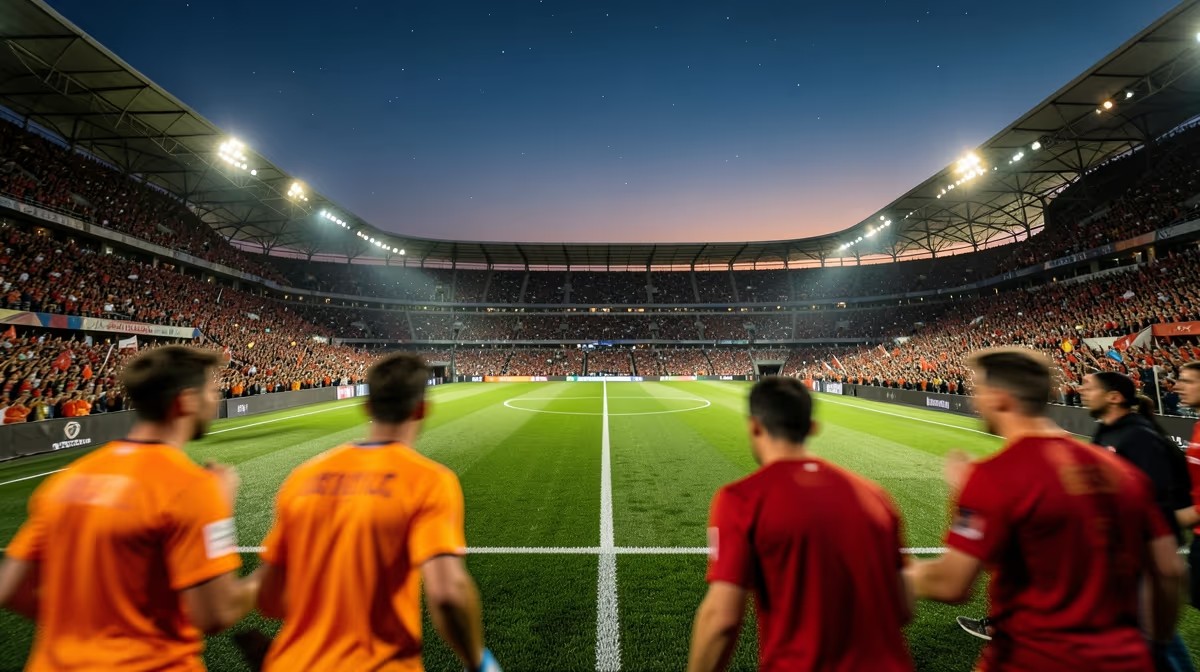
The prospect of a footballing collision between the Netherlands and Morocco at the 2026 tournament creates a unique intersection of tactical elite sports and complex cultural identity. As fans track the evolving landscape of international football, the anticipation for a Netherlands vs Morocco World Cup showdown has intensified, with supporters envisioning a high-stakes fixture that would showcase the technical brilliance of stars like Frenkie de Jong and Achraf Hakimi at the Monterrey stadium.
Historical Context and Footballing Ties
The relationship between Dutch and Moroccan football is deeply rooted in the history of migration that began in the 1960s and 70s. This movement created a permanent Moroccan minority in the Netherlands, fostering a dual identity that is vividly reflected on the pitch. While the two nations have faced each other in various international competitions, their history on the world stage is limited. The most recent high-stakes encounter occurred during the 1994 FIFA World Cup in the United States, where the Netherlands secured a 2-1 victory in a group stage match in Orlando. Dennis Bergkamp and Bryan Roy provided the scoring for the Dutch, while Hassan Nader found the net for Morocco. That victory remains the primary historical reference point for a direct clash in the tournament, though the dynamics of both squads have evolved significantly since that time.
Key Facts and Tactical Landscapes
Modern football fans recognize the Netherlands for its legendary Oranje fan base and its historic influence on tactical structure, often associated with the principles of Total Football. Conversely, Morocco has cemented its status as a powerhouse of African football, achieving a historic milestone in 2022 as the first African team to reach a World Cup semi-final. This rise to prominence has turned their potential meetings into marquee events. The tactical battle in these matchups often features players who compete in the same top-tier European leagues, creating a high level of familiarity with each other’s styles. The clash is characterized by the structured, possession-oriented play of the Dutch against the disciplined defensive organization and creative flair that defines the current Moroccan approach.
The Sociopolitical Dimension
The significance of these matches resonates far beyond the 90 minutes played on the field. For the Moroccan-Dutch diaspora, these encounters serve as a bridge between cultures and a moment of shared pride. However, this connection also brings complex challenges. The intersection of post-colonial identity and diaspora integration remains a central theme, as does the political discourse surrounding dual loyalty. In the Netherlands, public debates regarding national identity and security policies occasionally intersect with football, particularly when massive street celebrations lead to public order concerns. Historical parallels, such as the tensions surrounding the 1998 France-Algeria match, provide a framework for understanding how athletic competition can mirror and sometimes exacerbate underlying sociopolitical fractures.
Geopolitical and Economic Perspectives
Beyond the social fabric, these fixtures touch upon broader interests. Morocco serves as a strategic security partner for the European Union in North Africa, creating a complex backdrop of bilateral trade and geopolitical interests. Meanwhile, the broadcasting rights and international betting markets recognize these matches as high-revenue events, capable of drawing record viewership in both Amsterdam and Rabat. Economic discussions also account for the mobilization of security resources in urban centers, which must be balanced against the cultural significance of the sport. There is a persistent risk that extremist factions may attempt to weaponize such high-profile events, seeking to exploit socioeconomic alienation among younger generations, a reality that security agencies monitor closely.
Anticipating the 2026 Tournament
As focus shifts to the 2026 World Cup, the Monterrey stadium in Mexico is being viewed as a potential host for this highly anticipated face-off. Analysts expect that if the draw pairs these two nations, the match would be treated as a cultural event of the highest order. Experts predict an intense tactical midfield battle, likely featuring heavyweights like Sofyan Amrabat and Cody Gakpo alongside de Jong and Hakimi. The best-case scenario is a high-quality, high-scoring contest that celebrates the positive integration of the Moroccan community within Dutch football. Conversely, there is awareness that partisan behavior could potentially lead to increased social tension in Dutch urban centers, necessitating proactive engagement and security planning.
Frequently Asked Questions
Have the Netherlands and Morocco ever played each other in a FIFA World Cup match?
As of the conclusion of the 2022 FIFA World Cup, the Netherlands and Morocco have never played each other in a tournament match; their 1994 encounter was an official group stage match, but in the context of tournament records, they have not met since.
What is the historical head-to-head record between the Netherlands and Morocco?
The two teams have played a small number of friendly matches throughout their history, characterized by large crowds due to the significant Dutch-Moroccan diaspora.
Did the Netherlands or Morocco reach the semi-finals of the 2022 World Cup?
Morocco made history by becoming the first African nation to reach a World Cup semi-final in 2022. The Netherlands reached the quarter-finals, where they were eliminated by Argentina in a penalty shootout.
Why is there a strong footballing connection between the Netherlands and Morocco?
The connection stems from a large population of Moroccan-Dutch dual citizens. Many professional footballers in the Eredivisie have developed through the Dutch academy system before choosing to represent the Morocco national team.
How did Morocco perform in the 2022 World Cup compared to the Netherlands?
Morocco finished fourth, defeating major teams including Belgium, Spain, and Portugal. The Netherlands finished as quarter-finalists, remaining unbeaten in regulation time throughout the tournament.
Are there many players who have played for both the Netherlands and Morocco?
Many players of Moroccan descent have played youth international football for the Netherlands before committing to the Morocco senior national team, a common path for stars raised in Dutch football.
Conclusion
The possibility of a Netherlands versus Morocco match at the 2026 World Cup remains a topic of intense speculation among football analysts and fans. While historical meetings have been rare, the cultural overlap and the rising competitiveness of both nations ensure that any potential fixture would carry significant weight. As preparations for 2026 continue, the sport community remains focused on the potential for a high-quality tactical battle that highlights the deep, multi-generational ties between these two nations. Future developments will be dictated by the official qualification outcomes and the subsequent tournament draw.


.webp)

.webp)
