
Fashion to Confuse Facial Recognition Is Emerging as a UK Reality
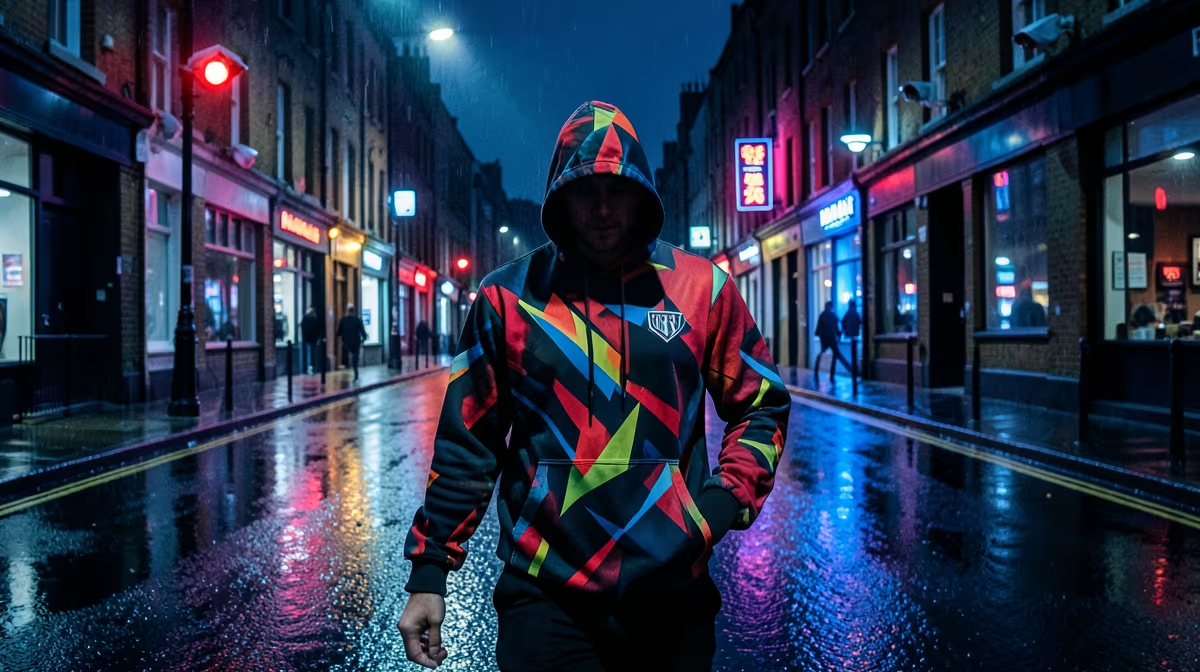
A clandestine arms race is unfolding on British streets, where the traditional boundary between personal expression and digital security is blurring into a complex battleground of fabric and light. As the UK government expands its use of digital surveillance, a new wave of fashion to confuse facial recognition is emerging as a form of protest and protection against the normalization of constant biometric tracking in public life.
The Mechanics of Adversarial Privacy
The core of this movement lies in a concept known as adversarial fashion, which employs visual distortions to deceive machine learning algorithms. Facial recognition systems rely on a set of mathematical markers—such as the distance between eyes, the bridge of the nose, and the contours of the jawline—to create a unique digital profile for every individual in view. By wearing garments that utilize high-contrast patterns, complex geometric shapes, or infrared LED-embedded accessories, individuals can introduce enough noise into the camera's feed to cause system misidentification or total failure.
These tools are not intended to hide a person from other humans, but rather to exploit the specific limitations of computer vision. Techniques range from specialized makeup patterns that disrupt facial landmark detection to hats that blind security sensors. The concept finds its roots in First World War era dazzle camouflage, which was used on ships to confuse rangefinders; modern designers have effectively adapted this logic for the digital age, turning the wearer into a target that is mathematically unreadable to automated surveillance systems.
Regulatory Friction and Public Trust
The expansion of Live Facial Recognition technology in London and other major metropolitan centers has served as the primary catalyst for this shift. With police forces and private retailers increasingly deploying these systems to manage urban spaces and loss prevention, the tension between state-led security and individual privacy has reached a breaking point.
The Biometrics and Surveillance Camera Commissioner has repeatedly highlighted significant gaps in the current UK regulatory framework, noting that the absence of clear, legally binding standards for biometric data collection has left the public in a state of uncertainty. This environment of mistrust has effectively transformed clothing from a commodity into a political statement. Experts suggest that when the public loses faith in how their biometric data is handled, they resort to direct intervention to reclaim their bodily autonomy.
The Surveillance Cat-and-Mouse Game
While activists and designers push for greater digital anonymity, the state apparatus is not static. Law enforcement agencies in the UK have been testing various surveillance strategies, leading to a dynamic environment where advancements in tracking are immediately met with new countermeasures. However, this struggle is not without its limitations.
Industry analysts point out that while these garments can successfully disrupt facial recognition software, they often fail to account for emerging biometric techniques. Gait analysis, which tracks the unique movement patterns of a human body, remains a hurdle that current fashion-based countermeasures cannot address. As the technology behind surveillance becomes more sophisticated, the effectiveness of visual obfuscation tools remains a subject of ongoing debate among privacy researchers and AI engineers.
Future Legislative Challenges
The legal landscape surrounding this trend is currently in a state of flux. While there is no explicit ban on wearing patterns or accessories that interfere with cameras in the UK, the path forward appears increasingly contentious. Legislative friction is considered inevitable as these trends scale. Authorities may soon face pressure to introduce public order laws that mandate identity disclosure in surveillance-heavy zones, potentially criminalizing the use of anti-surveillance gear during public protests.
Experts predict a bifurcated future for this issue. In a best-case scenario, the government establishes a transparent regulatory framework that protects individual privacy while upholding public safety standards through strict algorithmic accountability. Conversely, a worst-case scenario involves total bans on face-obscuring clothing, which could trigger mass civil unrest and widen the ideological rift between the state and digital privacy advocates.
A Global Regulatory Testbed
The United Kingdom is currently acting as a primary testing ground for Western surveillance technologies, making its regulatory decisions highly influential. The international community is closely watching how the British government reconciles its commitment to digital privacy rights with the integration of smart city infrastructure. Because the deployment of these technologies influences global standards for data harvesting and surveillance, the outcomes of current UK legal battles are expected to reverberate across other liberal democracies, setting precedents for how society balances the need for security with the fundamental right to remain anonymous in public.
Frequently Asked Questions
Can fashion really stop facial recognition technology?
Certain designs, often called adversarial fashion, can disrupt facial recognition algorithms by projecting patterns that confuse machine vision. While these methods can successfully prevent basic systems from identifying a face, they are not foolproof against advanced biometric surveillance.
What kind of clothing helps block facial recognition?
Clothing featuring high-contrast patterns, complex geometric shapes, or infrared LEDs can interfere with cameras. These items aim to overwhelm the software by presenting conflicting data, making it difficult for the system to detect or map human facial features.
Is it legal to wear anti-surveillance fashion in the UK?
Generally, it is legal to wear clothing that obscures your face or interferes with cameras in public spaces. However, you must remain mindful of local laws regarding face coverings, such as those that may be enforced during specific police operations or public protests.
Do infrared glasses actually work to hide your identity from cameras?
Infrared glasses emit light invisible to the human eye but very bright to digital camera sensors. This creates a glare that hides your eyes or face from security cameras, effectively causing a white-out effect in the video feed.
What is adversarial fashion?
Adversarial fashion refers to garments designed specifically to deceive artificial intelligence and computer vision systems. These pieces use aesthetic prints that mimic objects or patterns that cause algorithmic errors, making the wearer appear as a non-human entity to the software.
Are face masks still effective against facial recognition?
Yes, standard face masks covering the nose and mouth can be highly effective at obstructing the mapping points used by facial recognition software. Because modern systems rely on specific facial geometry, blocking key areas like the bridge of the nose significantly increases the failure rate of identification.
Conclusion
The rise of adversarial fashion in the UK serves as a barometer for public anxiety surrounding the rapid expansion of biometric surveillance. As developers of surveillance technology continue to refine their detection capabilities, the persistence of anti-surveillance trends highlights a growing demand for legislative clarity and digital rights protections. Moving forward, the relationship between citizen anonymity and public security will likely be defined by the outcome of ongoing legal challenges and the potential for a new, codified regulatory framework. For now, the streets of British cities remain a site of active negotiation, where the choice of attire is increasingly viewed as a crucial tool for reclaiming civil liberties.


.webp)


.webp)
