
FIFA World Cup 2026 Plans Trigger Massive Global Economic Shift
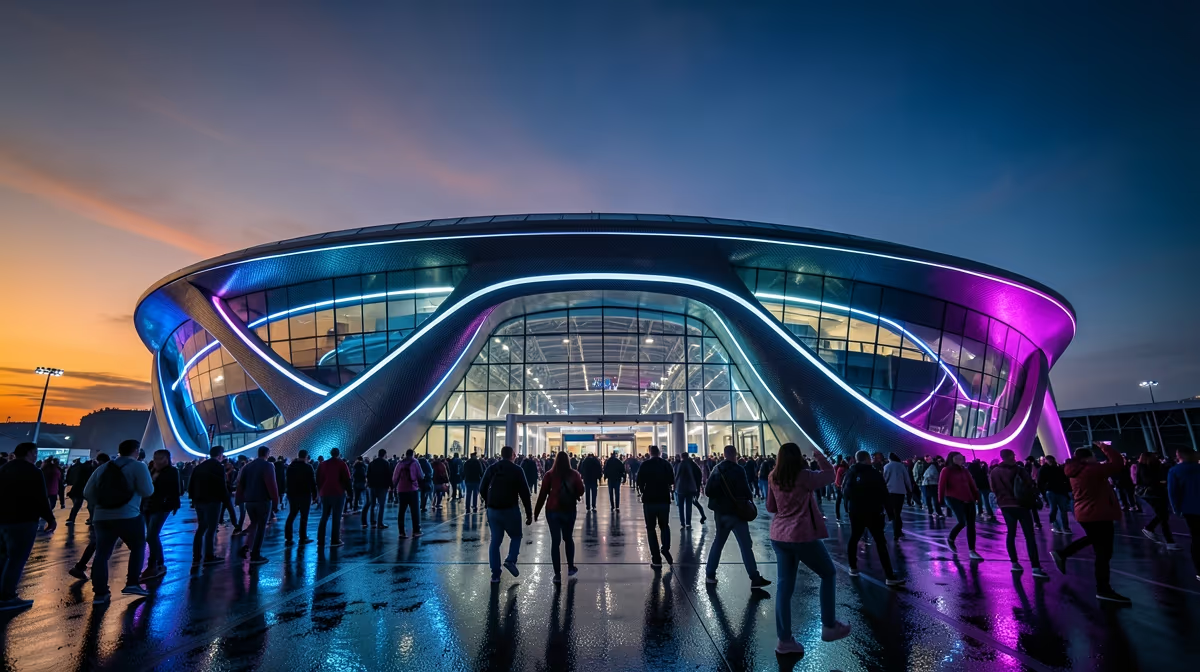
The landscape of international sport is shifting toward a model of unprecedented scale, testing the limits of infrastructure and cross-border cooperation in a way never before attempted. As preparations accelerate for the FIFA World Cup 2026, global stakeholders are analyzing the unprecedented scale of the upcoming tournament. From the projected FIFA World Cup 2026 economic impact to shifts in FIFA governance, this expanded 48-team event is set to redefine international sports hosting by moving away from the traditional single-nation model in favor of a sprawling, continent-wide collaboration.
The Mechanics of an Expanded Tournament
The 2026 tournament, scheduled to take place from June 11 to July 19, 2026, represents a fundamental pivot in the sport’s history. For the first time, 48 national teams will compete for the title, a significant increase from the previous 32-team format. This expansion necessitates a complex tournament structure consisting of 12 groups of four teams each, followed by a new round-of-32 knockout stage. In total, 104 matches will be played across 16 host cities: Atlanta, Boston, Dallas, Guadalajara, Houston, Kansas City, Los Angeles, Mexico City, Miami, Monterrey, New York/New Jersey, Philadelphia, San Francisco, Seattle, Toronto, and Vancouver.
This format change is not merely a quantitative increase in games; it is an organizational evolution designed to maximize commercial scalability and mitigate the infrastructure risks associated with hosting such a massive event. By spreading the competition across the United States, Canada, and Mexico, FIFA is utilizing existing stadiums and transport networks, aiming to reach a wider audience while testing the efficacy of a multi-country logistical framework.
Geopolitical and Economic Drivers
The decision to host the event across three nations is rooted in a strategic move to solidify North American influence within the global sports ecosystem. Analysts point to the exertion of soft power by the United States, Mexico, and Canada as a means to counter the rising influence of Middle Eastern sovereign wealth funds in global athletics. By functioning as a mega-region, these countries are creating a template for future collaborative alliances, sharing the fiscal burden while concentrating broadcasting and hospitality revenue.
The economic angle is equally ambitious. With 104 matches scheduled, the tournament is projected to generate billions in tourism, hospitality, and local spending. However, this revenue is balanced against the high costs of integrating security protocols and logistical systems across three distinct national jurisdictions. The expansion reflects a calculated risk: moving from a singular host nation model to a complex, multi-state operation to maintain the tournament's status as the world's most lucrative sporting event.
The Evolving Regulatory Landscape
The lead-up to 2026 has prompted significant shifts in how international football is governed. FIFA is currently overseeing an aggressive restructuring of international labor regulations and security protocols. This move sets a potential precedent for future transnational law enforcement cooperation during civil mass-gatherings. FIFA President Gianni Infantino has noted that the tournament is no longer a dream but a reality that will take shape across 16 state-of-the-art stadiums.
Within the next 24 hours, FIFA executives are expected to finalize logistical packages for training sites and hotel allocations for participating member associations ahead of a major workshop in Zurich. This follows a period of intense negotiation regarding venue readiness. Over the next 72 hours, media attention is expected to sharpen on infrastructure reports for host venues in Canada and Mexico as stadium renovation reviews move into their final phases.
Future Outlook and Operational Risks
The success of the 2026 event depends on the seamless management of a highly complex logistical web. The expanded 48-team format will trigger a significant shift in how international travel and broadcasting rights are managed. The best-case scenario involves smooth operational implementation, leading to record-breaking ticket sales and efficient cross-border mobility for fans. Conversely, experts warn that the worst-case scenario involves logistical bottlenecks at border crossings and transit hubs, which could lead to fan displacement and sharp criticism regarding the complexity of the multi-country format. The 2002 World Cup, co-hosted by Japan and South Korea, serves as a historical parallel for how joint-hosting can overcome regional political friction, yet the scale of the 2026 edition remains in a category of its own.
Building a Lasting Legacy
The legacy of this tournament is expected to transcend the pitch. For host cities, the event acts as a catalyst for long-term improvements in urban infrastructure and public transit systems. Beyond the immediate economic benefits, the tournament serves as a global stage that fosters cultural exchange and promotes the growth of soccer across North America. By testing stadium capacity and transit networks on such an unprecedented scale, the 2026 World Cup is essentially serving as a stress test for the future of global football hosting. The project is a study in balancing the demands of a massive, multinational audience with the bureaucratic and regulatory requirements of three separate sovereign nations.
Frequently Asked Questions
Where will the 2026 FIFA World Cup be held?
The 2026 FIFA World Cup will be co-hosted by three North American nations: Canada, Mexico, and the United States. This will be the first time in history that the tournament is hosted by three different countries.
How many teams will compete in the 2026 World Cup?
The 2026 tournament will feature a historic expansion to 48 teams, up from the previous 32-team format. This increase allows for a more inclusive tournament with more matches played across the three host nations.
When does the 2026 FIFA World Cup start?
The 2026 FIFA World Cup is scheduled to kick off on June 11, 2026. The tournament will conclude with the final match on July 19, 2026.
Which cities are hosting the 2026 World Cup?
There are 16 host cities selected across North America, including major hubs like New York/New Jersey, Los Angeles, Mexico City, and Toronto. These venues were chosen based on their stadium capacity, infrastructure, and ability to accommodate large international crowds.
What is the new format for the 2026 World Cup?
The 2026 tournament will feature a new format consisting of 12 groups of four teams each, followed by a knockout stage that now includes a round of 32. This format was designed to maintain excitement while accommodating the larger field of participants.
Where will the 2026 World Cup final be played?
The 2026 FIFA World Cup final is scheduled to be held at MetLife Stadium in East Rutherford, New Jersey, near New York City. This iconic venue was selected by FIFA to host the tournament's championship match.
Conclusion
The FIFA World Cup 2026 represents an ambitious transformation of global sporting events. With 48 teams, 104 matches, and a three-nation hosting structure, the tournament is set to test the limits of modern logistical and security frameworks. While the economic potential for host cities is substantial, the success of the endeavor rests on the coordination of cross-border systems and the effective management of an expanded competition format. As FIFA finalizes the logistical details for participating nations, the focus remains on the operational readiness of the 16 host cities ahead of the June 2026 kick-off. The tournament will ultimately serve as the primary indicator for whether the multi-country, expanded-format model is a sustainable future for international athletics.


