
FIFA World Cup 2026 Reveals Unseen Economic and Geopolitical Shifts
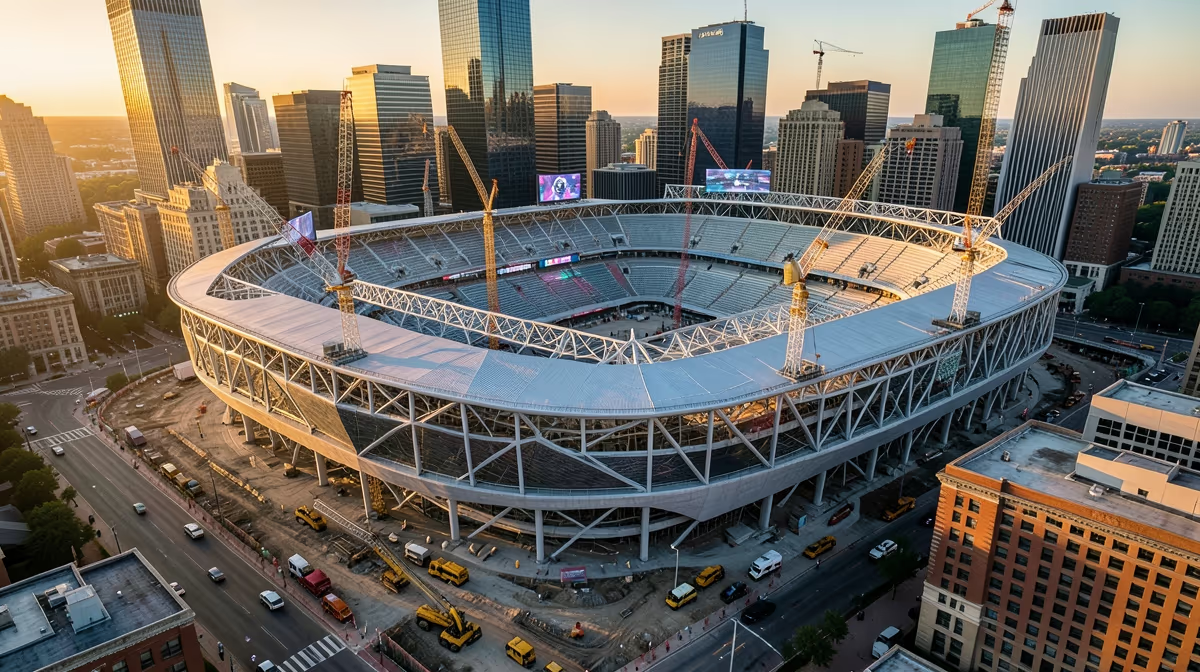
As preparations accelerate, the FIFA World Cup 2026 stands as a defining moment for international sports and global relations. This historic event serves as a massive logistical, cultural, and economic undertaking, representing the first time in history that three nations have united to host the world's most watched sporting tournament.
The Mechanics of an Expanded Global Stage
The 2026 FIFA World Cup is set to make history as the first tournament hosted across the United States, Canada, and Mexico, featuring an expanded format of 48 teams competing for the ultimate championship title. FIFA has confirmed the tournament will run from June 11 to July 19, 2026, marking a significant departure from previous iterations. The expansion to 48 teams means the total number of matches will increase to 104, utilizing a format of 12 groups of four teams. From these, the top two teams and the eight best third-placed finishers will advance to the round of 32. This structure is strategically designed to maximize engagement, satisfy broadcast rights requirements, and accommodate a larger global field of participants.
Economic Catalysts and Infrastructure Monetization
Beyond the spectacle on the pitch, the tournament acts as a massive economic catalyst for the host regions. The project is effectively a study in infrastructure monetization and the shift toward a decentralized, multi-country model. By spreading the burden of hosting across North America, the event reduces the fiscal strain on any single nation while creating a complex, multi-jurisdictional sponsorship and commercial landscape. Local authorities are currently integrating large-scale public transport upgrades and specialized security protocols to manage the expected influx of millions of international fans. The tournament is projected to generate billions of dollars in revenue for host cities, flowing through tourism, local service industries, and increased media visibility.
Geopolitical Influence and Regional Soft Power
Hosting by the United States, Canada, and Mexico serves as a soft-power synchronization of the North American bloc. This collaborative effort reinforces regional stability and economic integration while allowing the host nations to navigate the complex internal politics of CONCACAF and FIFA relations. The tournament functions as a theater for sporting diplomacy, attempting to project unity in an era of shifting global narratives. While FIFA’s primary driver for the 48-team expansion is the maximization of commercial leverage, the geopolitical consequence is a project that binds the three North American neighbors in a singular, high-stakes operational goal.
Navigating Logistical Hurdles
In the immediate term, the organizational pressure is mounting. Within the next 24 hours, FIFA officials are expected to finalize regional transport logistics and local fan-zone security frameworks across the 16 host cities. Looking toward the next 72 hours, the focus will shift to the rollout of the ticketing platform and the announcement of secondary infrastructure updates for training facilities. Experts suggest the tournament will trigger unprecedented commercial growth, though logistical hurdles regarding multi-country travel for fans and teams will necessitate innovative mobility solutions. The best-case scenario involves a seamless, tech-integrated fan experience across all three nations, while the worst-case involves logistical bottlenecks and cybersecurity threats that could disrupt inter-city transit and result in reputational challenges for the organizing committees.
The Corporate Evolution of FIFA
A critical, often overlooked aspect of the 2026 cycle is the internal governance shift within FIFA. The organization is transitioning toward a corporate-style conglomerate model, where decision-making is increasingly detached from traditional federation politics in favor of private equity interests and global broadcast strategies. This marks a departure from the historical governance of international football. Many analysts compare the 2026 cycle to the 1974 FIFA World Cup in West Germany, which served as a similar catalyst for professionalizing the tournament into a modern global commercial product during a period of geopolitical bifurcation.
Host City Selection and Legacy
Matches will be held across 16 iconic host cities, with the final match scheduled to take place at MetLife Stadium in East Rutherford, New Jersey. Each city was selected based on its existing infrastructure, stadium capacity, and ability to accommodate large-scale international events. These cities are now tasked with managing a massive, multi-faceted operation that extends far beyond a typical stadium event. The 2026 World Cup serves as a platform to boost the popularity of soccer in North America, testing the readiness of these diverse urban centers to function as a cohesive, continental host.
Frequently Asked Questions
Where is the 2026 FIFA World Cup taking place?
The 2026 FIFA World Cup will be co-hosted by three North American countries: Canada, Mexico, and the United States. This will be the first time in history that the tournament is hosted by three different nations.
How many teams will participate in the 2026 World Cup?
The 2026 tournament will feature an expanded format consisting of 48 teams, an increase from the previous 32-team format.
Which cities are hosting games for the 2026 World Cup?
There are 16 host cities across the three countries, including major locations like New York/New Jersey, Los Angeles, Mexico City, Toronto, and Vancouver.
When does the 2026 FIFA World Cup start?
The tournament is scheduled to kick off in June 2026. The final match will take place on July 19, 2026.
Where will the 2026 World Cup final be played?
The final match will be held at MetLife Stadium in East Rutherford, New Jersey, near New York City.
How can I buy tickets for the 2026 World Cup?
Ticket information will be released directly through FIFA's official website. Fans are encouraged to sign up for the official FIFA newsletter for updates on sales phases.
Conclusion
The 2026 FIFA World Cup represents a monumental shift in how global sporting events are conceptualized, financed, and executed. With the transition to a 48-team, tri-national format, the tournament stands as a test of North American infrastructure and diplomatic cooperation. As qualifying rounds continue globally, the focus remains on finalizing the complex logistical frameworks, security protocols, and ticketing platforms necessary to manage 104 matches. The event is set to leave a lasting impact on the global sports industry, redefining the standard for commercial growth and regional sporting diplomacy.


.webp)
