
Prosecutor of the ICC Faces Growing Pressure Amid Global Tensions
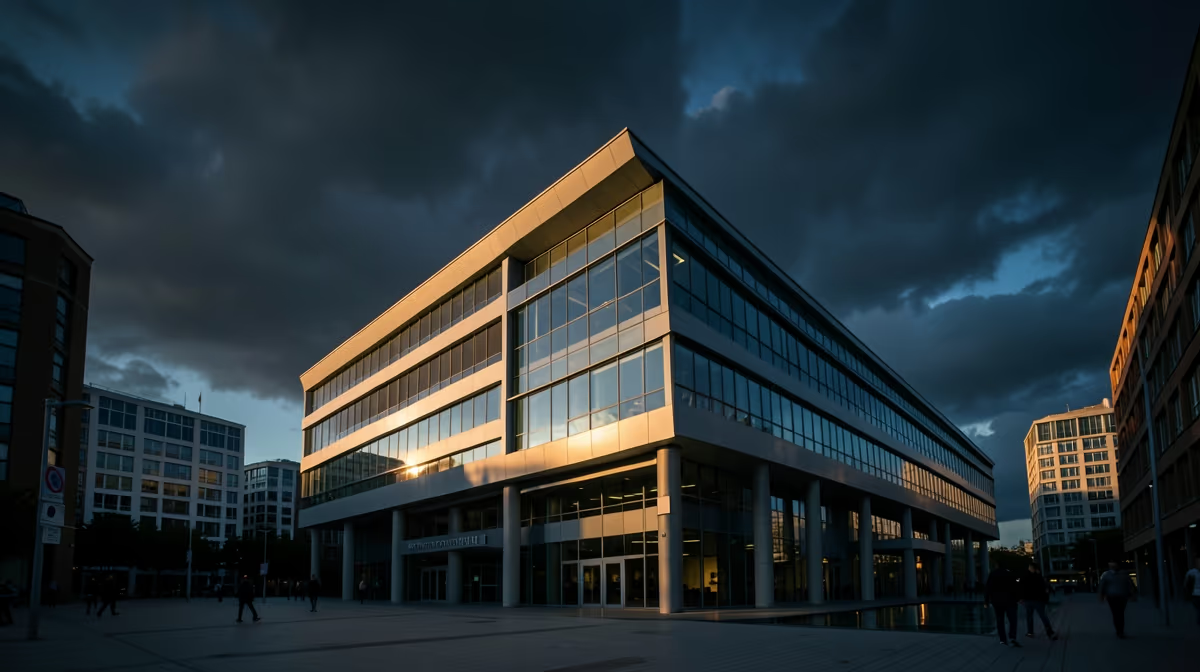
The office of the prosecutor of the international criminal court, currently held by Karim Khan, faces intensifying scrutiny from U.S. lawmakers following reports that the tribunal may issue arrest warrants for high-ranking Israeli officials, marking a significant point of tension between the Biden administration and the Hague-based institution. As the court navigates these complex legal landscapes amid ongoing investigations, its maneuvers are triggering significant geopolitical fallout that challenges the foundations of sovereign immunity in an era of global conflict.
The Mandate and the Institution
The International Criminal Court is an independent organization based in The Hague that investigates and prosecutes individuals for the world's most serious crimes, including genocide, war crimes, and crimes against humanity. The prosecutor acts as a global investigator for the most severe human rights abuses, stepping in when national legal systems are unable or unwilling to hold perpetrators accountable. Operating under the Rome Statute, the court functions as a court of last resort, distinct from the United Nations, though it maintains a formal relationship with the international body. The prosecutor is elected by an absolute majority of the Assembly of States Parties for a single, non-renewable nine-year term, a design intended to shield the office from external political interference.
Analyzing Recent ICC Investigations and Geopolitical Fallout
The current friction centers on the prosecutor’s evaluation of potential arrest warrants related to the conflict in Gaza. Tensions escalated this week as members of the U.S. Congress signaled potential legislative retaliation if the ICC proceeds with these actions. While the United States is not a signatory to the Rome Statute, the court maintains that it holds jurisdiction over alleged crimes committed within the Palestinian territories. This creates a fundamental incompatibility between the American stance on military immunity and the universal jurisdiction mandate of the Rome Statute.
For the Biden administration, the situation is delicate. Officials are attempting to discourage the issuance of warrants, arguing that such moves could undermine ongoing hostage release negotiations and regional stability. Critics within Washington, including a bipartisan group of senators, have warned that targeting Israeli officials would be viewed as a direct threat to U.S. interests. This has led to accusations of selective application of international standards, as the United States has supported the court’s work in other contexts, such as the war in Ukraine.
Challenges to Global Justice in the Current Political Climate
The path forward is fraught with legislative and diplomatic hazards. A root cause of this instability is the persistent struggle between the American desire to maintain military sovereignty and the ICC's mandate to operate as a neutral arbiter of international humanitarian law. Historically, the relationship has been defined by a series of legislative hurdles, such as the 2002 American Service-Members' Protection Act, often referred to as the Hague Invasion Act. More recently, in 2020, the executive branch imposed sanctions against then-prosecutor Fatou Bensouda to obstruct investigations into U.S. actions in Afghanistan.
The economic and security implications are equally significant. There is a palpable risk that if Congress moves to pass restrictive legislation, it could trigger retaliatory measures from ICC member states, leading to a breakdown in diplomatic channels. Furthermore, the possibility of sanctions against ICC officials threatens the stability of the global financial clearing system and creates legal volatility for multinational corporations operating in conflict zones. From an intelligence perspective, there is an ongoing internal struggle regarding whether the U.S. should leverage the ICC to target foreign adversaries while simultaneously shielding its own personnel from identical scrutiny.
The Road Ahead
The next 24 to 72 hours are expected to see increased diplomatic communication between the Office of the Prosecutor and U.S. Congressional leadership regarding potential oversight or sanction legislation. It is highly probable that White House officials will issue public statements attempting to strike a balance: affirming support for the principles of international justice while reiterating that the U.S. will protect its officials and service members from ICC jurisdiction. Expert predictions suggest that the U.S. will likely pursue a policy of strategic engagement, cooperating on select investigations like the one in Ukraine, while maintaining hard legislative barriers to prevent the court from asserting authority over American citizens. A best-case scenario involves a procedural understanding that allows for continued cooperation on war crimes in Eastern Europe without creating friction over personnel in other regions.
Frequently Asked Questions
Who is the current Prosecutor of the International Criminal Court?
The current Prosecutor of the International Criminal Court is Karim A.A. Khan KC, who was sworn into the position in June 2021.
What are the main responsibilities of the ICC Prosecutor?
The Prosecutor is responsible for conducting investigations and prosecutions of individuals accused of genocide, crimes against humanity, war crimes, and the crime of aggression.
How is the Prosecutor of the International Criminal Court selected?
The Prosecutor is elected by an absolute majority of the members of the Assembly of States Parties of the ICC to serve a single, non-renewable term of nine years.
Is the Office of the Prosecutor independent?
Yes, the Office of the Prosecutor operates as an independent organ of the court to ensure investigations are conducted without political interference.
Can the ICC Prosecutor initiate investigations on their own?
Yes, the Prosecutor can initiate an investigation proprio motu, or on their own initiative, provided they receive authorization from the Pre-Trial Chamber of the ICC.
What is the relationship between the ICC Prosecutor and the United Nations?
While the ICC is an independent institution, it has a formal Relationship Agreement with the UN, and the UN Security Council can refer situations to the Prosecutor for investigation.
Conclusion
The situation remains fluid as the Office of the Prosecutor evaluates its next legal steps regarding the conflict in Gaza. While the United States continues to emphasize that it is not a party to the Rome Statute, the ongoing tension highlights the broader, systemic challenges facing international law in an era of competing geopolitical interests. The coming days will determine whether Washington and The Hague can find a procedural middle ground or if the relationship will slide toward a more confrontational legislative standoff. For now, the focus remains on whether the Prosecutor will formally file for warrants and how the U.S. administration will navigate the conflicting pressures of global human rights obligations and domestic political mandates.


.webp)


.webp)
