
Ballistic Missile Defense Shift Signals Major Change in Regional Power
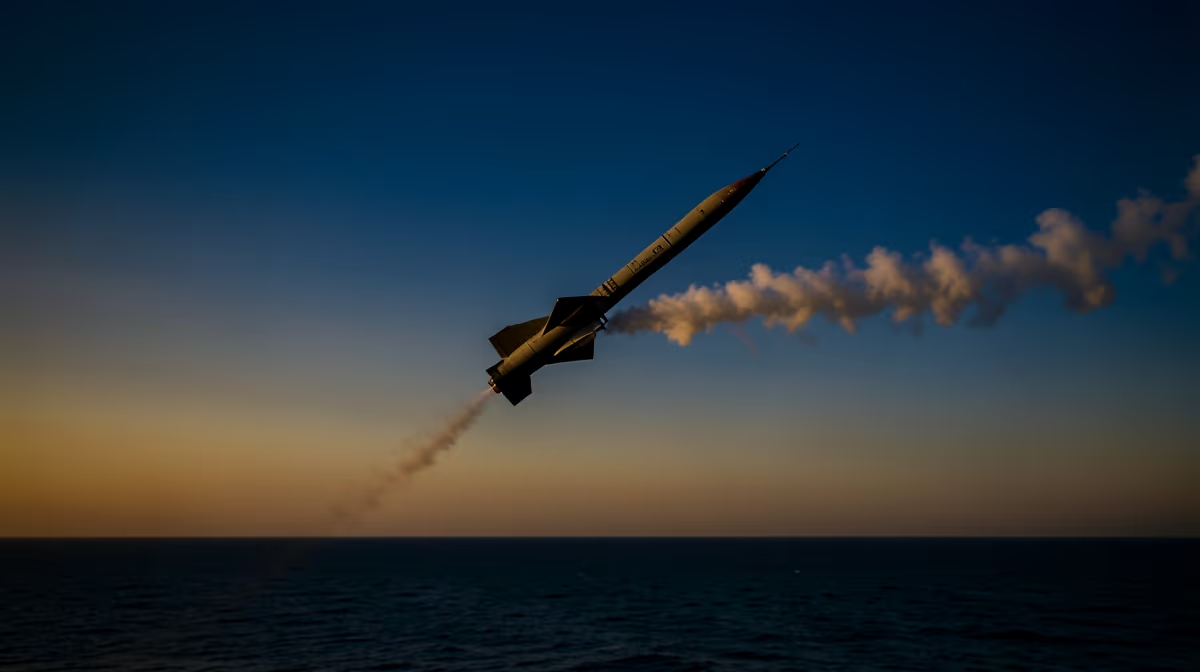
The successful flight test of the Agni-5 missile, equipped with advanced Multiple Independently Targetable Re-entry Vehicle technology, marks a transformative moment for regional security dynamics in South Asia. This leap in precision and strike capability has effectively brought the nation's defense policy into sharp focus, forcing analysts and neighboring states to reconsider the existing balance of power.
The Mechanics of Strategic Deterrence
A ballistic missile is a type of rocket-powered weapon that follows a specific, high-arcing flight path like a ball thrown into the air. It climbs high into space before falling back down toward its target, using gravity to gain incredible speed as it approaches the ground. Because these missiles move so quickly and travel such long distances, they represent one of the most powerful tools in a country's defense arsenal. Unlike cruise missiles that fly within the atmosphere and utilize self-propulsion throughout their flight, ballistic missiles rely on rocket power only during the initial launch phase.
In the Indian context, the development of these systems is primarily focused on strategic deterrence, designed to prevent conflict by ensuring the state can respond effectively to threats. The Agni series, which serves as the backbone of the country's long-range capabilities, features platforms capable of being launched from land-based mobile units, ships, or submarines. These systems are categorized by their range, spanning from short-range tactical variants to long-range intercontinental ballistic missiles, or ICBMs.
Development and Technical Milestones
India successfully conducted a flight test of its long-range Agni-5 ballistic missile on Monday, utilizing MIRV technology from APJ Abdul Kalam Island off the Odisha coast. This mission, codenamed Divyastra, represents the culmination of efforts led by the Defence Research and Development Organisation to modernize the national arsenal. The successful integration of MIRV technology allows a single missile to deploy multiple nuclear warheads at different targets, significantly complicating adversary missile defense systems.
The test confirmed the high precision of the missile, which is capable of reaching targets at ranges exceeding 5,000 kilometers. By incorporating advanced avionics and high-accuracy sensor packages, the system followed a predetermined trajectory that was monitored by various tracking stations throughout the flight. Prime Minister Narendra Modi publicly commended the DRDO scientists for this achievement, signaling that the technological validation of these systems is a priority for the current administration.
Geopolitical and Strategic Implications
The pursuit of this technology is rooted in the necessity of maintaining a credible minimum nuclear deterrent against a two-front threat environment. This strategic posture is designed to discourage aggression by ensuring that any potential adversary understands the costs of a conflict. From a geopolitical perspective, the move shifts the regional balance of power, forcing an accelerated competition in naval and nuclear modernization within the Indian Ocean and South Asia.
Furthermore, there is a clear political dimension to these developments. The assertion of these capabilities reflects a consolidation of nationalist sentiment and a shift away from earlier paradigms toward a more assertive role for the nation as a leading power. Economically, this reliance on the indigenous DRDO to foster the Atmanirbhar Bharat initiative underscores a long-term goal of reducing dependence on foreign hardware. This approach is not entirely new; it parallels the 1974 Smiling Buddha nuclear test, which redefined the country's sovereign status during the Cold War era.
Analysis of Security Posture
Experts suggest that the integration of MIRV technology signals a shift toward a more complex counterforce capability. While the government maintains that the program is strictly defensive and consistent with the nation's nuclear doctrine, the military implications are profound. The ability to engage multiple targets with a single launch platform effectively serves as a strategic deterrent, influencing how neighboring nuclear-armed states assess their own security architecture.
In the next 24 hours, one can expect increased surveillance activities and a heightened operational readiness posture by the Indian Armed Forces in response to these regional developments. Within the next 72 hours, there is potential for further strategic communication from the Ministry of Defence to demonstrate the country's commitment to a stable deterrent posture. Moving forward, the focus will likely remain on the steady-state advancement of the Agni-series programs to ensure the country maintains its strategic edge amidst evolving regional threats.
Assessing the Risk and Outlook
The ideal outcome of these developments is the successful technological validation of missile systems, which can lead to stabilized regional security dynamics through transparent strategic signaling. However, there remains a worst-case scenario where regional tensions could be triggered by the misinterpretation of testing schedules, potentially leading to defensive military posturing by neighboring nuclear-armed states.
The security assessment remains complex, as the government continues to balance its push for indigenous technological self-reliance with the need for regional stability. The ongoing standardization of MIRV-equipped missiles within the Strategic Forces Command arsenal will be a key area of observation. As India continues to refine its missile architecture, the reliance on advanced, precision-guided deterrence will likely remain the centerpiece of its defense policy, shaping the security landscape of South Asia for years to come.
Frequently Asked Questions
What is the definition of a ballistic missile?
A ballistic missile is a weapon system that follows a sub-orbital ballistic flight path to deliver warheads to a predetermined target. It is powered only during the initial phase of flight, after which it relies on gravity and inertia to reach its destination.
How does a ballistic missile differ from a cruise missile?
The primary difference lies in their flight paths and propulsion. While ballistic missiles follow a high, arc-like trajectory and spend much of their time in space, cruise missiles fly within the atmosphere and are self-propelled throughout their entire flight to the target.
What are the different ranges of ballistic missiles?
Ballistic missiles are categorized by their range, including Short-Range, Medium-Range, Intermediate-Range, and Intercontinental Ballistic Missiles. These categories help determine the geographical reach and strategic purpose of the specific missile system.
Does India possess intercontinental ballistic missiles?
Yes, India has developed the Agni-V missile, which is classified as an Intercontinental Ballistic Missile. It features a range of over 5,000 kilometers, allowing it to reach targets across vast distances as part of India's strategic deterrence capabilities.
What is the role of an anti-ballistic missile system?
An anti-ballistic missile system is designed to detect, track, intercept, and destroy incoming ballistic missiles. These defense systems are critical for protecting nations against nuclear or conventional missile strikes by neutralising threats in mid-flight or during their terminal phase.
Are ballistic missiles always nuclear-armed?
Not necessarily, as ballistic missiles can be equipped with either conventional high-explosive warheads or nuclear payloads. While many strategic missiles are designed to carry nuclear weapons, many short-range tactical variants are used with conventional warheads for precision strikes.
Conclusion
The successful flight test of the Agni-5 missile with MIRV technology confirms India’s progress in advancing its strategic defense architecture. By strengthening its credible minimum deterrent, the nation is asserting its position as a significant military power within a complex regional security environment. Future efforts are expected to focus on the standardization of these systems within the Strategic Forces Command, as defense policymakers continue to navigate the dual goals of national self-reliance and regional stability. All developments remain consistent with the national defense doctrine, with continued surveillance and strategic communication serving as the primary mechanisms for managing regional tensions.


.webp)

.webp)
