
Iran Nuclear Program Developments Signal a Major Shift in Global Security
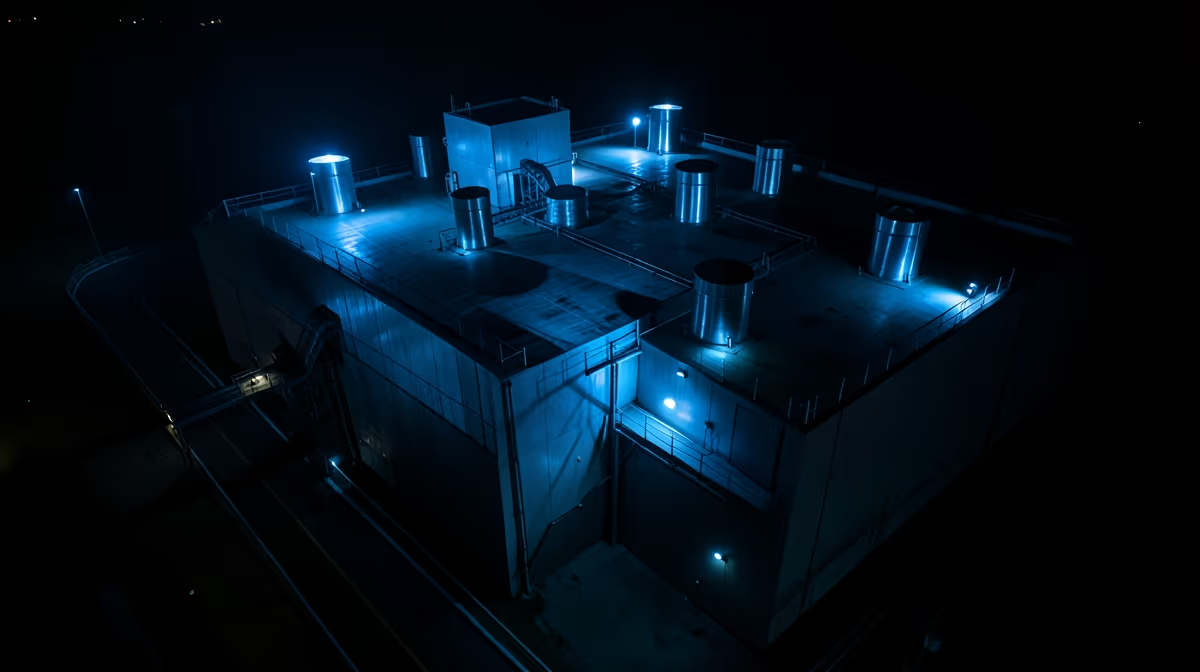
Deep beneath the fortified crust of the Middle East, the hum of advanced centrifuge cascades at Natanz and Fordow represents more than just industrial progress; it serves as a flickering warning light for the global security architecture. As the nuclear program of Iran pushes beyond the thresholds once strictly governed by international agreements, policymakers and intelligence observers are recalibrating their understanding of a region standing at a precarious precipice.
The Fragile Architecture of Non-Proliferation
For years, a tense standoff has defined the relationship between Tehran and the West, centered on the dual-use nature of nuclear energy technology. While Iran maintains that its efforts are strictly for peaceful energy production, the United States and its allies remain deeply skeptical, fearing that the country is secretly working to develop weapons-grade material. This confrontation is rooted in a history that spans back to the 1950s, evolving from early cooperation to a post-1979 revolution landscape marked by deep mutual distrust, cyber-warfare, and persistent sanctions. The 2015 Joint Comprehensive Plan of Action, or JCPOA, was designed to keep Iran at least one year away from breakout capacity, a buffer that has largely evaporated since the United States withdrew from the accord in 2018.
Confirmed Developments and Technical Reality
The current reality on the ground is marked by an undeniable surge in enrichment activities. International inspectors from the International Atomic Energy Agency have reported that Iran is currently enriching uranium to 60 percent purity, a level significantly higher than the 3.67 percent limit established by the 2015 agreement. Furthermore, the IAEA has repeatedly noted that its access to certain nuclear facilities remains restricted, limiting the global community's ability to verify the full scope of Tehran's activities. While there is no public evidence to suggest that Iran currently possesses a functional nuclear weapon, intelligence assessments confirm that the technical knowledge and materials now held by the regime have significantly shortened the potential timeline to produce one.
Geopolitical Realignment and Strategic Deterrence
The pursuit of this nuclear capability is widely viewed by analysts as a strategy for existential deterrence. By holding the potential to develop a weapon, the Iranian leadership seeks to prevent regime change and project power as a regional hegemon. This has triggered a profound shift in Middle Eastern security alliances. Israel and several Sunni Arab states have increasingly integrated their security interests, driven by the shared perception of an Iranian nuclear threat. This geopolitical pivot creates a complex landscape where the traditional diplomatic framework is under immense strain. Washington finds itself caught between two dominant schools of thought: those advocating for a return to multilateral diplomacy and those favoring a strategy of maximum pressure through financial and industrial isolation.
The Economic and Security Fallout
The economic angle of this crisis is as critical as the military one. Secondary sanctions have been utilized as a weaponized financial tool to limit Tehran's access to hard currency, yet their impact on internal stability remains a subject of intense debate. Beyond the financial impact, the standoff affects the global energy market, where volatility remains a constant risk factor. Any intensification of the conflict threatens to disrupt crude oil supply chains, potentially causing shockwaves in energy-dependent economies worldwide. The potential for a regional arms race—where other nations might feel compelled to develop their own deterrents in response to a nuclear-armed Iran—remains a primary concern for international policy makers.
Projected Paths and Managed Tension
In the immediate term, the situation is likely to remain in a state of managed tension. Predictor models suggest that the next 24 hours will likely see heightened diplomatic rhetoric and increased monitoring by the IAEA as Tehran navigates its internal deliberations on enrichment levels. Looking toward the 72-hour window, the international community may witness the imposition of new, targeted U.S. sanctions and intensified back-channel communications. Experts argue that Tehran is currently calibrating its enrichment levels to maximize leverage without triggering a direct military conflict. While the best-case scenario involves a renewed indirect diplomatic framework leading to a temporary freeze on high-grade uranium production, the worst-case remains a rapid dash toward weapons-grade material, which risks a kinetic strike on nuclear infrastructure and a wider regional war.
Frequently Asked Questions
What is the current status of Iran's nuclear program?
Iran has significantly expanded its nuclear activities, including enriching uranium to levels near weapons-grade purity. International monitors continue to report concerns regarding the lack of transparency and the increased stockpile of enriched materials.
Why is the US concerned about Iran's nuclear program?
The US government expresses concern that Iran's nuclear advancements could potentially lead to the development of a nuclear weapon. This poses a significant threat to regional stability, global non-proliferation efforts, and the security of US allies in the Middle East.
What was the Joint Comprehensive Plan of Action (JCPOA)?
The JCPOA, commonly known as the Iran Nuclear Deal, was a 2015 agreement between Iran and several world powers aimed at limiting Iran's nuclear program in exchange for economic sanctions relief. The United States withdrew from this agreement in 2018 under the Trump administration, leading to a period of heightened tensions.
Does Iran currently have a nuclear weapon?
There is no public evidence to suggest that Iran currently possesses a functional nuclear weapon. However, intelligence assessments indicate that the country has gained enough technical knowledge and material to shorten the time required to potentially produce one if they chose to do so.
What are the primary goals of the IAEA regarding Iran?
The International Atomic Energy Agency (IAEA) aims to verify that Iran's nuclear activities remain exclusively peaceful. They conduct regular inspections and monitoring to ensure compliance with nuclear safeguards and to investigate any undisclosed nuclear material or activities.
Are there ongoing negotiations to revive the Iran nuclear deal?
Diplomatic efforts to revive the 2015 nuclear deal have stalled repeatedly over the last few years due to unresolved disagreements between Tehran and Washington. While intermittent discussions have taken place through intermediaries, no formal agreement to return to the original terms has been reached.
Conclusion
The nuclear program of Iran remains one of the most volatile variables in global security. With the enrichment of uranium to 60 percent purity and the continued restriction of IAEA oversight, the international community faces a narrowing window for diplomatic resolution. As the U.S. and its allies prepare for potential new sanctions and intensified monitoring, the risk of miscalculation remains high. Future stability depends heavily on the success of back-channel communications in maintaining a state of managed tension, preventing a breakout that could fundamentally alter the security architecture of the Middle East and trigger a wider regional conflict.


.webp)

.webp)
