
Indian Police Service Faces Massive Overhaul Amid Deepening Security Gap
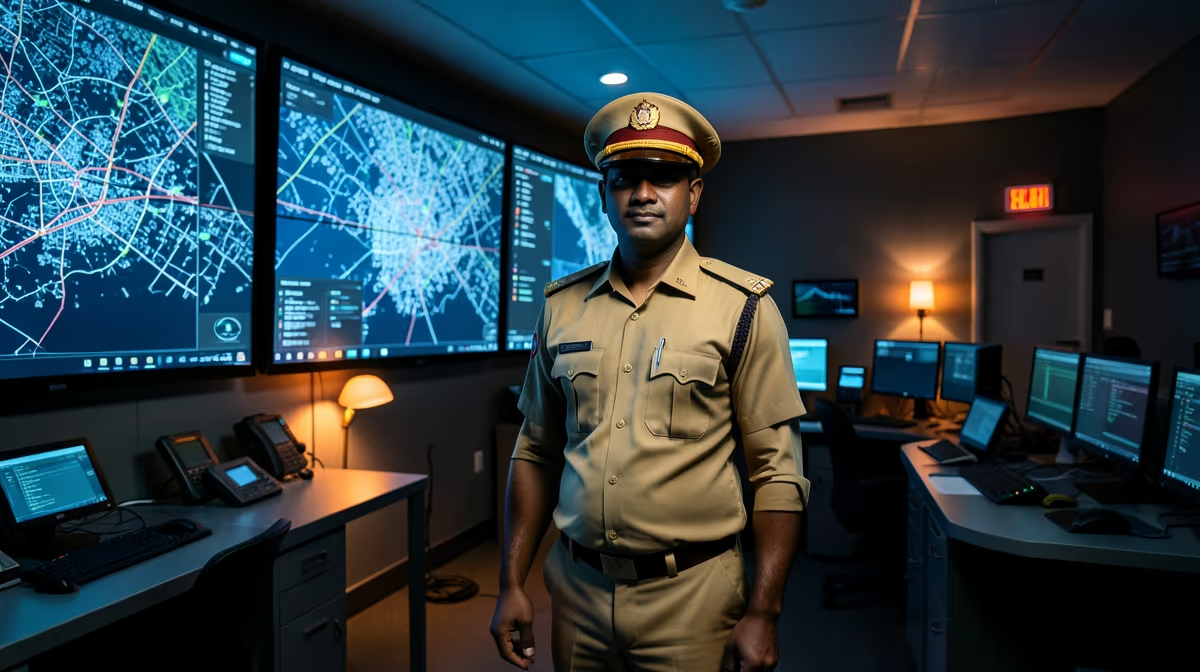
The Ministry of Home Affairs has initiated a nationwide cadre review for the Indian Police Service to address the acute shortage of senior-level officers across multiple states, a move designed to bolster the national security architecture. This systemic overhaul arrives as the Indian Police Service, the premier policing agency in India, confronts a critical juncture in balancing its colonial-era legacy with the urgent, digital-first requirements of a modernizing nation.
The Anatomy of the Service
The Indian Police Service stands as a cornerstone of India's administrative framework, responsible for maintaining law and order and ensuring internal security across the nation. Unlike localized enforcement agencies, these officers are recruited by the central government via the Civil Services Examination conducted by the Union Public Service Commission. Once selected, they undergo rigorous training at the Sardar Vallabhbhai Patel National Police Academy in Hyderabad, where they are forged into leaders capable of managing complex jurisdictions. They are organized into state cadres, acting as a bridge between national security policies and local enforcement. Their roles range from Superintendents of Police in districts to Commissioners in major metropolitan areas, as well as leadership positions in central intelligence and investigative agencies like the CBI and the Intelligence Bureau.
Addressing the Leadership Gap
The current policy focus is driven by a stark reality: official statistics indicate that several state cadres are operating at nearly 25 percent below their sanctioned strength. This vacancy crisis—most acute in the Deputy Inspector General and Inspector General ranks—has forced many senior officers to hold additional charges, potentially diluting administrative focus. The Ministry of Home Affairs has directed all state governments to submit updated cadre data to facilitate a structural adjustment. This process, mandated to occur at five-year intervals, is not merely a bureaucratic exercise in filling vacancies; it is a recalibration effort aimed at synchronizing career progression with the escalating demands of cyber warfare and cross-border security threats.
Root Causes and Structural Challenges
The internal architecture of the Indian Police Service remains deeply rooted in the 1861 Police Act. Analysts point out that this colonial-era foundation historically prioritized regime security and political control, often at the expense of citizen-centric public safety. The service frequently finds itself at the intersection of conflicting pressures, where it acts as a primary instrument of executive power while facing expectations of bureaucratic neutrality. Furthermore, a visible internal class divide exists between the elite, centrally-recruited officers and the grassroots state police constabulary. This fragmentation creates a fragile enforcement hierarchy that is often vulnerable to local political capture and systemic resource constraints, which in turn hinders the adoption of modern forensic capabilities.
The Shift Toward Modernized Policing
As India navigates the next decade, the service is expected to pivot toward specialized training in cyber forensics and data-driven policing. A senior official at the Ministry of Home Affairs noted that the cadre review is a periodic necessity to ensure that the leadership pipeline remains robust enough to address emerging threats, with the rationalization of posts remaining the top priority. This modernization drive includes the integration of the Crime and Criminal Tracking Network and Systems to enhance crime resolution rates. However, experts warn that the transition is not without risk. The worst-case scenario involves rising public friction caused by remaining bureaucratic hurdles, which could challenge the delicate balance between state-specific political pressures and federal mandates.
Regional and Global Implications
The perceived effectiveness of the Indian police apparatus has implications that stretch beyond domestic borders. As India positions itself as a global democratic pillar, the internal security landscape directly influences international security cooperation and the nation's soft power projection. Human rights assessments and transparency in law enforcement are increasingly monitored by the international community. Consequently, the ongoing tension between judicial directives for greater police autonomy and the persistence of executive resistance to such oversight is a critical observation point for security analysts. The modernization of infrastructure in metropolitan units is essential, not just for domestic safety, but for maintaining the credibility of India’s rule-of-law framework in an increasingly interconnected global environment.
Anticipated Developments
In the immediate term, the next 24 to 72 hours will likely see an increased focus on digital surveillance initiatives and expedited internal administrative transfers within state departments to address localized law and order concerns. Following these administrative moves, an uptick in coordination between central and state units regarding cross-border investigative intelligence is expected. While the long-term outlook remains centered on digital-first capabilities, the immediate priority remains the stabilization of the leadership pipeline through the current cadre review, ensuring that every district and agency is equipped with the senior command necessary to respond to a rapidly shifting national security landscape.
Frequently Asked Questions
What is the role of an Indian Police Service officer?
An IPS officer is primarily responsible for maintaining public order, preventing and investigating crimes, and ensuring the safety of citizens. They lead police forces at various levels, from districts to state and national organizations, to enforce the rule of law effectively.
How can I join the Indian Police Service?
To join the IPS, candidates must clear the Civil Services Examination conducted annually by the Union Public Service Commission. The selection process involves a rigorous three-stage procedure including the Preliminary exam, the Main exam, and a personal interview.
What is the salary of an IPS officer in India?
The salary is determined by the 7th Central Pay Commission, starting at the rank of Assistant Superintendent of Police with a Level 10 pay matrix, supplemented by various allowances such as Dearness Allowance and House Rent Allowance.
Is IPS training hard?
Yes, training at the Sardar Vallabhbhai Patel National Police Academy is physically and mentally demanding, encompassing intensive fitness, weapons handling, law enforcement procedures, and leadership development.
What is the difference between IAS and IPS?
While both are All India Services, IAS officers focus on administrative tasks, policy formulation, and district governance, whereas IPS officers specialize in internal security, law and order, and police department management.
Can an IPS officer become a DGP?
Yes, the Director General of Police is the highest-ranking officer in a state, with promotion based on years of service, professional merit, and selection committee recommendations.
Conclusion
The nationwide cadre review for the Indian Police Service represents a pivotal effort by the Ministry of Home Affairs to stabilize leadership and adapt to modern security complexities. By addressing chronic vacancies and emphasizing specialized skills in cyber forensics, the service aims to overcome long-standing bureaucratic hurdles rooted in colonial-era structures. While the immediate focus remains on administrative rationalization and data collection, the long-term success of these initiatives will depend on the effective integration of digital policing tools and the ability to balance federal security mandates with state-level operational requirements. The ongoing transition marks a significant attempt to evolve the service into a more agile, modern force capable of meeting the challenges of the coming decade.


.webp)
