
KH-59 Missile Recoveries Reveal a Global Supply Chain Crisis in Ukraine
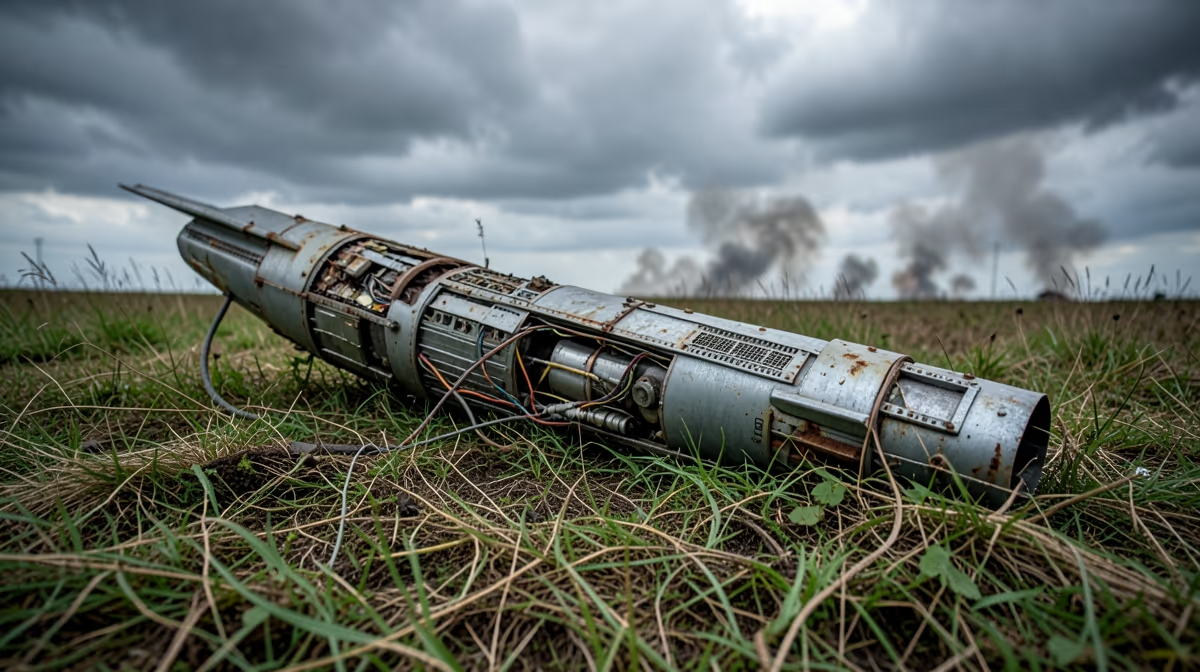
Deep within the debris fields of recent strikes across Ukraine, investigators are uncovering components that point to a sophisticated, albeit illicit, global supply chain sustaining modern Russian air warfare. The use of the KH-59 missile has become a significant focal point in recent Ukraine news, as defense intelligence agencies monitor its deployment and the origins of the advanced microelectronics powering its guidance systems.
Technical Evolution and Standoff Capability
The KH-59 Ovod, originally conceptualized during the late Soviet era, has evolved from a manual command-guided weapon into a complex, medium-range precision-guided munition. Modern variants, such as the KH-59MK and KH-59M2, represent a shift toward standoff capability, allowing Russian aerospace forces to engage high-value targets from distances ranging between 115 and 285 kilometers. By deploying these systems from fixed-wing aircraft like the Sukhoi Su-34 and Su-35, Russian forces can strike deep behind defensive perimeters, effectively minimizing the exposure of their flight crews to ground-based air defense systems.
These missiles utilize a combination of inertial navigation, satellite guidance, and, in some configurations, active radar homing to navigate toward fixed infrastructure, such as command centers or energy grids. The shift from manual TV-command guidance to more autonomous, fire-and-forget capabilities marks a significant leap in the weapon's utility. Each missile typically carries a high-explosive or penetration warhead weighing between 320 and 350 kilograms, a payload specifically engineered to compromise hardened bunkers and critical national infrastructure.
The Global Supply Chain Challenge
A critical finding emerging from defense intelligence reports is the persistent presence of Western-manufactured semiconductors within the internal circuitry of recovered KH-59 wreckage. Despite the comprehensive suite of international sanctions and export controls aimed at throttling Moscow’s access to dual-use technologies, investigators have confirmed that these precision instruments continue to reach the production line. This development highlights a major vulnerability in global enforcement efforts, suggesting the existence of a complex network of third-party intermediaries.
The reliance on these foreign-sourced electronic components is not merely a logistical quirk but a fundamental requirement for the missile's accuracy. Military analysts, including those from the Institute for the Study of War, have noted that the continued reliance on Western components in Russian cruise and tactical missiles suggests that current export controls, while impactful, require more rigorous enforcement to completely sever supply lines. The U.S. Department of Commerce and its international partners are currently intensifying efforts to identify and dismantle the specific intermediaries facilitating these restricted transfers to Russian defense contractors.
Strategic and Economic Implications
The deployment of the KH-59 serves as a manifestation of the proliferation gap where advanced cruise missile technology is utilized to bridge the deficit in long-range precision strike capabilities. By integrating these missiles with older airframes, the Russian aerospace sector is executing a legacy modernization strategy designed to maximize the lifespan of Soviet-era tactical aviation. However, this strategy comes at a high fiscal cost.
High per-unit production costs, combined with high attrition rates in combat, create significant economic strain on domestic defense industries. This financial pressure is driving a noticeable shift toward researching cost-effective, drone-integrated alternatives that can mimic the precision of the KH-59 at a fraction of the cost. Furthermore, the reliance on specific guidance subsystems underscores a lingering vulnerability to global supply chain sanctions, forcing a realignment of defense imports toward non-Western high-tech suppliers. For NATO-aligned states, the documentation of these strikes serves as a crucial signaling mechanism, highlighting both the resilience of the Russian defense industry and the persistent need for heightened regional security aid.
Projected Tactical Shifts
Within the next 24 to 72 hours, defense intelligence agencies expect increased monitoring of Russian strike capabilities as NATO units assess the deployment of recent missile variants. The U.S. Department of Defense is likely to undergo internal briefings regarding the technical characteristics of these updated systems, which may lead to adjustments in the regional security aid strategies currently provided to Ukrainian forces.
The expert consensus suggests that the U.S. will likely expedite the delivery of air defense interceptor systems to Ukrainian forces to mitigate the tactical threat posed by the standoff capabilities of the KH-59. A best-case scenario would see improved, U.S.-led air defense integration successfully neutralizing these threats, thereby leading to a de-escalation of standoff strikes. Conversely, the worst-case scenario involves significant civilian infrastructure damage from unintercepted missiles, which would likely trigger intensified U.S. sanctions and a dangerous escalation in rhetorical tensions.
Frequently Asked Questions
What is the Kh-59 missile?
The Kh-59 Ovod is a Russian air-to-surface missile equipped with a TV guidance system. It is designed for precision strikes against high-value ground and surface targets from tactical aircraft.
What is the range of the Kh-59 missile?
The operational range of the Kh-59 varies depending on the specific variant, typically ranging from 40 to over 280 kilometers. Modern versions like the Kh-59MK2 feature extended range capabilities to allow for standoff attack missions.
Which aircraft can carry the Kh-59?
The Kh-59 is compatible with a variety of Russian tactical aircraft, including the Su-24M, Su-30, Su-34, and Su-57. It requires specific target acquisition and guidance systems integrated into the launch platform to function effectively.
Is the Kh-59 a cruise missile?
The Kh-59 is often categorized as a tactical air-launched cruise missile or a precision-guided standoff missile. While it utilizes a turbojet engine for flight, its primary purpose is tactical engagement rather than long-range strategic bombardment.
How is the Kh-59 guided to its target?
Early versions of the Kh-59 relied on TV command guidance, requiring a controller in the aircraft to steer the missile. Newer variants incorporate inertial navigation systems combined with satellite guidance and active radar homing for autonomous operation.
What is the destructive capacity of a Kh-59?
The Kh-59 typically carries a high-explosive or penetration warhead weighing between 320 and 350 kilograms. This payload is engineered to destroy hardened structures, bunkers, and large surface vessels with high precision.
Conclusion
The Kh-59 remains a vital component of Russia’s tactical air warfare inventory, consistently deployed to target infrastructure in Ukraine. Intelligence efforts have confirmed the reliance of these systems on dual-use Western electronics, underscoring the ongoing necessity for strict international export control enforcement. As U.S. and NATO officials evaluate the performance and procurement channels of these munitions, the focus remains on enhancing Ukrainian air defense capabilities to offset the standoff advantage the missile provides. The next phase of this conflict will likely involve an intensified effort to degrade these strike capabilities, both through direct military countermeasures and the disruption of critical supply lines.


.webp)


.webp)
