
Mark Carney Canada NATO Defense Stance Signals Major Policy Shift
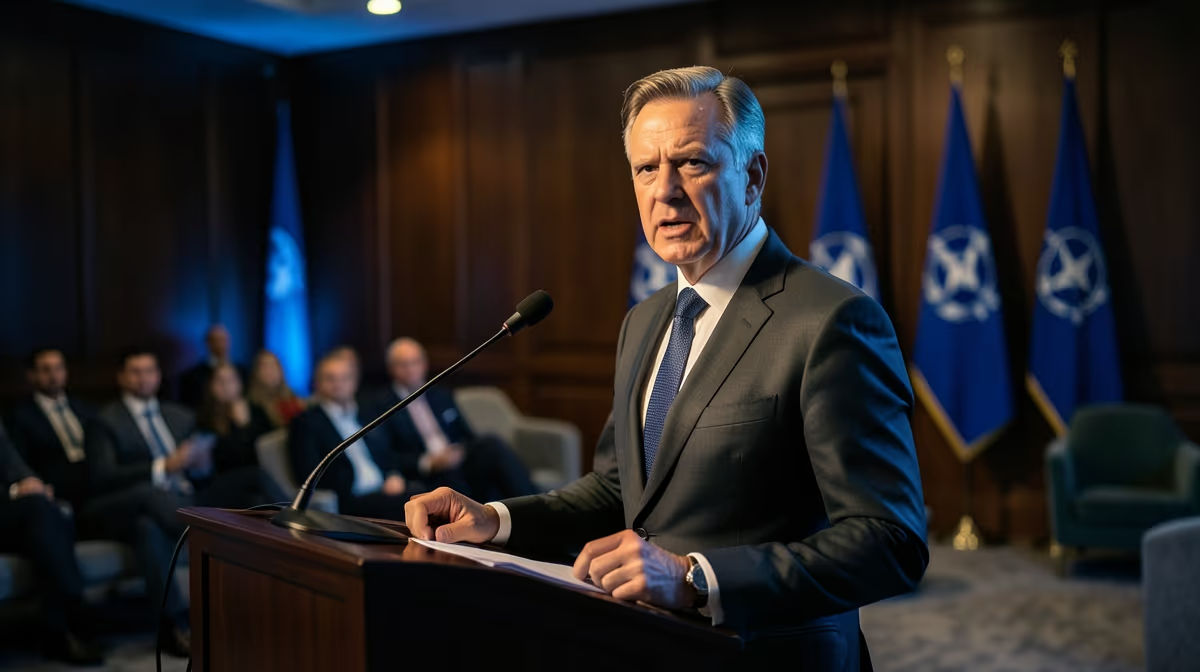
The traditional reliance on geographic isolation as a primary pillar of national security is rapidly dissolving in an era of heightened global volatility. As geopolitical tensions rise, the debate over Mark Carney Canada NATO defense spending has become a focal point for policy analysts and voters alike, signaling a potential shift in how Canada reconciles its fiscal policy with its international obligations.
A Shifting Geopolitical Landscape
Former Bank of England and Bank of Canada Governor Mark Carney has intensified calls for Canada to meet its NATO defense spending commitments, citing the shifting global geopolitical landscape as a primary driver for increased domestic investment. Speaking in the context of mounting international pressure on the Trudeau government, Carney has argued that Canada’s economic sovereignty and security are inextricably linked to its contributions to the Western alliance.
For decades, Canada has operated under the assumption that its vast oceans and northern location provided sufficient protection. However, the current reality of rising global conflicts has necessitated a more proactive stance. Carney emphasizes that the luxury of relying on geographic separation is no longer a viable security policy. The global stage is currently defined by a shift toward geoeconomics, where international trade and economic stability are deeply tied to participation in major geopolitical alliances. In this framework, national security is no longer a peripheral concern but the very foundation upon which a modern, stable economy must be built.
The Mechanics of the 2 Percent Target
At the heart of the current policy discourse is the commitment to spend 2 percent of annual economic output on defense. NATO members established this voluntary guideline in 2014, with the expectation that all member states would reach this threshold by 2024. Canada has consistently lagged behind this target, a reality that has caused friction with its allies, particularly within the United States.
Carney frames the necessity of meeting this target as a matter of modern economic statecraft. He has noted that a credible defense posture is the bedrock of the rules-based international order upon which the Canadian economy relies. By failing to hit the 2 percent mark, Canada risks not only its reputation with key allies but also its leverage in critical trade negotiations. The persistent pressure from U.S. lawmakers to modernize military infrastructure—especially maritime patrol capabilities in the Arctic—serves as a constant reminder that Canada’s contributions are currently viewed as insufficient by those overseeing the alliance.
Economic Implications and Industrial Strategy
The transition toward higher defense spending is not viewed by Carney as a mere fiscal burden, but as a strategic investment. By aligning domestic industrial policy with defense requirements, Canada could potentially stimulate its manufacturing sector while simultaneously fulfilling its international obligations. This approach effectively uses defense procurement as a form of industrial policy stimulus, attempting to reconcile the country’s existing fiscal constraints with the urgent requirement for military modernization.
This strategy addresses a root cause of the current dilemma: the need to align Canadian fiscal policy with shifting North American defense industrial requirements. Under the looming threat of U.S. protectionism, Canada is attempting to regain relevance within the G7 and NATO by framing its defense contribution as a vital component of Arctic security and North American supply chain resilience. Whether this transition will lead to higher taxes or a fundamental shift in budget priorities remains a primary concern for taxpayers and policymakers.
The Political Dimension
While Carney has not officially declared a candidacy for federal office, his recent public interventions on fiscal and security policy have fueled intense speculation regarding his future political ambitions. Analysts suggest that Carney is positioning himself as a technocratic bridge, capable of aligning the Liberal Party's progressive base with a necessary pro-NATO defense posture. This positioning aims to counter criticisms of Canadian free-riding from Washington while navigating internal party dynamics.
Within the next 24 to 72 hours, observers expect increased media speculation regarding Carney’s potential political future. Analysts will likely dissect his past statements on military fiscal policy to determine if he is indeed positioning for a leadership bid or a cabinet post focusing on national security. The worst-case scenario for the Liberal Party involves this discourse triggering internal friction, alienating its progressive wing while failing to satisfy the requirements for faster defense implementation set by the United States. Conversely, a best-case scenario would see Carney successfully bridge the gap between fiscal hawkishness and defense necessity, potentially leading to a rare bipartisan consensus on accelerated military procurement.
What Comes Next
The path forward for Canadian defense policy involves a delicate balance between fiscal discipline and international expectations. Carney’s advocacy for a more assertive international posture suggests that the dialogue regarding defense spending will remain at the forefront of the next federal election cycle. The primary development to watch is the degree to which the federal government accelerates its defense spending timeline to meet the 2 percent target. As Carney continues to frame national security as an inseparable component of economic security, his influence on the Canadian policy landscape is expected to grow. His role as an architect for a post-Trudeau economic doctrine remains the hidden angle in this broader geopolitical shift, as the country seeks to modernize its capabilities in a rapidly changing world.
Frequently Asked Questions
What is Mark Carney's stance on Canada's NATO defense spending?
Mark Carney has publicly emphasized the necessity for Canada to increase its defense spending to meet the NATO target of 2% of GDP. He has argued that investing in national and collective security is crucial for maintaining Canada's influence and credibility on the global stage.
Does Mark Carney support Canada reaching the 2% NATO target?
Yes, Carney has aligned himself with the view that Canada must prioritize hitting the 2% NATO defense spending benchmark. He suggests that fiscal discipline should not prevent the country from fulfilling its international security obligations during a period of rising global instability.
What has Mark Carney said about Canada's role in global security?
Carney frequently speaks about Canada's need to modernize its military and bolster its defense capabilities to address contemporary threats. He advocates for a more proactive foreign and defense policy to ensure Canada remains a trusted partner within the NATO alliance.
How does Mark Carney view the link between the economy and national defense?
Carney argues that a strong economy is the foundation of national security, but acknowledges that defense spending is a vital component of a nation's stability. He maintains that Canada must balance its domestic fiscal requirements with the urgent need to contribute effectively to international defense efforts.
Is Mark Carney currently involved in Canadian defense policy?
While not currently holding a government office, Mark Carney acts as a prominent economic advisor and influential voice in Canadian policy circles. His commentary on defense spending is closely watched as it often reflects emerging consensus within the Liberal Party regarding international commitments.
Why is Mark Carney's opinion on NATO significant for Canada?
As a former Governor of the Bank of Canada and the Bank of England, Carney's perspectives carry significant weight in Canadian political and economic debates. His advocacy for higher defense spending helps shape the national conversation on how Canada should position itself in a shifting geopolitical landscape.
Conclusion
The debate surrounding Mark Carney’s influence on Canadian defense spending represents a pivotal moment for national policy. As confirmed by his public advocacy and the ongoing pressure from NATO allies, the necessity of meeting the 2 percent GDP target has moved from a secondary policy objective to a core component of economic sovereignty. While the government faces the practical challenge of reallocating federal funds without alienating domestic stakeholders, the consensus among analysts is that the link between defense spending and international economic credibility is becoming impossible to ignore. Moving forward, the focus will remain on whether Carney’s technocratic framework can successfully influence federal budget priorities and whether the country can reconcile its fiscal constraints with the urgent requirement for military modernization.


.webp)
