
North Korean Destroyer Choe Hyon Shifts Indo-Pacific Power Balance
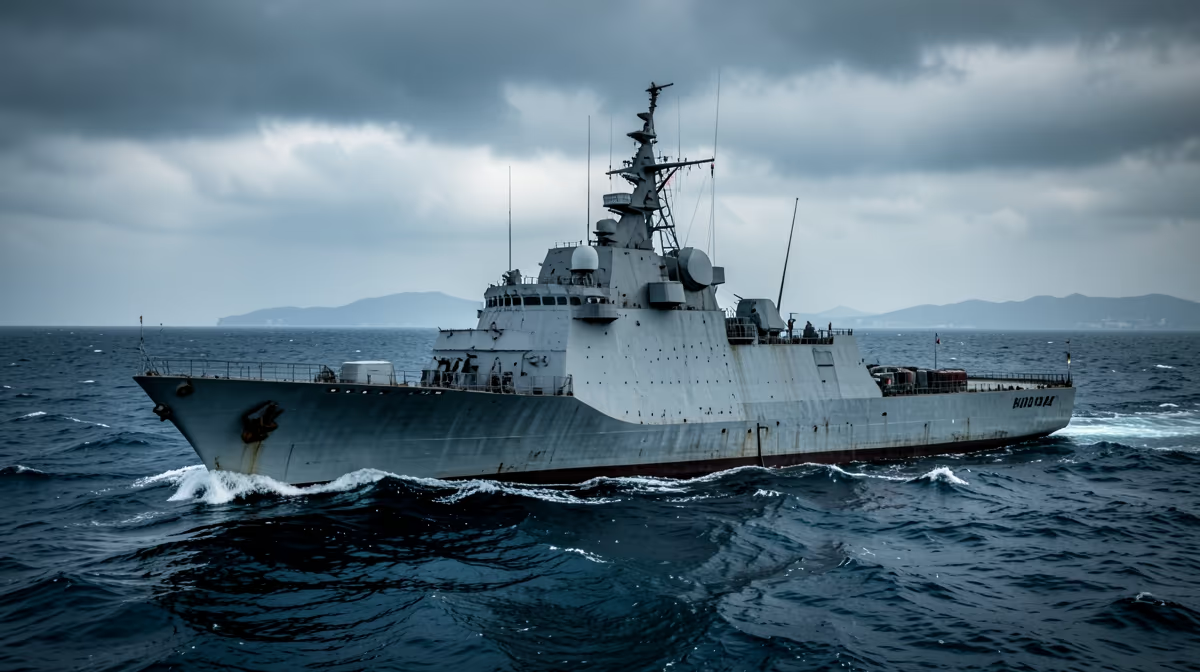
The emergence of the North Korean destroyer Choe Hyon has drawn significant attention from defense analysts tracking the North Korea military and its evolving maritime capabilities. As regional instability rises, the deployment of the Choe Hyon destroyer remains a focal point for experts concerned with maintaining long-term Indo-Pacific security. This vessel, which serves as a visible marker of Pyongyang’s ongoing efforts to modernize its naval fleet, is currently undergoing intense scrutiny from intelligence agencies tasked with monitoring the Sea of Japan and the Yellow Sea.
Technical Analysis of the Vessel
The Choe Hyon is widely identified by international defense observers as a Nampo-class guided-missile destroyer, a platform designed primarily for littoral defense and anti-surface combat operations. While categorized as a destroyer, its operational profile suggests it is optimized for coastal waters rather than deep-sea power projection. Key technical features of this vessel include an integrated helicopter deck and hangar, which facilitate anti-submarine warfare capabilities. Furthermore, the ship has been equipped with updated radar suites and potentially enhanced anti-ship weapon systems, moving beyond the aging technology that has historically defined the Korean People's Navy. Despite the classification, analysts note that the vessel represents a modernization of existing Soviet-era ship designs, serving as a critical asset for the North Korean maritime inventory.
The Historical Context and Naming Conventions
The naming of the Choe Hyon carries deep ideological weight within Pyongyang. Named after a prominent military commander and politician who served as a close aide to Kim Il Sung and a leader during the anti-Japanese guerrilla struggle, the vessel functions as a pillar of the founding revolutionary mythos. By linking contemporary military hardware to such foundational figures, the North Korean regime seeks to cement the legitimacy of the Kim dynasty while signaling to both domestic and international audiences that its military expansion remains a self-reliant endeavor. This practice mirrors historical Soviet-era strategies, where naming surface combatants after key commanders served to boost ideological morale during global arms races.
Strategic Intent and Maritime Expansion
The integration of this destroyer into the North Korean naval fleet reflects a broader push toward what experts term the navalization of the country’s military. Historically, the navy has been the least developed branch of the North Korean armed forces compared to its land-based artillery and ballistic missile programs. However, recent years have seen a prioritized investment in new warships and submarine technologies. The operational deployment of the Choe Hyon near the maritime demarcation line serves as a tactical irritant for the US Indo-Pacific Command and the South Korean Ministry of National Defense, compelling these forces to divert surveillance and reconnaissance assets to monitor its maneuvers and verify its true armament capabilities.
Geopolitical Implications and Regional Stability
The appearance of the Choe Hyon complicates security dynamics in the Indo-Pacific, forcing neighboring nations to recalibrate their maritime defensive strategies. While the vessel is often viewed by some analysts as a signaling tool—a potential Potemkin deterrent designed to force rivals into costly monitoring exercises without requiring actual high-tech parity—its presence along the Northern Limit Line adds layers of complexity to ongoing regional friction. For countries like South Korea and Japan, as well as the United States, the vessel's movements serve as a primary metric for gauging the regime’s naval endurance and its willingness to challenge maritime norms. The ship’s ability to conduct regular patrols underscores a persistent intent to maintain a posture of constant military readiness.
Economic Dimensions of Military Modernization
The persistent allocation of scarce national resources toward expensive maritime combat platforms occurs in the face of heavy international sanctions. This trend highlights a regime strategy that prioritizes survivalist militarism over civilian economic development. By building and maintaining vessels such as the Choe Hyon, Pyongyang effectively signals that its military modernization is shielded from the economic constraints imposed by international actors. This policy, however, exacerbates the country's reliance on illicit trade networks to sustain its defense-industrial base, creating a cycle where maritime expansion directly dictates the regime's economic survival strategy.
Projected Developments in the Coming Days
In the next 24 hours, defense analysts expect increased monitoring by US Indo-Pacific Command and South Korean naval intelligence to track the vessel’s patrol patterns and verify the extent of its electronic warfare potential. Looking toward the next 72 hours, the diplomatic landscape may shift as representatives from the US State Department and the UN Security Council consider issuing statements regarding the vessel’s unauthorized movements should any provocations occur near contested waters. Expert consensus suggests the vessel’s appearance is primarily a signaling exercise meant to test the responsiveness of US-ROK surveillance systems rather than a precursor to a kinetic strike. While a best-case scenario involves the vessel remaining within territorial waters, a worst-case scenario involves provocative maneuvers near the Northern Limit Line, which could trigger a high-stakes standoff.
Frequently Asked Questions
What is the Choe Hyon class destroyer?
The Choe Hyon refers to the Nampo-class guided-missile destroyer, which intelligence suggests is based on Krivak III-class designs originally intended for Soviet maritime border guard duties.
Does North Korea operate Choe Hyon class warships?
Yes, these vessels are currently part of the Korean People's Navy inventory and represent some of the most technologically sophisticated surface combatants in the fleet.
Who was Choe Hyon after whom the ship is named?
Choe Hyon was a high-ranking North Korean military leader and anti-Japanese partisan fighter who played a vital role in establishing the state's early military infrastructure.
What are the capabilities of a Choe Hyon class destroyer?
These ships are designed for littoral defense, featuring a helicopter deck for anti-submarine operations, updated radar systems, and an array of automatic naval guns and torpedo tubes.
Are Choe Hyon ships still active in the North Korean Navy?
They are active assets utilized for regular maritime patrols, though their operational frequency remains a closely guarded secret by the North Korean regime.
Why is the Choe Hyon important to North Korean naval power?
The ship provides North Korea with significantly improved patrol endurance and coastal surveillance capabilities, representing a substantial upgrade over the country's legacy patrol craft.
Conclusion
The Choe Hyon stands as a central pillar of North Korea's ongoing effort to modernize its maritime forces and assert its influence within coastal waters. While intelligence confirms its role as a guided-missile destroyer optimized for littoral defense, the extent of its electronic warfare and missile guidance upgrades remains a subject of active monitoring by international observers. The vessel's deployment serves both domestic propaganda objectives and broader geopolitical goals, complicating the security posture of the Indo-Pacific region. As US and South Korean forces continue to track the vessel’s movements, the international community remains focused on whether these maneuvers will remain within the bounds of symbolic signaling or escalate into more direct maritime friction. Moving forward, the operational status of the Choe Hyon will continue to serve as a critical metric for assessing North Korean naval readiness and the regime's strategic commitment to challenging regional maritime dominance.


.webp)
