
North Korean Destroyer Choe Hyon Signals New Maritime Tensions
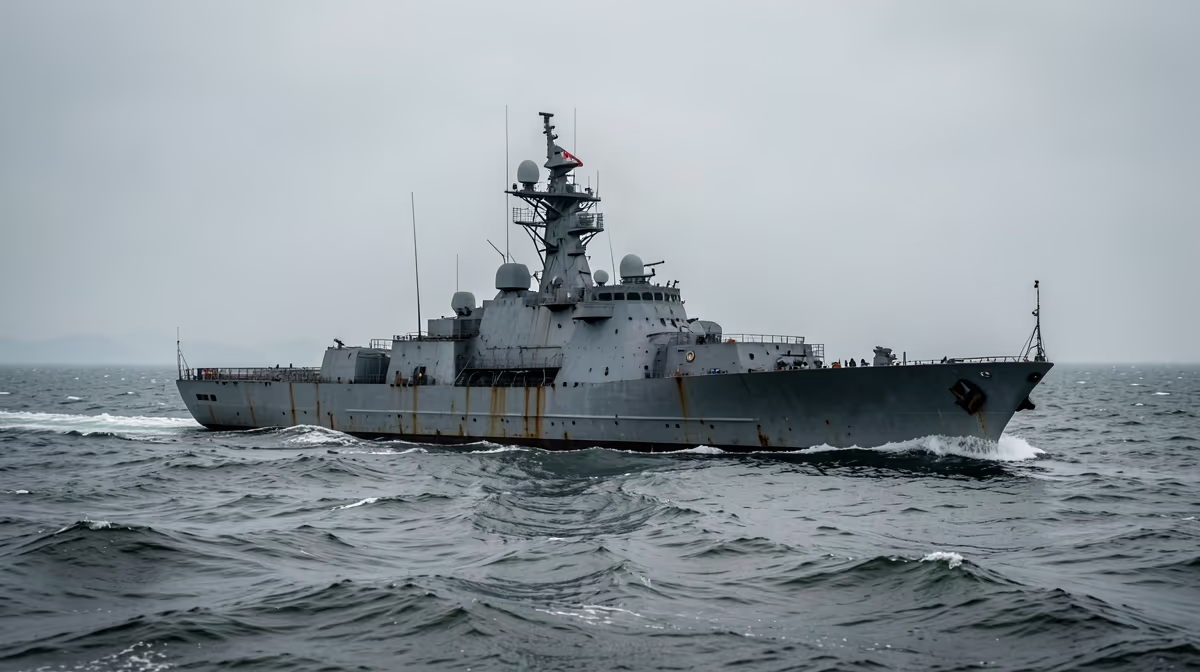
The deployment of the North Korean destroyer Choe Hyon has drawn renewed attention to the shifting balance of power in the region, highlighting North Korea naval capability in an era of heightened Korean Peninsula tension. While the vessel is often touted as a cornerstone of the nation’s maritime strength, its presence on the open sea serves as a complex intersection of historical legacy, domestic propaganda, and evolving military posturing.
The Evolution of Maritime Posturing
The vessel identified as the Choe Hyon, a Sariwon-class corvette, has become a focal point of regional security analysis following increased activity by the Korean People's Navy near the Northern Limit Line. Intelligence officials in the United States and South Korea have been monitoring the ship closely, noting that while the vessel is one of the older platforms in the fleet, it remains an active component of North Korea’s coastal defense operations.
Naming the vessel after Choe Hyon, a legendary military official and key architect of the North Korean state, serves as more than a simple commemorative act. It is a calculated mechanism to reinforce the Kim family's revolutionary legitimacy. By anchoring the state’s military identity to the anti-Japanese guerrilla heritage, the regime seeks to solidify its ideological foundations. The ship functions as a symbol of the Mount Paektu lineage, intended to project strength during periods of diplomatic standoff.
Technical Capabilities and Hardware Realities
Despite the official classification often debated in international naval circles, the vessel is fundamentally a Sariwon-class corvette. It lacks the sophisticated stealth capabilities, advanced sensor suites, and long-range engagement systems found on modern destroyers in Western or South Korean service. The ship is optimized for littoral engagements and supporting coastal batteries, prioritizing asymmetric deterrence over blue-water dominance.
The focus on such legacy platforms highlights a notable disparity between propaganda and operational reality. While the regime emphasizes the ship's role in projecting power, analysts suggest the focus on historical names obscures a broader issue of hardware obsolescence. The vessel is equipped with anti-ship missiles, anti-aircraft guns, and torpedo launchers designed for coastal environments, but it remains significantly less advanced than the assets deployed by regional neighbors or the United States. Its frequent deployment is viewed as a way to maintain a persistent, low-cost presence in contested waters.
Geopolitical Implications and Strategic Risks
The movement of the Choe Hyon cannot be viewed in isolation. As North Korea enhances its naval surface presence, it increases the risk of accidental clashes, particularly in the waters surrounding the Korean Peninsula. For the US and its allies, the vessel acts as a test of regional response times and monitoring capabilities. While there is no evidence that the ship possesses the capability to strike the US mainland, its presence is a reminder of the volatile state of maritime borders.
Economically, the continued allocation of resources to maintain and deploy aging surface combatants signals that Pyongyang prioritizes asymmetric deterrence over economic relief, a policy that continues to exacerbate the nation’s fiscal isolation. The ship serves as a persistent instrument of defiance against US-led regional containment strategies, ensuring that the maritime environment remains a theater for symbolic posturing and potential tactical friction.
Intelligence Perspectives and Future Projections
Within the next 24 hours, South Korean and US military intelligence agencies will likely increase the intensity of their monitoring to verify the status and readiness of the Choe Hyon. State media may release imagery of the vessel to assert maritime preparedness. Over the next 72 hours, analysts from the Pentagon and Indo-Pacific Command may declassify specific intelligence regarding the ship's operational deployment, which could prompt formal statements from the US State Department calling for restraint.
Experts predict that the destroyer will primarily be utilized as a platform for low-level provocations or localized testing, serving as a morale booster rather than a fundamental shift in the regional strategic balance. A best-case scenario involves the vessel remaining in port for maintenance, allowing for a temporary de-escalation of rhetoric. Conversely, a worst-case scenario would see the vessel engage in live-fire exercises near the Northern Limit Line, forcing a direct encounter with South Korean assets and necessitating an emergency response from allied naval forces.
Frequently Asked Questions
What is the Choe Hyon class destroyer?
The Choe Hyon is a class of warship operated by the Korean People's Navy, named after a high-ranking North Korean military official and defense minister. It is more accurately classified as a Sariwon-class corvette rather than a modern destroyer.
What is the history of the Choe Hyon warship?
It is a modified version of Soviet-era design principles, adapted for North Korea’s coastal defense requirements. The vessel has been in service for several decades as a part of the nation's aging naval inventory.
What are the capabilities of a North Korean vessel like the Choe Hyon?
These ships are equipped with anti-ship missiles, anti-aircraft guns, and torpedoes. While lacking the stealth and electronics of modern blue-water navies, they are optimized for littoral engagements and supporting coastal defense batteries.
Who was Choe Hyon?
Choe Hyon was a prominent military commander and close associate of Kim Il-sung who played a significant role in the establishment of the North Korean state and the Korean War.
Is the Choe Hyon currently active?
Yes, it is an active vessel within the North Korean People's Navy, though its specific mission status is often kept confidential.
How does the Choe Hyon compare to modern destroyers?
It is significantly smaller and less technologically advanced than modern destroyers used by the US or South Korea, functioning primarily as a patrol vessel for local waters.
Conclusion
The Choe Hyon remains a vital symbolic asset for North Korea, blending historical revolutionary sentiment with the practical needs of coastal patrolling. While the vessel does not represent a transformative shift in the naval balance of power in the Pacific, its deployment serves as a persistent indicator of regional tension. Future developments will depend on how the vessel is utilized in upcoming maritime exercises, with intelligence agencies maintaining a close watch to ensure that tactical posturing does not escalate into a direct security crisis. Efforts by the US and its allies continue to focus on monitoring these legacy platforms to maintain stability and prevent miscalculation in the Sea of Japan.