
Sam Altman AI Singularity Views Reveal a Shift We Did Not See Coming
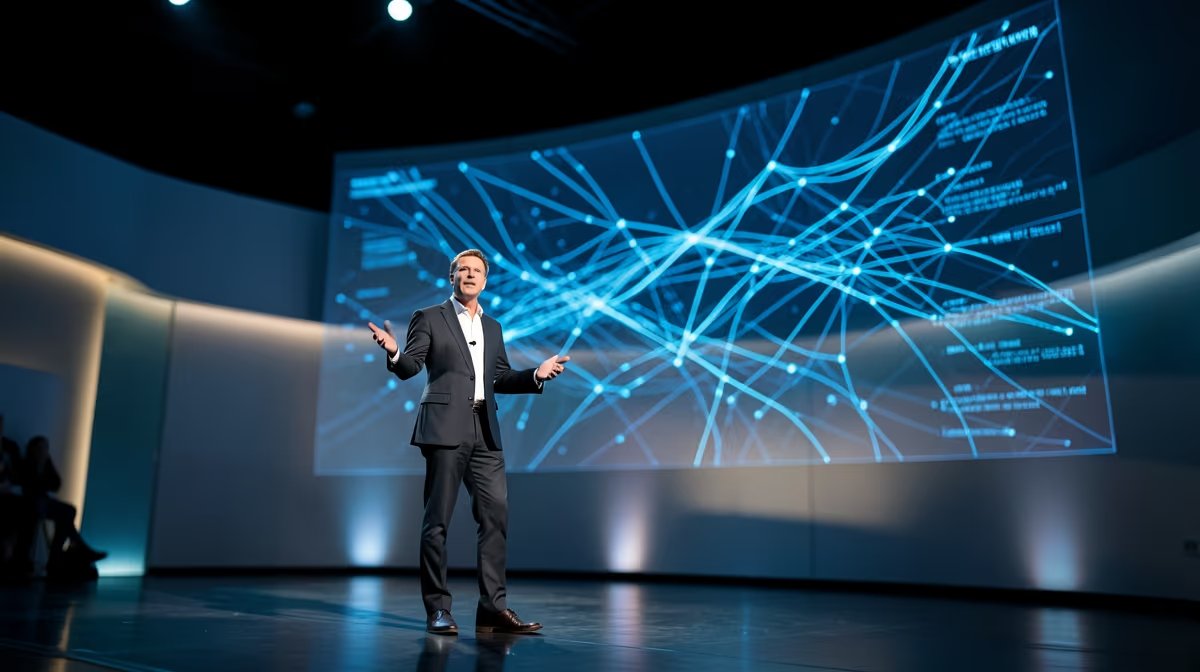
Exploring sam altman ai singularity views reveals fascinating insights into the trajectory of modern technology and what lies ahead for humanity. OpenAI CEO Sam Altman has consistently maintained a perspective that the technological singularity—a hypothetical point where artificial intelligence surpasses human intelligence and accelerates uncontrollably—is approaching within decades, fundamentally altering human civilization. This techno-messianic conviction treats achieving artificial general intelligence as an inevitable historical destiny and an existential imperative to solve humanity's greatest challenges, effectively fusing Silicon Valley techno-solutionism with a quasi-religious pursuit of creation.
Understanding Sam Altman's Perspective on the AI Singularity
Sam Altman defines the singularity as a point where AI surpasses human intelligence across all domains. He believes this technology will evolve rapidly through self-improvement and thinks AI will eventually become so advanced it can cure most major human diseases. Altman advocates for global cooperation and regulation to safely manage the transition. OpenAI was founded with the stated mission of ensuring artificial general intelligence benefits all of humanity.
Altman has frequently addressed the singularity in public forums and essays, notably emphasizing that artificial general intelligence will usher in an era of unprecedented abundance and solve complex global challenges such as climate change and disease. However, he has also underscored the existential risks associated with such a monumental technological shift, advocating for robust international governance and safety measures. Sam Altman wrote in his Moore's Law for Everything essay that the future of humanity is almost unimaginably bright and that within the next five decades, we will achieve the capability to compute anything we want and do almost anything we want.
Recent OpenAI Developments and the Path to AGI
The debate surrounding Altman's timeline often centers on the rapid scaling of large language models and the massive investments pouring into computational infrastructure. While critics argue that current architectures face fundamental limits and that singularity talk is speculative hype designed to secure funding, proponents point to exponential gains in reasoning capabilities and autonomous agent development as indicators of a shifting paradigm. Regulatory bodies in the United States and abroad are increasingly taking notice of these projections, balancing the race for AI dominance against the need for rigorous oversight. Altman's public positioning serves as both a catalyst for commercial investment and a focal point for policymakers attempting to anticipate the socio-economic disruptions of an AI-driven future.
Verified facts establish that Sam Altman is the Chief Executive Officer of OpenAI, an organization that develops advanced large language models and frontier AI systems. Altman has publicly discussed the timeline for achieving artificial general intelligence, and OpenAI has raised billions in funding from major investors including Microsoft to scale AI infrastructure. What is confirmed is that Sam Altman views the arrival of artificial general intelligence and a subsequent technological singularity as plausible within decades, necessitating proactive safety measures and governance. What is currently developing includes the exact timeline for achieving artificial general intelligence, the technical feasibility of reaching a true singularity, and the specific regulatory frameworks that governments will implement to govern advanced systems.
Societal, Economic, and Geopolitical Implications
If Altman's predictions come true, society is about to undergo the biggest transformation in history, touching every job, economy, and aspect of daily life. The choices made by tech leaders today will determine whether this super-intelligence creates a utopian future of abundance or causes massive societal disruption. Those affected include every person on Earth, particularly the global workforce, students planning careers, policymakers, and future generations. The concept of the singularity was popularized by mathematician Vernor Vinge and futurist Ray Kurzweil decades ago, but recent rapid breakthroughs in generative AI and large language models like ChatGPT have brought this science-fiction idea into mainstream business and political discussions.
The economic angle involves an unprecedented concentration of capital and the commodification of human cognition, threatening systemic displacement of labor, radical wealth concentration, and the restructuring of global markets around compute infrastructure as the ultimate currency. Politically, the centralization of planetary-scale power in the hands of a small corporate oligopoly bypasses traditional democratic oversight and shifts sovereign governance toward unelected technological technocrats who dictate the terms of human progress and security. Geopolitically, this unfolds as a high-stakes US-China techno-nationalist arms race where AI supremacy is equated with global hegemony, turning compute clusters, semiconductor supply chains, and talent acquisition into the new battlegrounds for superpower dominance. A hidden angle involves the diversion of immense physical resources—energy, water, and rare minerals—away from immediate terrestrial crises like climate change to fuel a speculative computational gods-engine, exacerbating global inequality under the guise of universal salvation.
Frequently Asked Questions
What is Sam Altman's view on the AI singularity?
Sam Altman believes the artificial intelligence singularity is approaching faster than many realize, driven by rapid scaling and algorithmic breakthroughs. He views this milestone as a pivotal turning point where machines will surpass human cognitive capabilities across virtually all domains. According to Altman, this transition will fundamentally reshape human civilization and solve some of our most complex challenges.
Does Sam Altman think AGI will lead to the singularity?
Yes, Altman connects the arrival of Artificial General Intelligence directly to the onset of the technological singularity. He has stated that once we achieve AGI, recursive self-improvement by the AI will trigger an intelligence explosion. This rapid escalation in capability is what defines his perspective on the coming singularity.
How does Sam Altman describe the timeline for the AI singularity?
Altman has often suggested that the singularity could occur within this decade, though exact timelines remain fluid as research accelerates. He emphasizes that the progression from narrow AI to superintelligence is happening much quicker than historical technological revolutions. OpenAI's primary mission is structured around safely navigating this compressed timeline.
What are the risks of the AI singularity according to Sam Altman?
While optimistic about AI's potential, Altman openly acknowledges existential risks associated with an uncontrolled intelligence explosion. He has stressed the critical need for global governance, rigorous safety testing, and alignment research before superintelligence is realized. Without these safeguards, he warns that humanity could lose control of autonomous systems.
How will the AI singularity impact the economy, according to Sam Altman?
Altman predicts the singularity will bring an era of radical abundance, drastically reducing the cost of goods, services, and labor through extreme automation. To address the displacement of traditional jobs, he advocates for economic models like a universal basic income funded by capital from AI companies. He believes this economic shift is necessary to ensure wealth is distributed equitably.
What does Sam Altman recommend humanity do to prepare for the AI singularity?
Altman urges global policymakers, scientists, and industry leaders to collaborate on international standards for safe AI development and deployment. He advocates for unprecedented transparency among leading AI labs and robust democratic oversight to prevent malicious use. Ultimately, he believes proactive preparation today is our best defense in shaping a beneficial post-singularity future.
Conclusion
Sam Altman's perspective on the technological singularity underscores a profound turning point in human history, characterized by rapid advancements toward artificial general intelligence and the promise of radical societal transformation. While OpenAI continues to scale computational infrastructure and secure massive investments, policymakers, researchers, and global markets grapple with the economic, political, and existential implications of a post-scarcity future. Navigating this compressed timeline requires balancing commercial acceleration with rigorous international governance, safety frameworks, and proactive economic models to ensure that advanced intelligence benefits all of humanity.


