
United Flight Diversion to Military Base Triggers Federal Probe
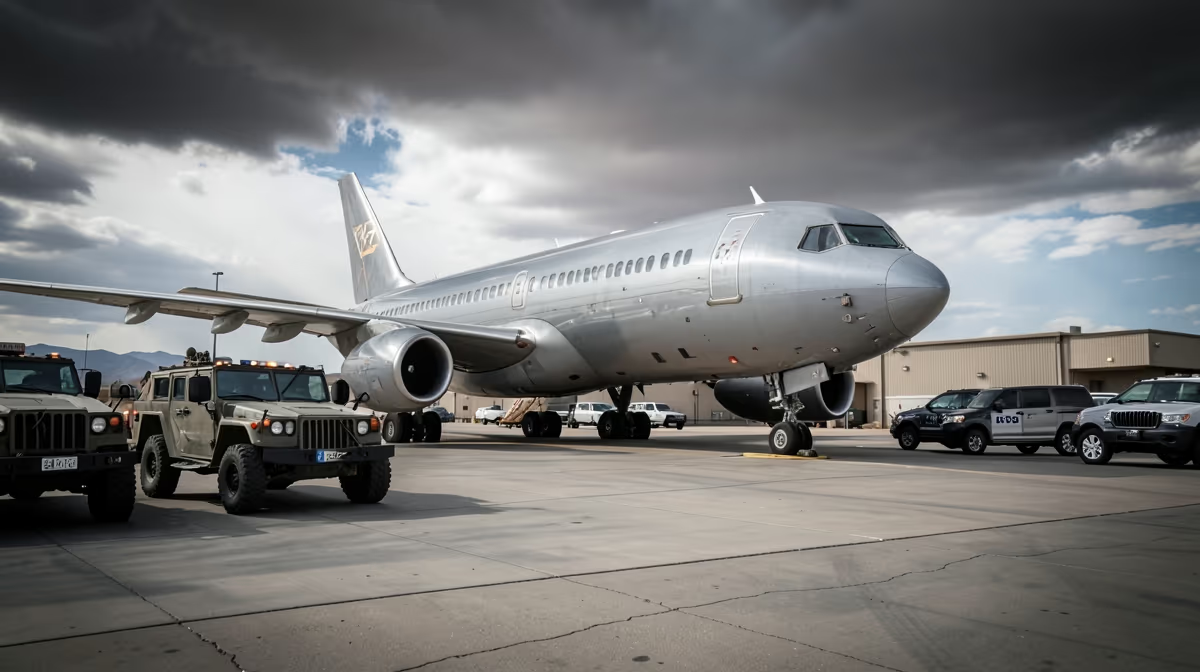
A commercial airliner experienced an unexpected united flight diversion arizona military base earlier today, prompting immediate security protocols and a federal investigation. A United Airlines flight traveling from Los Angeles to Boston was forced to divert and make an unscheduled landing at a military installation in Arizona on Tuesday afternoon following a passenger disturbance.
Flight Dynamics and the Unplanned Stop
United Airlines Flight 1239 landed safely at Davis-Monthan Air Force Base in Tucson, Arizona, after the flight crew reported a disruptive passenger who refused to comply with safety instructions. Military and local law enforcement personnel met the aircraft on the tarmac immediately upon landing. According to initial reports from aviation authorities, the flight crew requested the diversion as a precautionary measure to ensure the safety of the more than 150 passengers and crew members on board. The aircraft taxied to a secure area of the military base where federal law enforcement agencies took the unruly individual into custody without further incident.
Passengers remained on the aircraft for a brief period while security sweeps were conducted before the plane was cleared to resume its journey to Boston Logan International Airport. No injuries were reported among passengers or crew members during the airborne disturbance or the subsequent military base landing. United Airlines issued a brief statement confirming the diversion, stating that they are grateful to their crew for their professionalism in handling this situation and to local and military law enforcement for their swift assistance upon arrival in Tucson.
Protocol and Operational Triggers
While commercial aircraft typically land at civilian commercial airports, standard aviation safety protocols allow pilots to divert to the nearest suitable runway, including military bases or private airstrips, whenever an urgent situation arises in mid-air. The root cause of this incident points to an unspecified security anomaly or communication breakdown triggering automated emergency protocols near restricted airspace.
Davis-Monthan Air Force Base in Tucson and Luke Air Force Base near Glendale are among the primary military installations capable of handling large aircraft. These bases possess massive runways and robust infrastructure suitable for emergency diversions. While civilian airports are always the first choice, these military sites serve as vital backups for transcontinental flights. When a commercial flight diverts to a military base, passengers typically must remain on the aircraft due to strict federal security restrictions. Military personnel and local law enforcement monitor the situation while the airline coordinates with airport authorities for refueling, maintenance, or towing. If the stop is prolonged, alternative transportation or terminal access may be arranged under heavily escorted conditions.
Security Assessment and Civil-Military Coordination
The incident highlights the complex interplay between civil aviation authorities and defense infrastructure. There exists a distinct political dimension characterized by tension between federal civil aviation authorities and military defense command regarding domestic airspace sovereignty and transparency. At the same time, the economic angle involves immediate financial loss for the carrier, increased insurance premiums, and systemic costs related to unscheduled delays and security sweeps.
Geopolitically, such events reflect heightened domestic vigilance reflecting broader concerns over asymmetric threats and foreign intelligence probes on critical infrastructure. A hidden angle in these occurrences is the potential testing of civil-military coordination and rapid-response capabilities during a period of elevated geopolitical friction. Historically, these events draw parallels to post-9/11 intercept protocols and the frequent commercial flight diversions caused by false alarms during heightened threat environments. The timeline typically follows a strict sequence: a commercial flight deviates from its normal flight path, military air defense assets are scrambled or notified per standard protocol, and the aircraft safely lands at a designated military installation for security assessment.
Outlook and Immediate Next Steps
In the next 24 hours, airlines and federal authorities will release preliminary findings regarding the security breach or mechanical issue that prompted the diversion, while passengers are processed and interviewed. Over the next 72 hours, investigations by the Federal Aviation Administration, the National Transportation Safety Board, and the FBI will clarify whether the diversion was due to a passenger disturbance, bomb threat, or technical malfunction, with increased security protocols implemented across regional flights.
Expert predictions suggest the incident will be classified as a precautionary measure due to a non-credible threat or minor onboard disruption, leading to heightened screening procedures at departure airports rather than systemic operational changes. In the best-case scenario, the diversion is determined to be a false alarm caused by a misunderstanding or minor technical glitch, with all passengers safely resuming their journeys within 24 hours. Conversely, the worst-case scenario would link the incident to a confirmed security threat or active safety hazard, triggering widespread investigations into airport screening lapses and temporary flight disruptions.
Frequently Asked Questions
Why did a United Airlines flight divert to an Arizona military base?
United Airlines flights occasionally divert to military bases in Arizona, such as Davis-Monthan Air Force Base or Phoenix-Mesa Gateway, due to severe weather, mechanical issues, or medical emergencies. Because these bases feature extended runways and specialized facilities, they can safely accommodate commercial aircraft during unexpected crises. Federal coordination ensures that security protocols are swiftly managed when civilian planes land on military installations.
What happens to passengers when a United flight lands at a military base?
When a commercial flight diverts to a military base, passengers typically must remain on the aircraft due to strict federal security restrictions. Military personnel and local law enforcement monitor the situation while the airline coordinates with airport authorities for refueling, maintenance, or towing. If the stop is prolonged, alternative transportation or terminal access may be arranged under heavily escorted conditions.
Can commercial planes like United Airlines land at military bases normally?
Commercial airlines do not routinely use military bases for scheduled passenger service, as these facilities are primarily designated for defense operations. However, the FAA permits emergency diversions to military airfields when safety is compromised and no civilian alternative is immediately reachable. Prior clearance and communication between air traffic control and base commanders are required for these rare landings.
Which military bases in Arizona are closest for flight diversions?
Davis-Monthan Air Force Base in Tucson and Luke Air Force Base near Glendale are among the primary military installations capable of handling large aircraft. These bases possess massive runways and robust infrastructure suitable for emergency diversions. While civilian airports are always the first choice, these military sites serve as vital backups for transcontinental flights.
How do pilots handle an emergency diversion to a restricted military zone?
Pilots declare an emergency with air traffic control and immediately seek the nearest available runway that meets safety requirements. When heading toward a military base, flight crews coordinate directly with defense radar and base operations to ensure a secure approach. Security protocols are instantly triggered on the ground to guide the aircraft safely away from sensitive defense areas.
Are passengers allowed to use phones after a diversion to a military base?
Passengers are generally permitted to use their mobile phones unless instructed otherwise by the flight crew or military security personnel. However, taking photographs or recording videos of classified military equipment, aircraft, or personnel is strictly prohibited. Crew members will announce specific communication guidelines as soon as the aircraft comes to a complete stop on the tarmac.
Conclusion
The United Airlines flight carrying more than 150 passengers safely landed at Davis-Monthan Air Force Base following an airborne disturbance caused by an unruly passenger. Federal law enforcement officials took the individual into custody without incident, and no injuries were reported among passengers or crew. Authorities continue to review the event to determine appropriate legal actions, while commercial and military agencies maintain standard coordination protocols for emergency airspace responses.


