
George Washington Bridge Shooting Triggers Urgent Multi-State Alert
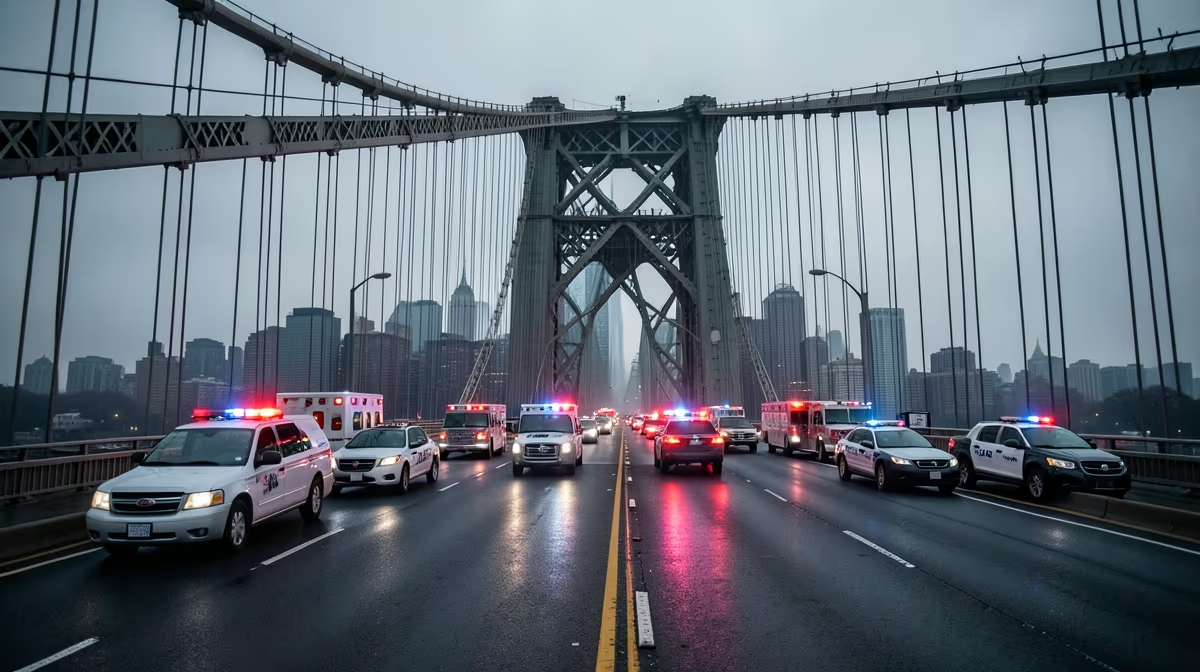
A sudden vehicle collision on one of the world’s busiest spans quickly unraveled into a lethal crime scene that brought interstate transit to an abrupt standstill. When emergency crews responded to what initially appeared to be a routine traffic accident on the crossing connecting Upper Manhattan and Fort Lee, New Jersey, they discovered the driver dead with a gunshot wound to the head. The brazen George Washington Bridge shooting has disrupted regional transit networks while triggering an intensive cross-state investigation into highway violence along vital arterial corridors.
A fatal drive-by shooting on the upper level of the George Washington Bridge has paralyzed regional transit, leaving one motorist dead and the suspect at large.
What Unfolded on the Upper Level
Emergency responders and law enforcement units converged on the upper level of the George Washington Bridge following reports of a severe vehicle collision. Upon reaching the battered vehicle, first responders discovered the driver inside, unresponsive and suffering from a fatal gunshot wound to the head.
Local reporting from ABC7 New York, FOX 5 New York, PIX11, News12 New Jersey, and the New York Post confirmed that the sequence of events began with an apparent drive-by attack mid-transit. The gunfire caused the victim's vehicle to crash, immediately blocking lanes on the upper deck. Law enforcement quickly cordoned off the area to preserve ballistic evidence, identify the victim, and determine the trajectory of the gunfire.
The immediate operational response required the partial shutdown of the upper span. Because the George Washington Bridge serves as a primary conduit between New York City and northern New Jersey, closing travel lanes instantly generated severe regional gridlock. Thousands of motorists found themselves trapped on the bridge approach ramps as patrol cruisers, forensic investigators, and emergency vehicles occupied the roadway.
Investigation and Law Enforcement Mobilization
The homicide triggered a coordinated multi-agency response, mobilizing the New York Police Department alongside New Jersey law enforcement agencies and transit police. Investigators are focusing their efforts on identifying the perpetrator, who fled the scene immediately after the gunfire and remains at large.
Detectives face complex challenges when processing a crime scene located on an interstate bridge. Vehicle movement, heavy traffic volume, and rapid egress routes allow suspects to exit into differing state jurisdictions within minutes. Law enforcement agencies have concentrated their initial operational timeline on several critical investigative steps:
- Securing physical ballistics and forensic evidence from the victim's crashed vehicle and surrounding roadway.
- Canvassing the upper level for immediate eyewitness accounts among stranded motorists and commercial drivers.
- Retrieving and examining high-density traffic camera footage across all bridge toll plazas, ramps, and approaches.
- Coordinating inter-agency intelligence between New York and New Jersey jurisdictions to track potential escape corridors.
Law enforcement authorities have urged the public and any motorists who crossed the span during the incident to come forward with dashboard camera footage or relevant observations to assist the active manhunt.
Critical Infrastructure and Transit Choke Points
The incident exposes significant security vulnerabilities inherent to high-volume transit chokepoints. Connecting Upper Manhattan directly to Fort Lee, the George Washington Bridge operates as a critical arterial lifeline for the entire Northeast corridor. When violent crime occurs directly on the infrastructure itself, emergency containment runs directly counter to traffic evacuation protocols.
The physical design of suspension bridges limits escape routes for civilian drivers while presenting unique operational hurdles for emergency vehicles attempting to navigate through miles of bumper-to-bumper congestion. When an act of violence occurs in moving traffic, surrounding motorists are effectively immobilized, creating both immediate physical danger and severe operational friction for responding tactical units.
Incidents on major transit arteries pose severe public safety concerns regarding gun violence while triggering instant regional paralysis across interconnected metropolitan networks.
The fatal shooting underscores the difficulty of monitoring thousands of moving vehicles simultaneously. Although major bridge crossings maintain extensive surveillance networks, detecting concealed weapons inside private passenger vehicles in real time remains functionally impossible without total gridlock. This reality leaves transit security forces reliant on rapid post-incident interdiction rather than real-time prevention.
The Economic and Commuter Toll of Bridge Gridlock
Beyond the direct criminal investigation, an emergency closure of the George Washington Bridge creates immediate economic and operational fallout. As one of the world's most heavily traveled vehicular bridges, any sudden lane closure impacts regional supply chains, interstate freight haulers, public transit bus lines, and thousands of daily commuters.
The economic fallout of unexpected shutdowns manifests across several key areas:
- Direct disruption of commercial freight logistics moving goods between New England, New York City, and central distribution hubs in New Jersey.
- Severe commuter delays that ripple outward into secondary crossings, overwhelming local surface streets in Upper Manhattan and Bergen County.
- Increased resource expenditure for regional law enforcement agencies forced to deploy extensive personnel for traffic redirection and scene preservation.
- Compounded psychological strain and anxiety for daily drivers navigating an increasingly high-stress urban transportation network.
For metropolitan commuters, the incident adds an acute layer of safety concern to an already taxing daily transit routine. When an everyday highway crossing becomes the site of an apparent drive-by homicide, public confidence in regional transit safety is inevitably shaken.
Historical Precedents and Regional Governance
The logistical chaos stemming from the bridge closure recalls past incidents that underscored the extreme fragility of the Hudson River crossings. The most famous operational disruption in the facility's modern history occurred during the 2013 Bridgegate lane closure political scandal, which demonstrated how manipulating a handful of toll access lanes in Fort Lee could immobilize an entire municipality within hours.
Similarly, historic security alerts on the George Washington Bridge have repeatedly demonstrated that any disruption on the structure generates an immediate domestic impact. Because the span connects two separate sovereign states, administrative oversight falls heavily under the Port Authority of New York and New Jersey, working alongside municipal police departments.
This complex administrative architecture increases the political pressure on transit authorities and oversight boards. Regional leadership faces immediate scrutiny regarding the efficacy of bridge monitoring systems, rapid-incident containment protocols, and the deployment of Port Authority police units. State and municipal officials are tasked with balancing rigorous physical security against the logistical necessity of keeping hundreds of thousands of vehicles moving daily.
The Operational Outlook and Next 72 Hours
Law enforcement agencies are operating under a tight investigative window as the search for the shooter expands across state borders. Over the next 24 hours, regional authorities are expected to release preliminary findings regarding the victim's identity, the vehicle involved, and updated assessments of commuter traffic patterns across the upper and lower levels.
During the next 72 hours, investigative priorities will pivot toward comprehensive forensic analysis. Specialists will examine ballistic evidence recovered from the upper deck, synthesize high-resolution traffic camera footage from bridge approaches, and verify potential license plate reader data to trace the suspect’s route before and after the shooting.
| Scenario | Anticipated Developments | Operational Impact |
|---|---|---|
| Best-Case Outcome | Rapid identification and apprehension of the suspect via surveillance tracking without incident. | Traffic normalization across all bridge levels and stabilization of commuter confidence. |
| Worst-Case Outcome | The suspect remains unidentified and at large across state lines amid prolonged evidentiary processing. | Heightened security checks, continued commuter delays, and persistent regional transit anxiety. |
Security analysts anticipate that regional transit officials will face demands for heightened vehicle checkpoints and elevated surveillance presence around major metropolitan crossings. Balancing commuter transit speed against aggressive highway interdiction remains the primary strategic challenge facing regional law enforcement in the days ahead.
Frequently Asked Questions
What happened during the George Washington Bridge shooting?
A motorist was found shot in the head on the upper level of the George Washington Bridge after their vehicle crashed. Police and news sources indicate it was a targeted drive-by shooting, which led to significant emergency responses and traffic disruptions.
Where exactly did the shooting take place?
The incident occurred on the upper level of the George Washington Bridge, a major transit crossing connecting New York and New Jersey. The location caused immediate shutdowns and severe delays for commuters traveling across the bridge.
Who was affected by the George Washington Bridge incident?
The primary victim was the driver who was fatally shot inside their vehicle. Additionally, thousands of drivers and commuters experienced major delays and gridlock as law enforcement shut down sections of the bridge to investigate the crime scene.
Has the suspect in the George Washington Bridge shooting been caught?
According to initial reports from law enforcement sources, the suspect remained at large immediately following the attack. Police agencies launched an ongoing manhunt to track down the individual responsible for the drive-by shooting.
Why does this shooting matter for regional traffic and safety?
As one of the busiest bridge crossings in the world, any fatal incident or major crime investigation on the George Washington Bridge severely impacts regional transit. The event highlights ongoing concerns regarding highway safety and rapid emergency response protocols in the metropolitan area.
What happens next in the George Washington Bridge investigation?
Law enforcement agencies are continuing to analyze evidence from the scene, review traffic and security camera footage, and interview witnesses. Authorities are working to piece together the events leading up to the crash and locate the suspect.
Conclusion
The fatal shooting on the upper level of the George Washington Bridge has brought critical vulnerabilities in metropolitan transit security into sharp focus. With the victim confirmed dead from a gunshot wound to the head and the perpetrator remaining at large, the multi-jurisdictional investigation led by New York and New Jersey authorities continues to center on digital surveillance tracking, forensic ballistic analysis, and witness outreach. As regional traffic flows are gradually restored, the incident leaves transit operators and law enforcement confronting the operational difficulties of policing vital transit choke points that carry hundreds of thousands of travelers daily.
Sources
- George Washington Bridge shooting: Driver found shot in head after crash — ABC7 New York
- Manhattan’s only lighthouse, made famous in children’s book, to get $13M facelift — New York Post
- Man shot on upper level of George Washington Bridge, police say — FOX 5 New York
- Fatal shooting shuts down George Washington Bridge: police — PIX11
- Source Driver Found Shot In The Head On Upper Level Of George Washington Bridge — News12 | New Jersey
- Motorist killed in drive-by shooting on George Washington Bridge, suspect remains in the wind: sources — New York Post


