
Yemen Conflict Escalation Signals a Dangerous Shift in Global Trade
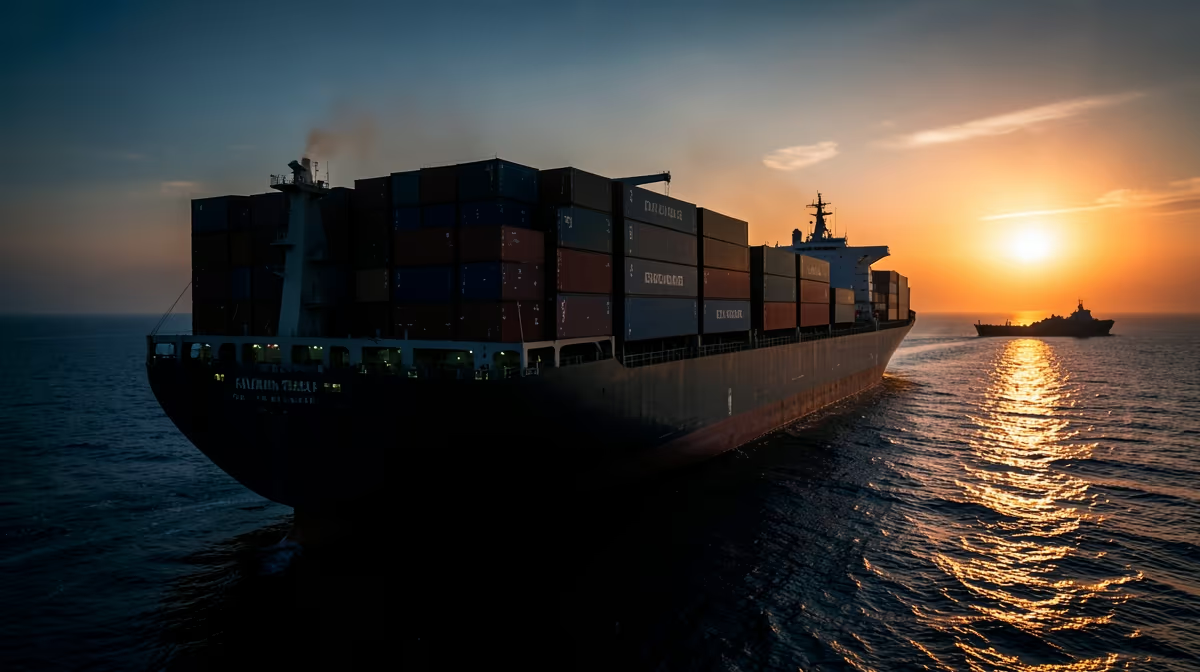
A clandestine theater of war, once relegated to the fringes of global attention, now holds the jugular of international commerce hostage through the tactical weaponization of the Red Sea. The escalating situation in Yemen continues to dominate international headlines as the Red Sea crisis disrupts global shipping routes, forcing a recalibration of naval strategy and supply chain management for the world’s most powerful economies.
The Historical Roots of a Fractured State
The current instability in Yemen is not a modern aberration but the result of a long-standing civil war that ignited in 2014 when Houthi insurgents seized the capital city, Sana'a. This move shattered the existing political order following the post-Arab Spring collapse of the 2011 National Dialogue. The power vacuum left in the wake of former leader Ali Abdullah Saleh's departure allowed the Zaydi Shia Houthi movement to assert dominance in the northern highlands, effectively pitting them against the internationally recognized Presidential Leadership Council.
By 2015, the intervention of a Saudi-led military coalition, seeking to restore the ousted government, transformed an internal power struggle into a protracted proxy conflict. This internationalization of the war mirrored historical precedents, specifically the 1960s North Yemen Civil War, where local tribal fractures became conduits for external regional rivalries. Decades of marginalization between the north and south, combined with deep-seated sectarian tensions, have ensured that the conflict remains a high-risk stalemate.
The Red Sea Crisis and Global Security
What was once a localized struggle has spilled into the maritime domain, turning the Bab el-Mandeb Strait into a frontline for international security. Houthi forces, officially known as Ansar Allah, have launched a persistent campaign against commercial shipping, asserting that their attacks are a moral duty in support of Palestinians in Gaza. This strategy has forced major global shipping lines to bypass the Red Sea entirely, opting for the longer, more expensive route around the Cape of Good Hope.
The disruption has prompted a robust military response from the United States and the United Kingdom, who have conducted multiple rounds of airstrikes targeting Houthi missile and drone infrastructure. Despite these efforts, the group maintains a significant arsenal, signaling that the maritime corridor will remain a zone of friction for the foreseeable future. This dynamic represents a major geopolitical shift: non-state actors are now successfully challenging the traditional naval architecture that has protected global trade routes for generations.
Humanitarian Consequences of Prolonged Conflict
Beyond the radar of military strategists, the human toll of the conflict remains devastating. The United Nations consistently classifies the situation in the country as the world's largest humanitarian crisis, with more than 20 million people requiring urgent assistance. Years of airstrikes, blockades, and the total degradation of the national currency have dismantled the state's infrastructure, leaving millions in a cycle of famine, disease, and poverty.
The recent maritime instability has only exacerbated this suffering. As the cost of imported goods, fuel, and food rises, the most vulnerable populations—particularly children—face an increasingly precarious existence. The weaponization of trade routes has effectively turned the basic survival of the Yemeni people into a bargaining chip, as warlords and localized tribal factions exploit the war economy for personal gain, stalling peace negotiations at every turn.
Analyzing the Strategic Stalemate
From a geopolitical perspective, the conflict serves as a primary theater for the regional rivalry between Saudi Arabia and Iran. While the Houthi movement relies on Iranian-linked logistics, the regional powers find themselves trapped in a cycle of limited engagement that prevents full-scale war but ensures perpetual instability. The internal exploitation of the status quo by various factions means that diplomatic progress remains elusive.
Current military projections suggest a high-risk future. Over the next 24 hours, analysts expect an uptick in Houthi drone and missile activity, likely followed by retaliatory surveillance or precision strikes by the U.S.-led coalition. Within 72 hours, diplomatic pressure is anticipated to intensify at the UN Security Council as maritime powers attempt to secure commercial corridors. The best-case scenario involves backchannel negotiations mediated by Oman, potentially leading to a temporary de-escalation of maritime attacks in exchange for increased humanitarian access. Conversely, the worst-case scenario involves a miscalculated strike resulting in significant loss of coalition life, which would force a wide-scale military escalation.
Expert Perspective on Future Outlook
The prevailing expert consensus is that the conflict will remain a series of persistent, low-intensity skirmishes. This strategy serves to keep the region in a state of flux without triggering an all-out regional war. For international business leaders and policy makers, this indicates that the volatility in energy markets and logistics costs is not a temporary anomaly but a new baseline.
The ability of the Houthi movement to continue operations despite international military intervention suggests that traditional air power may have reached the limits of its effectiveness in this theater. Until the underlying issues—the collapse of state functions and the regional proxy dynamics—are addressed, the maritime security architecture will remain under constant threat.
Frequently Asked Questions
Why is there a war in Yemen?
The war began in 2014 when Houthi insurgents took control of the capital, Sana'a. It has since evolved into a complex multi-party conflict involving international coalitions and internal factions competing for political control.
What is the current humanitarian situation in Yemen?
Yemen is facing one of the world's largest humanitarian crises, characterized by widespread famine, disease outbreaks, and a collapse of essential public services. Millions of people require urgent food, water, and medical aid.
Is Yemen safe for tourists right now?
No. Most governments advise against all travel to Yemen due to severe security threats including armed conflict, terrorism, and the risk of kidnapping.
Who are the Houthis in Yemen?
The Houthis, or Ansar Allah, are a Zaydi Shia political and militant movement from northern Yemen that controls the capital and much of the north.
What is the main religion in Yemen?
The population is almost entirely Muslim, split between Zaydi Shia and Shafi'i Sunni branches, which have historically coexisted despite modern political tensions.
What is Yemen famous for?
Yemen is famous for its ancient architecture, including UNESCO-listed mud-brick skyscrapers, and its historic status as a major hub for the international coffee trade.
Conclusion
The instability in Yemen has transcended its origins as a civil war, evolving into a significant threat to global energy supply chains and maritime security. While military coalitions and diplomatic mediators continue to grapple with the daily disruptions in the Red Sea, the core issues remain unresolved. The immediate future holds a high probability of continued low-intensity skirmishes and ongoing economic strain, with the civilian population bearing the heaviest burden of the stalemate. Moving forward, the effectiveness of backchannel negotiations will be the primary indicator of whether the region can move toward de-escalation or if it will continue to serve as a volatile bottleneck for international trade.


.webp)


.webp)
