
Nancy Grace Roman Space Telescope Launch Sparks New Cosmic Search
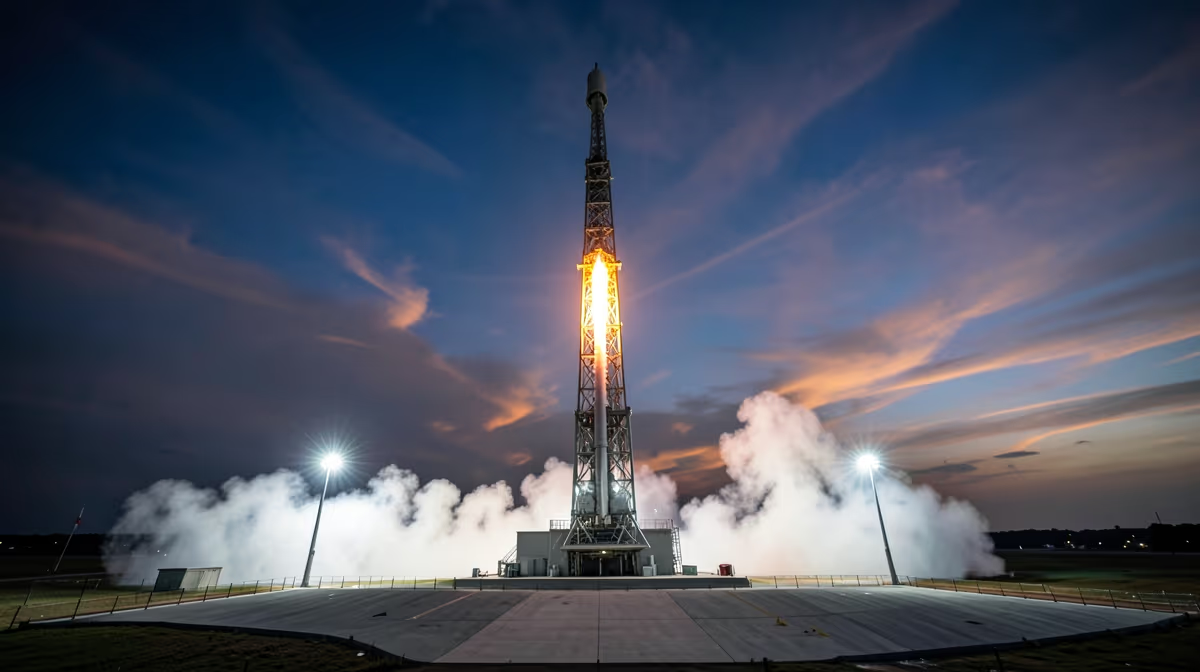
earthinsider.in brings you the latest developments on the Nancy Grace Roman Space Telescope. What secrets of the deep universe await as humanity casts its gaze toward the cosmic unknown? A collaborative effort between NASA and SpaceX has officially sent a powerful new observatory into space, aiming to decode some of the most mysterious forces governing the cosmos.
Mission Objectives and Capabilities of the Roman Space Telescope
NASA and SpaceX have successfully launched the Nancy Grace Roman Space Telescope from Florida's Space Coast, embarking on a mission designed to spot the weird, the rare, and the unusual in the universe. The launch took place from Cape Canaveral, Florida, drawing widespread coverage as space agencies collaborate on deploying this new observatory. The Nancy Grace Roman Space Telescope aims to expand our understanding of the cosmos by focusing on unique and elusive astronomical phenomena.
Ahead of the liftoff, space enthusiasts and researchers closely followed updates on how to watch the mission unfold live. Media outlets tracked the preparations and the eventual successful deployment from Florida's Space Coast. With the telescope now successfully launched, the mission enters its next phase of operations. Scientists and astronomers anticipate that the observatory will soon begin providing unprecedented data regarding the deep universe, helping to answer long-stating questions in astrophysics.
What to Expect from the Upcoming NASA Space Launch
The imperative to advance deep space observation capabilities forms the root cause of this mission, specifically to investigate dark energy, dark matter, and exoplanets through wide-field infrared astronomy. Continued bipartisan support for NASA's flagship astrophysics missions highlights space science as a rare area of consensus in US domestic policy, serving as a soft-power instrument for the administration.
Collaboration with commercial spaceflight providers like SpaceX demonstrates the ongoing cost-optimization of heavy-lift rocket launches, while feeding multi-million dollar contracts into the aerospace manufacturing sector. Furthermore, this initiative reinforces US technological dominance and leadership in multinational space exploration, setting technical benchmarks that influence global scientific partnerships and shared cosmic data access.
The vast collection of wide-field infrared data generated by the Roman Space Telescope could inadvertently catalyze new dual-use space situational awareness capabilities, tracking orbital debris or foreign spacecraft with unprecedented clarity. Historically, this mirrors the 1990 launch of the Hubble Space Telescope, which similarly revolutionized observational astronomy and reshaped public and geopolitical perceptions of US scientific supremacy.
Timeline of the Mission
- August 25, 2026: Media outlets outline public viewing and broadcast schedules for the upcoming launch.
- August 30, 2026: NASA and SpaceX successfully launch the Nancy Grace Roman Space Telescope from Florida's Space Coast.
- Post-Launch Phase: The telescope begins calibration to scan the cosmos for the weird, rare, and unusual.
Project Background and Key Facts
Named after NASA's first Chief of Astronomy, often dubbed the Mother of Hubble, this observatory builds on decades of space exploration technology. It was developed to address critical questions in astrophysics by combining a wide field of view with Hubble-like sensitivity. Space telescopes deployed above Earth's atmosphere can capture clearer, unobstructed views of the universe compared to ground-based observatories.
- The Nancy Grace Roman Space Telescope successfully launched on August 30, 2026.
- The launch took place from Florida's Space Coast, specifically Cape Canaveral.
- The mission is a collaborative effort involving NASA and SpaceX.
- The telescope's primary scientific goals include spotting the weird, the rare, and the unusual in the universe.
- Coverage of the event was provided by major outlets including CNN, Engadget, WFLA, WESH, and ABC11 News.
Operational Outlook and Projections
Coverage over the next 24 hours will focus on the immediate aftermath of the Nancy Grace Roman Space Telescope launch, including initial telemetry checks and mission status updates from launch authorities. Following that, in the next 72 hours, analyses and technical reports regarding the successful deployment phase, trajectory adjustments, and initial calibrations of the space telescope's instruments will be published.
Analysts would likely expect continuous monitoring of the observatory as it travels to its operational destination, with early attention turning toward the commissioning phase of its wide-field infrared imaging capabilities. In the best-case scenario, the telescope achieves a flawless launch and precise trajectory insertion, allowing all initial systems to power on smoothly and keeping the mission on track to study dark energy, dark matter, and exoplanets. Conversely, unforeseen technical anomalies during launch or deployment phases could prompt prolonged troubleshooting by mission controllers, delaying early-stage science operations.
The Nancy Grace Roman Space Telescope successfully launched from Cape Canaveral to revolutionize wide-field infrared astronomy and investigate cosmic dark energy.
Frequently Asked Questions
What is the NASA Nancy Grace Roman Space Telescope and when did it launch?
The NASA Nancy Grace Roman Space Telescope is a new observatory launched to spot the weird, the rare, and the unusual in the universe. It successfully lifted off from Florida's Space Coast via a SpaceX rocket to begin its groundbreaking mission.
Why does the launch of the Nancy Grace Roman Space Telescope matter?
This powerful telescope matters because it is designed to peer deep into the cosmos to unlock mysteries surrounding dark energy and dark matter. By observing vast areas of space with unprecedented infrared capability, it will help scientists understand the fundamental physics of cosmic expansion.
Who is affected by the Nancy Grace Roman Space Telescope mission?
The mission directly impacts the global astronomical community, researchers, and space enthusiasts who rely on advanced data to study the universe. It also benefits future generations by expanding human knowledge of exoplanets and cosmic evolution.
What happens next now that the telescope has been launched?
Following its successful launch from Cape Canaveral, mission controllers will oversee the telescope's journey to its operational orbit and the delicate deployment of its instruments. Once calibration is complete, the observatory will begin capturing its first deep-space images and gathering vital scientific data.
What is the background of the Nancy Grace Roman Space Telescope project?
Named after NASA's first Chief of Astronomy, often dubbed the 'Mother of Hubble,' this observatory builds on decades of space exploration technology. It was developed to address critical questions in astrophysics by combining a wide field of view with Hubble-like sensitivity.
Where did the Nancy Grace Roman Space Telescope launch from?
The telescope was launched from Florida's Space Coast at Cape Canaveral utilizing a SpaceX rocket. The liftoff drew significant media attention from outlets like CNN, Engadget, and WESH as it successfully headed into space.
Conclusion
The successful launch of the Nancy Grace Roman Space Telescope from Cape Canaveral marks a major milestone for NASA, SpaceX, and the global scientific community. As initial telemetry checks and instrument calibrations unfold over the coming days, the observatory is positioned to advance humanity's understanding of dark energy, dark matter, and elusive cosmic phenomena. Mission controllers will continue to oversee its journey toward operational status as researchers prepare for a new era of infrared astronomy.
Sources
- NASA’s newest space telescope launches to spot ‘the weird, the rare and the unusual’ — CNN
- How To Watch The Nancy Grace Roman Space Telescope's Launch — Engadget
- Nancy Grace Roman Space Telescope — NASA Science (.gov)
- NASA, SpaceX launch new Nancy Grace Roman Telescope — WFLA
- Nancy Grace Roman space telescope launches from Florida's Space Coast — WESH
- LIVE: NASA to launch Nancy Grace Roman Space Telescope from Cape Canaveral, Florida — ABC11 News


.webp)