
Operation Safed Sagar Revealed The Untold High Altitude Air War Risks
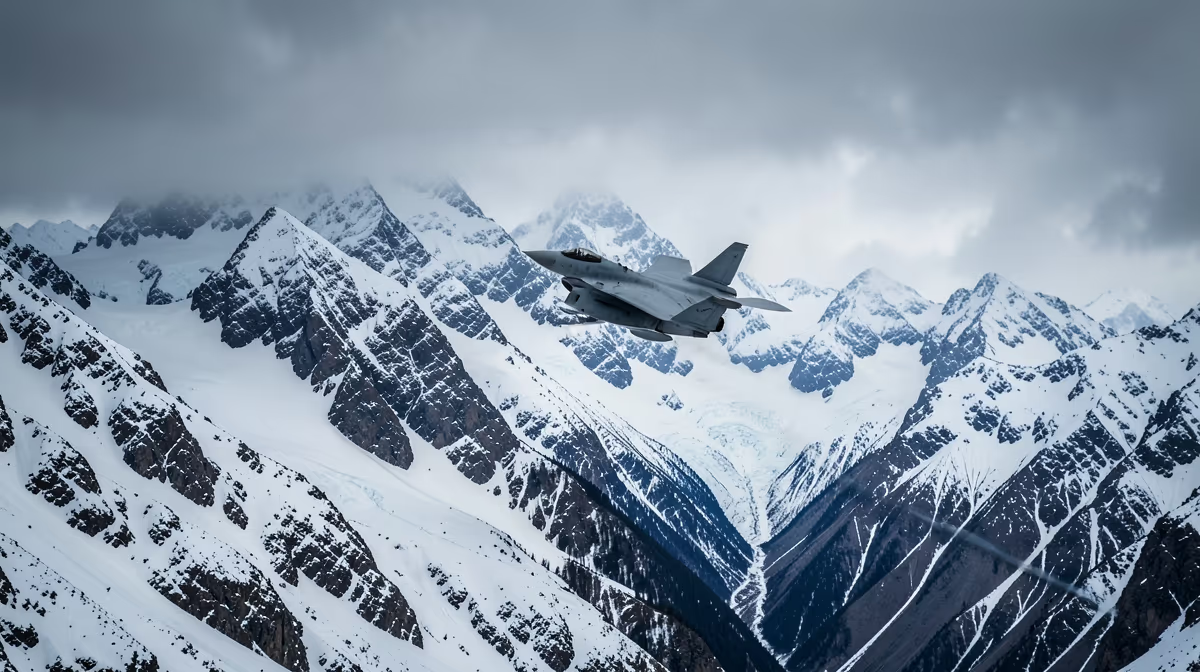
During the 1999 Kargil War, the Indian Air Force launched operation safed sagar, deploying fighter jets and helicopters at extreme high altitudes to dislodge Pakistani intruders entrenched in the rugged heights of Jammu and Kashmir. This remains one of the most critical military engagements in modern Indian history, showcasing the strategic power of the indian air force operations during the 1999 conflict. Operating in narrow valleys under the constant threat of surface-to-air missiles, pilots faced unprecedented logistical and tactical challenges that fundamentally altered modern high-altitude air warfare.
Background Context and Root Causes
The Kargil War began when Pakistani soldiers and militants secretly crossed the Line of Control and occupied vacant winter outposts on the Indian side of Kashmir. Operation Safed Sagar was the air component of the wider military response to evict them. Analysts point to a miscalculated risk assessment by the Pakistan Army regarding India's willingness to cross the Line of Control using air power, combined with the strategic imperative to internationalize the Kashmir dispute, as the primary root cause of the conflict. The clandestine infiltration of Pakistani regular troops into vacant winter positions across the Line of Control occurred during the winter of 1998 to 1999, remaining undetected until May 1999 when the intruders were officially discovered, prompting the launch of the Indian Army Operation Vijay followed immediately by the Indian Air Force combat deployment.
Operational Dynamics and High-Altitude Challenges
Initiated in May 1999, Operation Safed Sagar marked the first time air power was utilized in such mountainous terrain and at such high altitudes. Fighter aircraft operated at altitudes exceeding 15,000 feet, facing severe environmental and tactical challenges where the thin air severely reduced payload and engine performance. MiG-21, MiG-23, MiG-27, and Mirage 2000 aircraft were deployed to carry out precision strikes against heavily fortified enemy bunkers, supply lines, and command posts perched above 15,000 feet. The aerial campaign worked in tandem with the Indian Army ground forces, significantly reducing the time and infantry casualties required to clear the strategic peaks. Pilots relied on visual bombing techniques and steep dive-bombing profiles to achieve maximum accuracy in restricted spaces. The logistical and technological failure of early Indian fighter jets like MiGs and Canberras at high altitudes forced a rapid, improvised tactical evolution, leading to the highly effective deployment of Mirage 2000s equipped with laser-guided bombs.
Key Facts of the Campaign
Operation Safed Sagar was officially launched in May 1999 by the Indian Air Force. The campaign utilized fighter jets including MiG-21s, MiG-23s, MiG-27s, and Mirage 2000s, operating at extreme high altitudes often ranging between 10,000 and 18,000 feet above sea level. This marked the first time air power was used extensively in such mountainous terrain. The Mirage 2000 fleet served as a game-changer by dropping laser-guided bombs on enemy supply dumps, logistics hubs, and command posts on Tiger Hill and Tololing. Additionally, Mi-17 and Chetak helicopters were extensively used for combat air support, reconnaissance, and casualty evacuation. Despite these successes, the operation saw operational hazards, resulting in the loss of one MiG-21 and one MiG-27 to enemy fire during the initial phase.
Geopolitical and Economic Dimensions
The conflict carried significant wider implications across political, economic, and diplomatic spheres. Prime Minister Atal Bihari Vajpayee's government leveraged the crisis to project decisive leadership ahead of general elections, while Pakistan's civilian leadership under Nawaz Sharif claimed ignorance of the military operation led by General Pervez Musharraf. Economically, the conflict diverted critical defense capital toward emergency procurement, increased India's long-term defense budget prioritization, and strained Pakistan's already fragile foreign exchange reserves and International Monetary Fund bailout negotiations. Geopolitically, the war marked a paradigm shift in United States-India relations as the Clinton administration pressured Pakistan to withdraw unconditionally, signaling a nascent strategic realignment in South Asia away from Cold War dynamics. Air Chief Marshal A.Y. Tipnis, who led the IAF during the conflict, emphasized the strategic necessity of air power, stating that the deployment was decisive in breaking the enemy's logistical backbone and morale in terrain where artillery alone proved insufficient.
Strategic Outlook and Tactical Implications
Retrospective military analyses and declassified documents continue to offer deeper insights into the technological adaptations and tactical innovations developed during the high-altitude air campaign. In the immediate tactical window, ongoing military assessments project that the deployment of air power proves decisive in neutralizing high-altitude logistical advantages held by entrenched forces, forcing gradual retreats under intense international diplomatic pressure. The best-case operational scenario involves rapid air-ground coordination successfully cutting off enemy supply routes to secure the swift recovery of occupied heights with minimal friendly casualties. Conversely, the worst-case assessment highlights the constant risk of escalation in aerial combat leading to cross-border aircraft losses or the widening of localized conflict into a broader conventional engagement between nuclear-armed states. Ultimately, the strategic objectives of Operation Safed Sagar were fully met, cutting off enemy supply lines and providing critical close-air support that facilitated the eventual recapture of all occupied heights by the Indian Army on July 26, 1999, altering military doctrine permanently.
Frequently Asked Questions
What was Operation Safed Sagar during the Kargil War?
Operation Safed Sagar was the code name assigned to the Indian Air Force combat role during the 1999 Kargil War, involving close air support to the Indian Army and the neutralization of fortified Pakistani infiltrator positions on high-altitude mountain ridges.
When did Operation Safed Sagar take place?
The operation was officially launched on May 26, 1999, following the Indian Army Operation Vijay, and continued actively until the intrusion was cleared and forces retreated in July 1999.
Why was Operation Safed Sagar unique and challenging?
The operation was unique because it was conducted at extreme altitudes ranging from 10,000 to 18,000 feet, where thin air reduced payload and engine performance, requiring innovative high-altitude bombing tactics.
Which aircraft were used in Operation Safed Sagar?
The IAF deployed MiG-21s, MiG-23s, MiG-27s, and Mirage 2000s for precision strikes, alongside Mi-17 and Chetak helicopters for combat air support, reconnaissance, and casualty evacuation.
What role did the Mirage 2000 play in the Kargil War?
The Mirage 2000 fleet served as a game-changer by utilizing laser-guided bombs to destroy enemy bunkers, logistics hubs, and command posts on Tiger Hill and Tololing.
What were the main achievements of Operation Safed Sagar?
The operation successfully destroyed critical enemy supply camps and ammunition dumps, demoralized intruders, shortened the conflict duration, and minimized ground troop casualties.
Conclusion
Operation Safed Sagar stands as a landmark military engagement that redefined high-altitude air warfare and proved the indispensable value of air power in mountainous terrain. The verified developments of the 1999 conflict underscore how precision air support, combined with ground coordination, successfully neutralized entrenched enemy positions and restored territorial integrity along the Line of Control. As military historians and defense analysts continue to examine declassified records and technological evolutions from the campaign, the strategic lessons of Operation Safed Sagar remain central to modern defense doctrine and operational planning.


.webp)
