
US Government Shutdown Avoided as Senate Reaches Last-Minute Deal
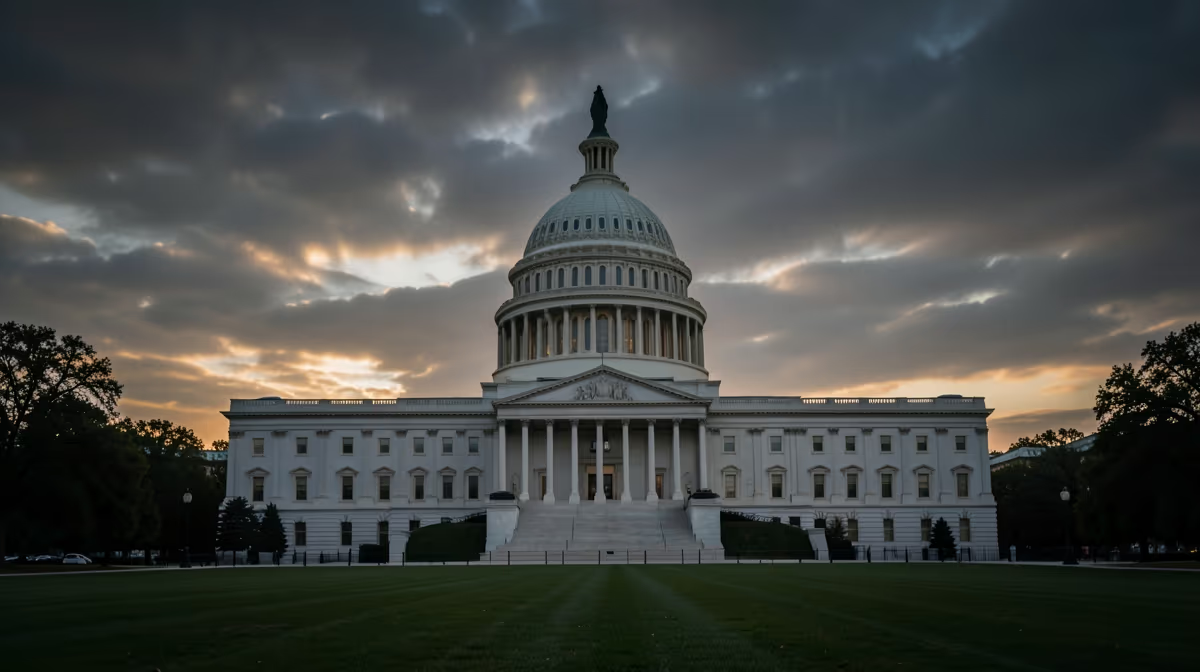
Deep structural gridlock within the United States legislature routinely pushes the federal apparatus to the edge of administrative collapse, requiring frantic eleventh-hour interventions to keep basic government functions online. The U.S. Senate overwhelmingly passed a bipartisan stopgap funding bill on Thursday, successfully averting a partial government shutdown just hours before federal funding was set to expire. This legislative maneuver, designed to buy time for deeper fiscal negotiations, prevents immediate operational chaos while exposing the brittle nature of congressional consensus.
What Unfolded
The legislation, which extends federal funding for several government agencies through early March and others through late March, passed with a 77-18 vote. Lawmakers had faced a tight midnight deadline to reach an agreement, with disagreements over border security and broader spending caps threatening to derail negotiations in the days leading up to the vote.
Following the Senate's action, the House of Representatives quickly took up and passed the bipartisan funding measure, ensuring it reached the president's desk just in time. The bill requires the signature of President Joe Biden to become law, which is expected before the deadline. The measure prevents a partial government shutdown that was slated for midnight, ensuring federal agencies resume normal operations while financial markets react with stability. Key players in these high-stakes negotiations included Chuck Schumer, Mitch McConnell, Mike Johnson, and Joe Biden, whose leadership proved vital in navigating the razor-thin majorities and ideological divides within Congress.
The Numbers Behind The Story
The mechanics of this temporary extension are rooted in the legislative tool known as a continuing resolution. A continuing resolution, or CR, is a temporary legislative measure that extends existing federal funding levels for a specific period. By temporarily prolonging current budgets, it buys Congress crucial time to resolve ongoing spending disputes without halting government operations.
The duration of the funding extension depends on the specific stopgap legislation recently passed by Congress, typically lasting anywhere from a few weeks to a couple of months. This window allows lawmakers to work through remaining policy disagreements and finalize comprehensive annual budgets. The 77-18 Senate vote demonstrates that when a hard deadline approaches, pragmatic coalitions can temporarily override fringe faction brinkmanship, even if the underlying structural divisions remain entirely unaddressed.
Why This Matters
A government shutdown creates massive financial stress for millions of Americans, from federal employees who rely on their paychecks to buy groceries to travelers dealing with airport delays. Avoiding a shutdown means the economy stays stable and everyday people do not have to suffer the consequences of political gridlock, at least for now.
When the Senate successfully avoids a government shutdown, federal employees continue to report to work and receive their regular paychecks without interruption. Essential public services, national parks, and federal agencies remain fully operational. This avoids the widespread economic uncertainty and stress that typically accompany a lapse in government funding, preserving short-term market stability, preventing sovereign credit rating anxieties, and averting unpaid federal worker furloughs.
Analyst Perspective
The root cause of these recurring fiscal crises lies in deep institutional polarization and structural gridlock in Congress, compounded by the weaponization of federal appropriations for partisan leverage and policy rider attachments. Delays in passing the federal budget usually stem from deep partisan disagreements over spending priorities, policy riders, and overall funding caps. Lawmakers often clash over specific domestic and defense allocations, leading to stalemates.
This dynamic highlights the fragile coalition dynamics needed to maintain legislative functionality under razor-thin majorities. Furthermore, the reliance on stopgap measures reflects a quiet consolidation of power among congressional leadership and appropriators who bypass traditional committee processes via omnibus or continuing resolution megabills at the eleventh hour, echoing historical parallels such as the 2018-2019 government shutdown.
Global And Economic Implications
Domestically, the prevention of an immediate funding lapse safeguards national security, the federal workforce, and congressional relations. Internationally, however, domestic institutional instability projects uncertainty to allies and adversaries alike, raising questions regarding the reliability of long-term United States foreign aid commitments and treaty funding.
Financial markets closely track these developments, reacting with stability once the stopgap measure clears the legislative hurdles. Yet, the economic relief is entirely temporary. The ongoing uncertainty surrounding annual appropriations leaves businesses, government contractors, and international partners guessing about future federal outlays and regulatory consistency.
What Comes Next
In the next 24 hours, the stopgap funding bill is slated for formal enactment as President Joe Biden signs the legislation into law just hours before the midnight deadline, officially averting the shutdown. Over the next 72 hours, federal agencies will resume normal operations, financial markets will continue to reflect stability, and lawmakers will begin jockeying for position regarding the upcoming broader budget negotiations and expiration of the new deadline.
Looking ahead, expert prediction indicates that while the immediate shutdown crisis is averted, the underlying partisan divisions over annual appropriations remain unresolved, setting up another high-stakes fiscal showdown in the coming months. The best-case scenario involves lawmakers using the temporary extension to forge a grand bargain on full-year appropriations bills, avoiding further brinkmanship and restoring fiscal predictability. Conversely, the worst-case scenario warns that hardline factions could dig in further during the grace period, making the next funding deadline even more volatile and increasing the probability of a future government shutdown.
Frequently Asked Questions
How did the Senate avoid the federal government shutdown?
The Senate avoided a government shutdown by overwhelmingly passing a bipartisan stopgap funding bill known as a continuing resolution. This short-term measure extends federal funding at current levels, giving lawmakers additional time to negotiate full-year appropriations bills. Both chambers quickly approved the legislation to prevent disruptions in government services.
What is a continuing resolution and how does it prevent a shutdown?
A continuing resolution, or CR, is a temporary legislative measure that extends existing federal funding levels for a specific period. By temporarily prolonging current budgets, it buys Congress crucial time to resolve ongoing spending disputes without halting government operations. This prevents federal agencies from furloughing workers and suspending critical programs.
How long does the new Senate funding bill extend government operations?
The duration of the funding extension depends on the specific stopgap legislation recently passed by Congress. Typically, these short-term measures last anywhere from a few weeks to a couple of months. This window allows lawmakers to work through remaining policy disagreements and finalize comprehensive annual budgets.
What happens to federal employees when the Senate avoids a shutdown?
When the Senate successfully avoids a government shutdown, federal employees continue to report to work and receive their regular paychecks without interruption. Essential public services, national parks, and federal agencies remain fully operational. This avoids the widespread economic uncertainty and stress that typically accompany a lapse in government funding.
Why were there delays in passing the federal budget in the Senate?
Delays in passing the federal budget usually stem from deep partisan disagreements over spending priorities, policy riders, and overall funding caps. Lawmakers often clash over specific domestic and defense allocations, leading to stalemates. When a deadline approaches without an agreement, a temporary stopgap bill becomes necessary to avert a crisis.
Did the House of Representatives also approve the Senate avoidance bill?
Yes, following the Senate's action, the House of Representatives quickly took up and passed the bipartisan funding measure. This coordinated legislative effort ensured the bill reached the president's desk just in time to be signed into law. Consequently, a costly federal government shutdown was successfully averted.
Conclusion
The U.S. Senate successfully averted a federal government shutdown by passing a bipartisan stopgap funding bill with a 77-18 vote, securing the operational continuity of federal agencies and ensuring that federal employees receive their regular paychecks. While the House approval and expected presidential signature have eliminated immediate economic disruption and market volatility, the underlying budgetary disputes remain entirely unresolved. As federal services resume normal operations, lawmakers face a brief window of weeks before the new funding deadlines expire, setting the stage for renewed fiscal negotiations over full-year appropriations.


.webp)

