
US Navy Blockade Cuts Iran Oil Exports as Economic Warfare Escalates
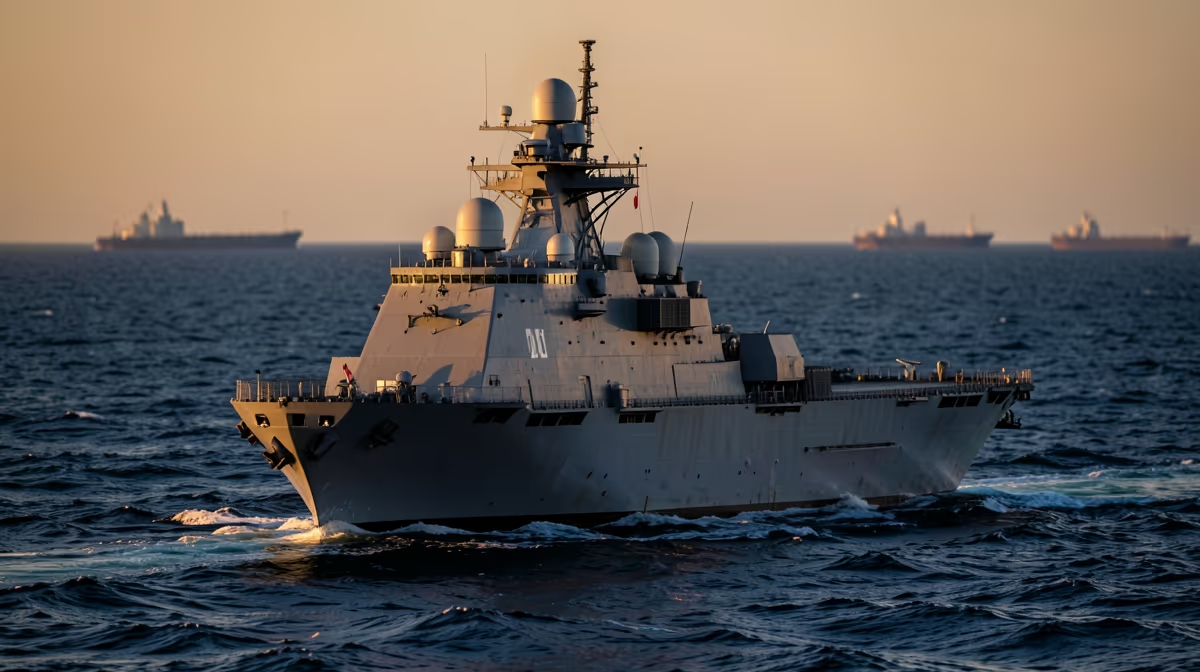
The latest escalation in the Middle East has seen the US Navy blockade Iran oil routes, drastically reducing petroleum shipments as the Trump administration shifts toward aggressive economic warfare. As the conflict between the U.S. and Iran reaches its six-month mark, military and economic pressures continue to shape the region, bringing global energy markets and maritime security to a critical juncture.
Strategic Shift to Economic Warfare
The Trump administration has shifted its strategy in the ongoing conflict with Iran, utilizing a targeted U.S. Navy blockade to severely slash Iranian oil exports. This move marks a pivotal turn toward economic warfare as the broader US-Iran conflict officially reaches its six-month milestone. With the blockade taking a heavy toll on Iran's shipping capabilities, global energy markets and regional tensions remain at the forefront of international attention.
The root cause of this development is the escalation of the US-Iran conflict into a prolonged six-month war centered on choke points like the Strait of Hormuz, prompting a strategic shift by the administration toward severe economic warfare. The Trump administration is leveraging military dominance and naval blockades to project decisive executive strength and force Tehran into a diplomatic corner as domestic political scrutiny over the war's duration intensifies.
- The U.S. Navy has implemented a blockade that has sharply reduced Iran's oil exports.
- The Trump administration has increasingly leaned into economic warfare as part of its strategy against Iran.
- The ongoing US-Iran conflict has officially reached the six-month mark.
The Battle for the Strait of Hormuz
While the Strait of Hormuz has been a central flashpoint for negotiations and military positioning, recent reports suggest the U.S. has gained the upper hand in keeping the vital waterway accessible. Control over the strait remains the central axis of global energy security, with Washington gaining the upper hand militarily while regional actors like Oman scramble to mediate and Tehran attempts renewed diplomatic maneuvers to reopen maritime routes.
Historically, this situation echoes the 1980s Operation Earnest Will during the Iran-Iraq War, where the U.S. Navy escorted reflagged tankers through the Persian Gulf to secure energy flows against hostile interference. Today, the operational reality of the strait involves intense naval patrols and continuous monitoring of shipping lanes by the U.S. Navy to enforce economic restrictions.
Economic Impact on Global Markets
A stringent U.S. Navy blockade has severely slashed Iran's oil exports, starving the regime of vital state revenue while keeping global energy market dynamics volatile despite overall oil prices remaining relatively low. When a major oil producer like Iran sees its exports severely restricted by a naval blockade, it can trigger widespread volatility in global energy prices and shipping routes.
For everyday consumers, this can translate directly into higher fuel and energy costs, while simultaneously altering geopolitical stability in the Middle East and shifting diplomatic leverage among global superpowers. Global energy consumers, international shipping companies, Middle Eastern nations reliant on regional trade stability, and the Iranian economy are all directly affected by these maritime disruptions.
| Metric / Focus | Current Status in Conflict |
|---|---|
| Conflict Duration | Six-month milestone reached |
| Primary Strategy | Naval blockade and economic warfare |
| Key Waterway | Strait of Hormuz |
| Regional Mediator | Oman |
Tehran's Diplomatic Push
In response to the mounting economic pressure, Tehran has initiated a renewed diplomatic push, floating proposals aimed at reopening the vital shipping lanes as the economic strain deepens. Tehran has touted new diplomatic proposals aimed at reopening the Strait of Hormuz, reflecting Iran's efforts to ease economic strangulation as the conflict enters a critical juncture.
Negotiations involving regional actors like Oman are also underway while oil prices remain relatively low. Developments on the ground continue to draw global attention as military measures intersect with broader energy security concerns, prompting observers to evaluate whether economic pressure or diplomacy will dictate the next phase of the crisis.
The U.S. Navy blockade has severely slashed Iran's oil exports, marking a decisive shift toward economic warfare at the six-month mark of the conflict.
Future Outlook and Market Predictions
As the conflict hits the six-month milestone with no definitive end in sight, international observers are closely watching whether economic pressure or diplomacy will dictate the next phase. Over the next 24 hours, continuous tracking of the U.S. Navy blockade enforcement in the Strait of Hormuz will focus on observing its immediate impact on shrinking Iranian oil export volumes as economic warfare strategies persist.
Looking ahead to the next 72 hours, analysts anticipate potential diplomatic responses or counter-proposals from Tehran regarding the Strait of Hormuz reopening, alongside ongoing market evaluations of low global oil prices amid restricted Iranian supply. Experts would likely expect the administration's pivot toward intense economic warfare and naval enforcement to keep Iranian oil exports severely suppressed, while keeping global energy markets sensitive to any shifts in regional diplomacy. In the best-case scenario, renewed diplomatic channels succeed in reopening the Strait of Hormuz, stabilizing regional commerce while economic pressures force a de-escalation of the conflict. Conversely, the worst-case scenario involves the ongoing naval blockade triggering severe retaliatory disruptions in the region, keeping energy routes volatile and prolonging the conflict with no clear end in sight.
Frequently Asked Questions
How has the US Navy impacted Iran's oil exports?
The U.S. Navy has enforced a blockade that has sharply reduced Iran's oil exports as part of a broader shift toward economic warfare by the Trump administration. This maritime strategy aims to severely restrict Tehran's financial lifelines amid ongoing geopolitical tensions.
Why is the Strait of Hormuz significant in the US-Iran conflict?
The Strait of Hormuz serves as a critical choke point for global oil transit and has been at the center of military confrontations and diplomatic negotiations. While recent updates indicate the U.S. has gained the upper hand in securing the passage, regional stability remains precarious.
Who is affected by the ongoing US-Iran economic warfare?
Global energy markets, neighboring countries like Oman, and nations dependent on Middle Eastern petroleum are heavily impacted by the maritime disruptions. The blockade and subsequent tensions directly influence international oil prices and regional security.
What happens next as the conflict reaches its six-month mark?
As the conflict hits the six-month milestone with no definitive end in sight, Tehran has engaged in a renewed diplomatic push and floated proposals to reopen the waterway. Meanwhile, international observers are closely watching whether economic pressure or diplomacy will dictate the next phase.
What is the background of the current tensions in the Strait of Hormuz?
The current crisis stems from a prolonged standoff between the United States and Iran that escalated into active military and economic conflict six months ago. Strategic control over the Strait of Hormuz has been the primary theater for both naval operations and diplomatic maneuvering.
What specific diplomatic proposals has Tehran recently made?
Amid mounting economic pressure from the U.S. blockade, Tehran has touted new diplomatic proposals aimed at reopening the Strait of Hormuz. These overtures reflect Iran's efforts to ease economic strangulation as the conflict enters a critical juncture.
Conclusion
The enforcement of the U.S. Navy blockade has successfully slashed Iran's oil exports, marking a strategic shift toward economic warfare by the Trump administration as the conflict reaches its six-month milestone. With tensions remaining high around the Strait of Hormuz and Tehran engaging in a renewed diplomatic push involving regional actors like Oman, global energy markets and international shipping continue to navigate a volatile landscape. Ongoing developments will depend on the interplay between sustained naval enforcement and emerging diplomatic proposals to reopen vital maritime trade routes.
Sources
- Oil prices remain low; Strait of Hormuz at center of Iran, Oman negotiations — Fox News
- U.S. Navy blockade slashes Iran oil exports as Trump administration shifts to economic warfare — CNBC
- US-Iran war reaches 6-month mark as Strait of Hormuz tensions remain high — Fox News
- Live Updates: Iran war hits 6-month mark with no end in sight — CBS News
- Iran War Updates: Tehran engages in renewed diplomatic push, touts proposal to reopen Strait of Hormuz — CBS News
- "That sucker is open": U.S. gains the upper hand in the battle for Hormuz — Axios


.webp)