
Exoplanet Radio Signals Detected in a Monumental Space Breakthrough
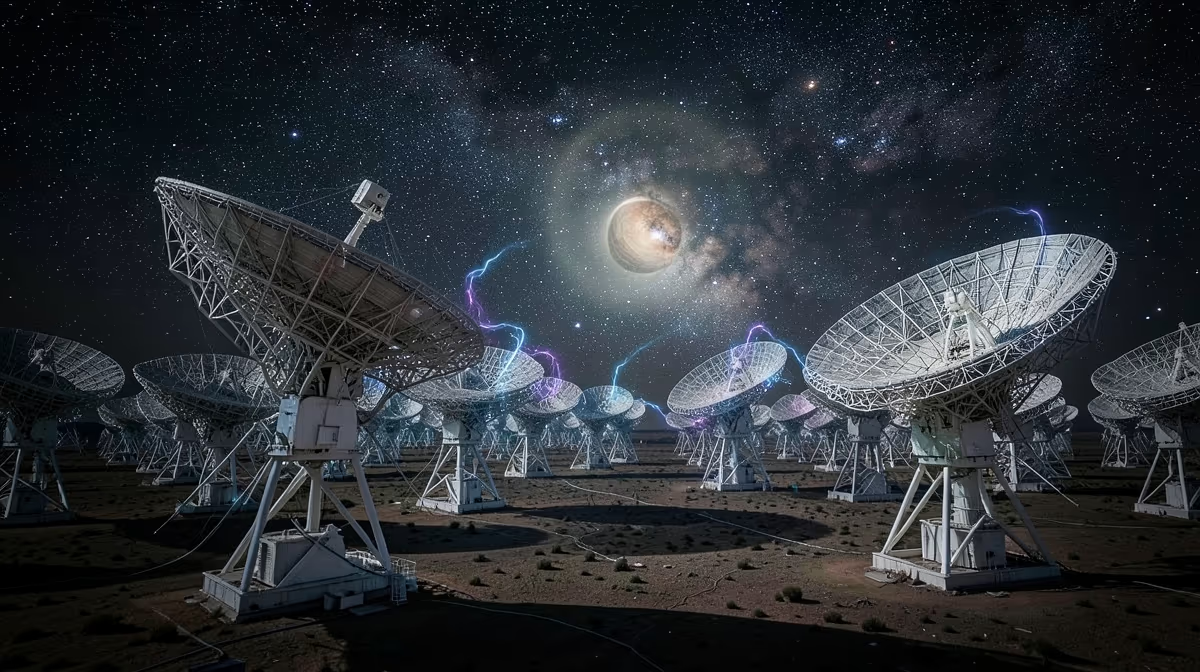
The silent void of deep space has finally spoken in a frequency humanity has never before captured from a world beyond our own. This landmark detection of radio signals from an exoplanet marks the moment our search for habitable worlds transitioned from observing visual shadows to eavesdropping on electromagnetic whispers.
In a monumental discovery for modern science, researchers have managed to capture radio signals from an exoplanet, opening a brand-new chapter in the search for alien worlds. For decades, the primary method of finding planets orbiting distant stars involved the transit method—watching for the subtle dimming of a star's light as a planet passed in front of it. While effective for cataloging thousands of worlds, this visual approach reveals little about the invisible forces that make a planet truly hospitable to life. The direct capture of radio emissions changes this paradigm entirely, providing a direct link to the magnetic environments of these distant spheres.
This unprecedented finding follows a series of recent discoveries and theoretical studies examining planetary mechanics. While radio waves are common on Earth and have been detected coming from our own Sun and gas giants like Jupiter, picking up these faint signals from planets orbiting other distant stars has historically been hindered by technical limitations. The breakthrough, reported in September 2026, signals that those limitations are finally being dismantled.
The detection of direct radio signals from an exoplanet provides the first reliable method to observe planetary magnetic fields, a critical shield required to protect atmospheres and sustain life.
The Mechanics of the Breakthrough
The detection of radio signals coming directly from a planet outside our solar system was not an accidental occurrence but the result of the technological evolution of low-frequency radio astronomy arrays. These sensitive instruments have finally reached a threshold where they can distinguish the faint planetary magnetosphere emissions from the overwhelming noise of their host stars.
Until now, the study of exoplanets was largely limited to their physical size and orbital distance. However, by capturing radio emissions, scientists gain a powerful new tool to analyze the atmospheric and environmental properties of alien worlds. These signals are believed to be generated by the interaction between stellar winds and the planet's magnetic field—a process that creates a planetary "shield" known as a magnetosphere.
- Radio waves are generated when charged particles from a host star hit a planet's magnetic field.
- These emissions are much fainter than the signals from stars, requiring advanced low-frequency arrays.
- This technique allows for the study of the planet itself rather than just its effect on starlight.
Why Magnetic Fields Matter for Habitable Worlds
The presence of a magnetic field is widely considered a prerequisite for life as we know it. On Earth, our magnetic field acts as a protective bubble, shielding the atmosphere from being stripped away by high-energy solar winds. Without this protection, a planet—even one in the "Goldilocks zone"—could become a barren, irradiated desert.
By analyzing these radio signals, researchers hope to better understand the magnetic environments of distant planets. This breakthrough brings the scientific community one step closer to figuring out if other worlds could potentially support life by determining which planets possess the necessary magnetic protection to retain a stable atmosphere.
Technological Evolution and the Global Race
The ability to detect these signals is deeply tied to the development and scaling of next-generation radio telescope infrastructure. A primary driver in this field is the Square Kilometre Array (SKA), which analysts expect will revolutionize our ability to spot magnetic fields on distant exoplanets. The discovery serves as a validation of long-term commercial and technological investments in ground-based radio telescope infrastructure.
| Technology Type | Primary Detection Method | Key Insight Provided |
|---|---|---|
| Optical Telescopes | Transit (Light Dimming) | Size, Orbit, and Density |
| Radio Arrays | Magnetosphere Emissions | Magnetic Field Strength |
| Next-Gen Arrays (SKA) | Direct Radio Signal Capture | Atmospheric Stability & Habitability |
This technological advancement has sparked a new era of scientific prestige and technological sovereignty. Nations are now competing for leadership in exoplanetary habitability research, as the ability to map the magnetic landscapes of the galaxy becomes a marker of diplomatic and scientific standing.
Analyst View: The Shifting Landscape of Astronomy
From an analytical perspective, the root cause of this breakthrough is the convergence of high-sensitivity hardware and advanced signal processing. However, there are deeper implications beyond pure science. Experts point to the "dual-use" nature of these ultra-sensitive radio astronomy arrays. While designed to catch whispers from alien worlds, these same technologies are vital for deep-space tracking, orbital domain awareness, and advanced signal intelligence capabilities.
Historical Parallel: From Pulsars to Planets
Analysts draw a clear historical parallel between this event and the 1967 discovery of pulsars by Jocelyn Bell Burnell and Antony Hewish. Just as the discovery of pulsars opened an entirely new observational window in astronomy, the first direct detection of planetary radio emissions signals a transition from "seeing" to "listening" to the cosmos.
This breakthrough is expected to accelerate funding and observational focus on detecting magnetic fields. As the technique is validated across multiple observatories, it could become the standard for assessing the habitability of distant planets, moving the field of astrobiology from theoretical models to empirical data.
Challenges and Emerging Anomalies
Despite the excitement, the search for life remains complex. Recent studies suggest that even if we find habitable environments, the life found on Earth’s closest alien neighbors is probably not very advanced. This context provides a grounding reality for the radio signal discovery: we are finding the "houses" where life could live, but the residents may be microscopic.
Furthermore, the universe continues to present anomalies that challenge our current models. Alongside the radio signal breakthrough, astronomers have noted weird exoplanets that orbit their host stars in the "wrong" direction, contrary to the rotation of the star itself. These findings highlight the extreme diversity of planetary systems and suggest that magnetic field dynamics on these "backward" planets may be even more complex than those we understand.
The Road Ahead for Space Research
In the next 24 to 72 hours, the global astronomical community is expected to release further technical commentary and peer reviews regarding the detection methodology. International space agencies and research consortia are likely to issue statements detailing how this discovery will shift the priorities of upcoming missions.
- Validation of the signal across multiple international radio observatories to ensure replication.
- Integration of radio astronomy data into existing global search frameworks for astrobiology.
- Categorization of the specific magnetic and atmospheric properties of the target exoplanet.
The best-case scenario involves the rapid validation of this technique, opening a reliable new method to study atmospheric conditions light-years away. However, a worst-case scenario exists where subsequent observations struggle to replicate the signal clarity, potentially leading to a prolonged scientific debate regarding the nature of the emissions.
Frequently Asked Questions
What did astronomers recently detect from an exoplanet?
Astronomers successfully detected radio signals coming directly from an exoplanet for the first time. This landmark observation marks a major step forward in planetary astronomy beyond our Solar System.
Why is detecting radio signals from an exoplanet important?
This discovery could greatly help scientists search for habitable worlds by providing new ways to study distant planets. It opens up possibilities for learning more about planetary environments outside our solar system.
How does this discovery affect the search for habitable worlds?
By analyzing these radio emissions, researchers hope to better understand distant planetary characteristics. This technique may ultimately assist in identifying conditions that could support life on alien worlds.
What happens next in this area of astronomical research?
Future studies will likely focus on utilizing advanced observatories and facilities like the SKA to detect magnetic fields on other distant exoplanets. Scientists aim to replicate and expand upon these initial radio signal detections.
What background context surrounds the search for exoplanet radio signals?
Detecting direct radio emissions from planets beyond our solar system has long been a challenge for astronomers due to weak signal strengths. Recent technological advancements and telescope capabilities have finally made these groundbreaking observations possible.
What specific detail was noted about exoplanet discoveries alongside radio signals?
In addition to radio wave detections, researchers continue to uncover unusual planetary dynamics, such as weird exoplanets that orbit their host stars in the wrong direction. These varied findings highlight the extreme diversity of planetary systems in the universe.
Conclusion
The first direct detection of radio signals from an exoplanet represents a fundamental shift in our capability to explore the universe. By moving beyond visual observations and tapping into the electromagnetic signatures of planetary magnetic fields, astronomers have unlocked a primary tool for identifying habitable worlds. While the discovery is a major milestone, it also marks the beginning of a rigorous period of validation and data integration. As next-generation arrays like the SKA come online, the focus will shift from simply finding planets to understanding the invisible shields that might allow life to thrive on them. The silent void of space is finally speaking; the next challenge for humanity is deciphering exactly what it is saying.
Sources
- Scientists find weird exoplanet that orbits its star in the wrong direction — Space
- Astronomers detect radio signals coming from an exoplanet for the first time — Phys.org
- Astronomers Detect Radio Signals Coming Directly From an Exoplanet For The First Time — ScienceAlert
- Radio signals detected from a planet beyond our Solar System. Landmark discovery could help us search for habitable worlds — BBC Sky at Night Magazine
- SKA may detect magnetic fields on distant exoplanets — Phys.org
- Earth’s closest alien life probably isn’t very advanced, says new study — Popular Science


.webp)


