
KOSPI opens higher as sudden policy shifts trigger market moves
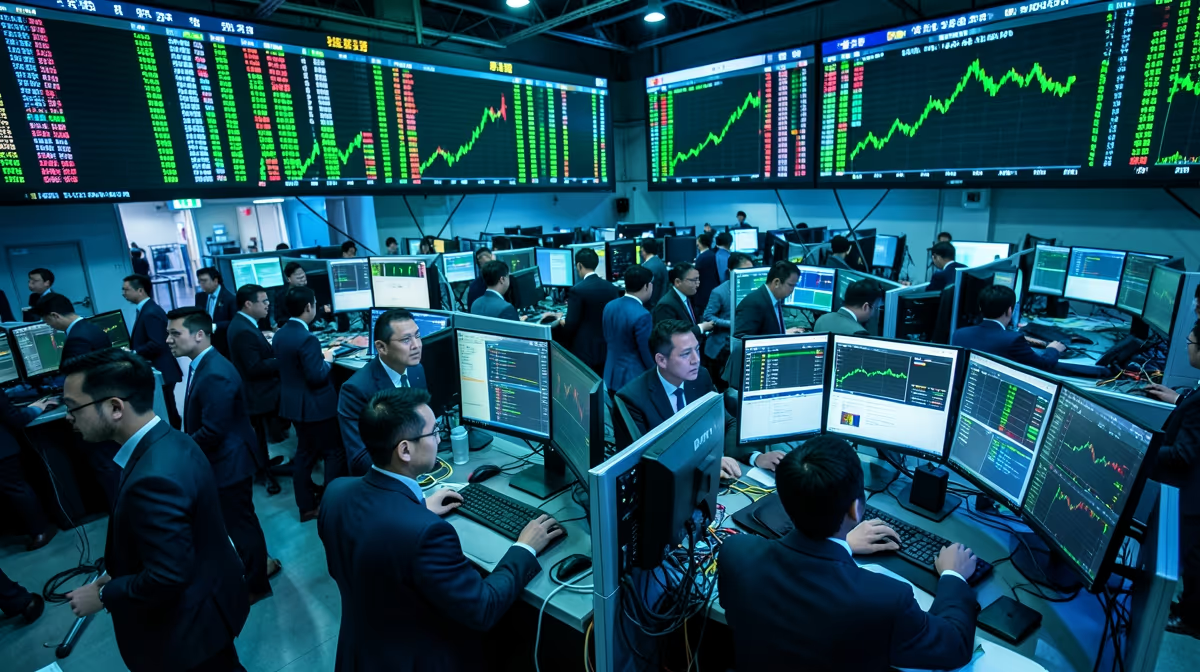
When global capital markets face policy shifts, unexpected clarity can instantly transform hesitation into aggressive buying momentum. The KOSPI opens higher today as global investors react positively to signs that Fed uncertainty is finally beginning to ease across regional financial exchanges.
The easing of Federal Reserve policy uncertainty has unlocked major foreign capital flows, driving South Korean equities higher as technology conglomerates lead a broader Asian market stabilization.
Morning Rally Driven by Policy Clarity
The morning buying wave was primarily anchored by major technology and industrial conglomerates, with shares of Samsung, Kioxia, and SoftBank experiencing notable rallies. Mid-September 2026 trading sessions across East Asia showed synchronized upward movements, with Japanese and South Korean exchanges opening in positive territory. As trading floors opened in Seoul, buying momentum accelerated rapidly, reflecting a broad-based appetite for risk assets following weeks of macroeconomic speculation surrounding the United States central bank.
Understanding the Federal Reserve Decision and Market Reaction
When the trajectory of interest rates becomes explicit, cross-border institutional capital often returns to developed and emerging regional markets. Investors recognized that while monetary policy remains restrictive, the predictability of central bank actions reduces equity risk premiums. This shift in investor sentiment allowed South Korean equities to decouple from immediate rate hike fears, converting what could have been a standard market contraction into a relief rally driven by structural clarity.
Regional Ripple Effects and Corporate Conglomerates
| Market Benchmark / Entity | Sector / Asset Class | Key Early Session Performance |
|---|---|---|
| South Korean KOSPI Index | National Equity Benchmark | Opened 0.9% to over 1% higher following Fed clarity |
| Major Conglomerates (Samsung, Kioxia, SoftBank) | Technology & Industrial Heavyweights | Led aggressive morning rally across regional trading floors |
| Regional Exchanges (Japan, Taiwan, India) | Asian Equity Benchmarks | Displayed synchronized early gains following global policy cues |
The strong participation of heavyweights like Samsung underscored how institutional portfolio managers are prioritizing large-cap technology stocks with strong balance sheets. Foreign capital inflows into East Asian hubs highlighted how regional trade centers can absorb tighter U.S. monetary policy when local corporate fundamentals remain resilient.
Macroeconomic Drivers and Structural Considerations
The cross-border capital flows observed across East Asian markets demonstrate how regional exchanges can decouple from immediate U.S. interest rate anxieties when policy transparency returns.
However, financial analysts point out that an aggressive market rally can sometimes mask underlying economic vulnerabilities. South Korea's financial ecosystem continues to navigate potential headwinds related to household retail debt levels and foreign exchange volatility. If future macroeconomic releases, particularly U.S. inflation data, compel the Federal Reserve to adopt a more hawkish stance than currently anticipated, these underlying structural vulnerabilities could re-emerge to test market stability.
Historical Context: Patterns from Past Monetary Cycles
Historically, market volatility peaks during periods of central bank ambiguity rather than during the actual execution of policy hikes. Once the U.S. central bank clarifies its policy outlook, global financial markets adjust discount rates, reprice corporate earnings, and resume capital allocation. The current movement across the KOSPI aligns closely with this historical pattern, where definitive monetary policy disclosures trigger relief rallies across export-oriented Asian economies.
Who Is Affected and Broad Economic Implications
- Retail investors holding individual technology equities or diversified mutual funds experience immediate portfolio appreciation.
- Institutional pension funds holding substantial allocations in South Korean conglomerates see asset valuations stabilize.
- Global asset managers reallocating capital into Asian markets benefit from reduced foreign exchange uncertainty.
When major benchmark indices like the KOSPI rise, the psychological impact extends beyond institutional trading floors into the broader economy. Enhanced market stability improves consumer and institutional confidence, supporting overall financial sentiment for everyday retirement accounts and broader economic planning.
Short-Term Trajectory and Market Outlook
- Next 24 Hours: The KOSPI is expected to sustain its upward trading momentum following its higher morning opening, supported by continued strong volume in major tech stocks such as Samsung.
- Next 72 Hours: Markets will continue to absorb the Federal Reserve rate decision while carefully tracking investor sentiment across Japanese, Taiwanese, and Indian equity indices.
Financial analysts expect short-term market stabilization as investors fully digest the monetary policy landscape. In a best-case scenario, continued strong buying across major Asian exchanges will push indices higher as investor confidence solidifies following the Fed decision. Conversely, a worst-case scenario involves sudden profit-taking or renewed macroeconomic concerns that could dampen the initial morning rally and cause the KOSPI to retrace its early gains.
Frequently Asked Questions
Why did the KOSPI open higher today?
The KOSPI opened higher as uncertainty surrounding the Federal Reserve's monetary policy decisions eased. Markets absorbed the recent Fed rate hike announcements, allowing Asian stock markets like South Korea and Japan to rally strongly.
How much did the KOSPI rise following the Fed announcement?
The KOSPI opened approximately 0.9% to over 1% higher during the morning session. This positive momentum pushed major indices higher as investors reacted favorably to clearer signals from the central bank.
Who is affected by the KOSPI opening higher after the Fed rate decision?
Investors in Asian markets, particularly in South Korea, are directly impacted by these movements. Major companies and tech stocks like Samsung experienced rallies alongside broader market gains.
What does easing Fed uncertainty mean for South Korean stocks?
Easing Fed uncertainty removes a layer of volatility that typically weighs on emerging and developed Asian markets. When the trajectory of U.S. interest rates becomes clearer, capital often flows back into regional equities like the KOSPI.
What is the background of the recent KOSPI market movement?
The recent market behavior is tied directly to the latest U.S. Federal Reserve rate hike decisions and subsequent global financial disclosures. Asian indices monitored these central bank cues closely before opening higher in morning trade.
What happens next for the KOSPI index and regional markets?
Markets will continue to monitor upcoming macroeconomic data releases and further commentary from global central banks to gauge future monetary tightening paths. Observers will watch whether major stocks can sustain their current upward trajectory near key resistance levels.
Conclusion
The higher opening of South Korea's KOSPI index highlights the critical role that monetary policy clarity plays in shaping global equity movements. By successfully absorbing the U.S. Federal Reserve's rate hike decision, regional Asian markets have demonstrated resilience, propelled by strong gains in key technology heavyweights like Samsung, Kioxia, and SoftBank. While potential challenges surrounding retail debt and currency volatility remain present in the background, the immediate reduction in policy uncertainty has established a more stable foundation for international capital flows. As financial markets navigate the coming sessions, participants will remain focused on whether this morning momentum can translate into sustained long-term market performance across East Asia.
Sources
- [Opening Market] KOSPI Opens 0.9% Higher As Fed Uncertainty Eases — Businesskorea
- Japan, South Korea Stocks Open Higher After Fed Rate Hike Decision; KOSPI Nears 6,800 as Samsung, Kioxia, SoftBank Rally — tradingkey.com
- Stock Market prediction tomorrow: Sensex, Nifty outlook for Thu | Kospi, Taiwan Index, Nikkei cues to watch | 17 Sept — Livemint
- KOSPI Rises Over 1% Despite Fed Rate Hike — 조선일보
- The KOSPI index opens above the 7,000 mark in Seoul — The Daily News | Texas' Oldest Newspaper
- KOSPI climbs as market absorbs Fed hike — Aju Press


.webp)


