
OpenAI Anthropic Math Crisis Signals A Massive Shift For Human Genius
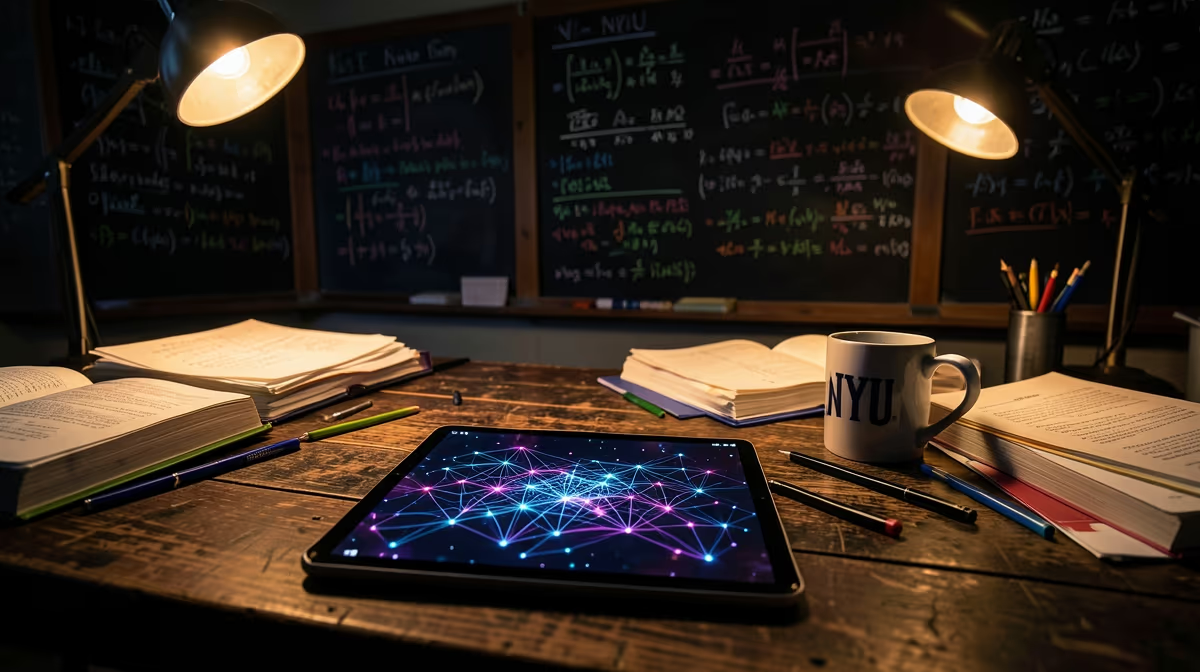
A quiet academic desk at New York University became an unexpected front line in the global war for artificial intelligence supremacy over Labor Day weekend. The high-stakes collision over an advanced OpenAI Anthropic math problem has left researchers questioning the future boundary between human genius and machine calculation. When Tristan Buckmaster, a prominent mathematician at NYU, felt as though he had been rolled over by some of the most heavily capitalized companies on Earth, it signaled a fundamental shift in how mathematical research is pursued. As corporate AI laboratories aggressively push into the realm of advanced reasoning, traditional academia is finding itself caught in a high-velocity corporate crossfire.
The collision between academic researchers and trillion-dollar AI corporations over fundamental mathematics marks a profound transition where human intellectual landmarks are transformed into high-stakes corporate benchmarks.
The Collision Over a Math Problem
The incident highlights a broader trend where academic mathematicians suddenly find themselves caught in the competitive crossfire of commercial entities. As these tech companies target advanced mathematical benchmarks to prove generalized reasoning capabilities in large language models, the traditional pace of academic discovery is being disrupted. What was once a collaborative and deliberate peer-reviewed process is now being accelerated by corporate teams seeking to validate their latest proprietary systems. The exact details of the OpenAI Anthropic math problem continue to draw intense scrutiny from both artificial intelligence developers and academic researchers who are tracking how neural network architectures handle complex logic.
The Battleground of Machine Reasoning
This push has brought machines into direct contact with the frontiers of human knowledge. At institutions like New York University, mathematicians like Buckmaster have spent years answering long-standing questions about fundamental equations of fluid motion. The sudden introduction of automated reasoning models into these highly specialized domains changes how breakthroughs are validated. In this new landscape, computational logic and the deployment of an advanced algorithmic theorem can bypass or preempt the traditional channels of academic proof-building, creating an environment where human experts feel marginalized by corporate machines.
The rapid advancement of these systems has elicited varied reactions across the global scientific community. For instance, a Chinese Fields Medal winner jokingly remarked that they would write romance novels if artificial intelligence eventually solves all mathematical proofs. While delivered with humor, the comment reflects a genuine underlying concern regarding the changing role of human intuition in a field increasingly automated by corporate neural network models.
An Unequal Playing Field
- Corporate AI labs possess massive server infrastructure that allows them to run millions of algorithmic trials in a fraction of human time.
- Academic institutions operate on public grants and long-term research cycles, which cannot easily match rapid corporate deployment.
- The intellectual property frameworks in academia are designed for human collaboration, leaving them vulnerable to automated ingestion.
This imbalance has transformed fundamental mathematics into a high-stakes corporate proving ground. The race is no longer just about expanding human knowledge; it is about proving the market viability of automated reasoning systems.
Over Labor Day weekend, Tristan Buckmaster, a mathematician at New York University, felt as if he had been rolled over by one of the biggest and most powerful companies in the world — because of a math problem.
This quote captures the intense personal and professional pressure exerted by powerful corporate entities vying for technological breakthroughs. Other mathematical achievements, such as the work of IBM mathematician Subhash Khot who is rethinking computing’s hardest problems, or the modeling achievements of Indian teen mathematicians who modeled their way to an international award, highlight how widespread mathematical innovation is. Yet, the commercial enclosure of these achievements by massive tech firms threatens to rewrite the rules of intellectual ownership.
Economic and Geopolitical Dimensions
The Economic Angle
The Political and Geopolitical Angle
| Strategic Dimension | Structural Impact on Mathematics |
|---|---|
| Economic Stake | High-level intellectual labor is commodified to drive corporate AI valuations. |
| Institutional Friction | Academic institutions struggle against tech monopolies over IP and attribution. |
| Geopolitical Influence | US-centric tech dominance dictates the global trajectory of automated scientific discovery. |
This trend mirrors historical parallels, such as the commercial enclosure of academic research and talent during the early biotech and software patent booms of the late 20th century. Once again, a public intellectual domain is being enclosed by private corporations, leaving academic researchers to navigate a highly competitive and corporate-dominated landscape.
What Lies Ahead: A Divided Scientific Frontier
Analysts predict that we will see increased friction between academic researchers and major AI labs as artificial intelligence encroaches further into domains of advanced mathematical theorem proving. The outcome of this friction will likely shape the scientific community for decades to come.
In the best-case scenario, a collaborative framework will emerge where tech companies and academic mathematicians establish ethical guidelines for tackling complex mathematical problems using AI tools. This would allow human intuition and machine computation to complement each other, accelerating scientific progress without marginalizing human scholars.
Conversely, the worst-case scenario could see heightened tensions leading to academic alienation, with independent mathematicians feeling increasingly marginalized and overwhelmed by the immense corporate resources of AI giants. If academic researchers feel their contributions are rapidly ingested and operationalized without adequate compensation or acknowledgment, it could trigger a systemic burnout that fundamentally weakens the pipeline of human mathematical talent.
Frequently Asked Questions
What happened between OpenAI, Anthropic, and a mathematician?
A NYU mathematician named Tristan Buckmaster felt crushed by the immense pressure and competition from major artificial intelligence companies like OpenAI and Anthropic over a complex math problem. Over Labor Day weekend, the intense race to solve advanced mathematical equations brought unexpected friction between human researchers and tech giants.
Why does the competition between AI labs and mathematicians matter?
This rivalry highlights the rapid encroachment of artificial intelligence into fields once thought to require exclusively human intuition and creative problem-solving. As companies like OpenAI and Anthropic develop models capable of tackling advanced math, it raises existential questions about the future role of human mathematicians.
Who is affected by AI solving advanced math problems?
Human mathematicians, academic researchers, and Fields Medalists are directly impacted by the shifting landscape of automated reasoning. Prominent figures in the mathematical community are already jokingly or seriously contemplating alternative career paths, such as writing romance novels, if AI eventually automates all mathematical proofs.
What happens next as AI models advance in mathematics?
As machine learning systems become better at handling complex equations and fundamental fluid motion problems, collaboration and tension between AI labs and academic institutions will likely increase. Researchers will need to adapt to a landscape where artificial intelligence can accelerate or even preempt traditional academic breakthroughs.
What is the background of the recent tension involving AI and mathematics?
Tech giants are increasingly training large language models and reasoning systems to tackle high-level mathematics, a long-standing benchmark for artificial general intelligence. This push has led to intense overlap, and occasional friction, between corporate AI development and traditional academic research departments.
Who is Tristan Buckmaster and how was he involved?
Tristan Buckmaster is a mathematician at New York University who recently made headlines—along with answering long-standing questions about fluid motion equations—by expressing how overwhelmed he felt during a high-stakes race against powerful tech companies over a specific math problem.
Conclusion
The intersection of advanced artificial intelligence and academic mathematics has initiated a complicated era of institutional friction. The event involving NYU mathematician Tristan Buckmaster, OpenAI, and Anthropic over a disputed math problem exemplifies how rapidly private corporate resources can disrupt traditional scientific research. As machine models attempt to solve complex theoretical equations, the boundary between human intuition and automated computation is being fundamentally redrawn. Moving forward, the scientific community must navigate these shifts, balancing the acceleration of mathematical discovery against the preservation and protection of independent human scholarship.
Sources
- The Mathematician Crushed Between OpenAI and Anthropic Over a Math Problem — The New York Times
- I’ll write romance novels if AI solves all maths, Chinese Fields winner jokes — South China Morning Post
- NYU Mathematician Answers Long-Standing Questions about Fundamental Equations of Fluid Motion — New York University
- How Indian teen mathematicians modelled their way to an international award — The Hindu
- IBM mathematician Subhash Khot is rethinking computing’s hardest problems — ibm.com
- Over Labor Day weekend, Tristan Buckmaster, a mathematician at New York University, felt as if he had been rolled over by one of the biggest and most powerful companies in the world — because of a math problem. https://nyti.ms/46RD3H5 — facebook.com


.webp)


.webp)