
US Space-Control Weapons Confirmed in Orbit as Global Security Reshapes
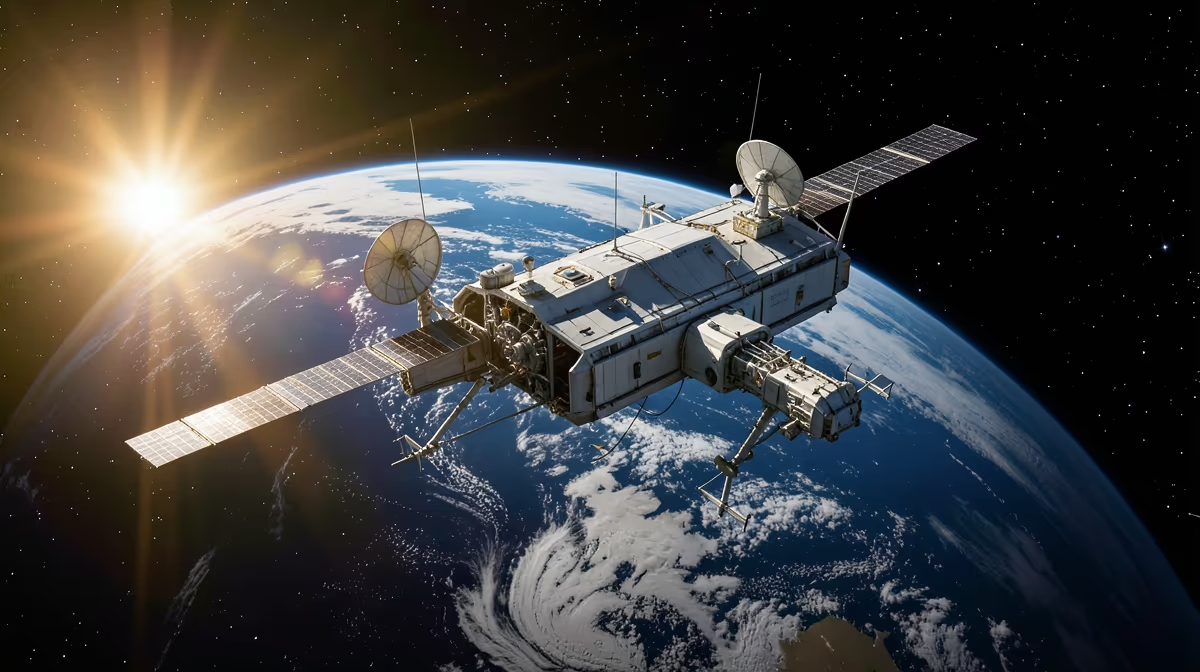
The silent expanse above our atmosphere has officially transitioned from a scientific frontier to an active military front. By formally acknowledging what was long whispered in classified corridors, the United States has forever altered the paradigm of extraterrestrial defense.
The United States has officially confirmed the orbital weapons deployment, marking a significant escalation in modern geopolitics. According to recent announcements by defense officials, these systems are designed to protect critical assets and maintain an operational edge in an increasingly contested outer space domain. Specifically, the secretary of the Air Force confirmed that the military has deployed space-control weapons directly into orbit. This official disclosure marks the first time the nation has publicly confirmed the presence of active, offensive or defensive weaponry in Earth’s orbit, highlighting a dramatic shift in how the nation approaches its security strategy.
The formal confirmation of space-control weapons in orbit shifts space from an auxiliary support domain into an active arena of strategic military deterrence.
A Shift in the Cosmos
This historic announcement represents a watershed moment in global defense policy. For decades, the space militarization debate remained a sensitive, largely unacknowledged topic, governed by the fragile consensus of international treaties. However, the official confirmation from the Air Force secretary has brought these highly classified capabilities into the public light. Reports from major international outlets, including the BBC, Ars Technica, and SpaceNews, have verified the official nature of the disclosure, signaling a deliberate policy change toward strategic transparency.
The deployed hardware comprises specialized space-control weapons designed to ensure the survivability of American assets in orbit. While the exact operational parameters and technical classifications of these systems remain strictly classified, their primary mission is clear: to defend essential military and civilian satellite networks. These networks, which facilitate everything from precision-guided munitions tracking to global communication systems, have increasingly been viewed as vulnerable targets by major global powers. By publicly acknowledging the deployment, the U.S. military is drawing a clear red line in low Earth orbit.
Behind the Strategy
The root cause of this sudden public acknowledgment lies in the escalating militarization of low Earth orbit. As modern nations rely heavily on satellites for global positioning, communications, and intelligence gathering, these celestial assets have become highly lucrative targets. Peer adversaries have spent years developing ground-based and orbital anti-satellite capabilities, forcing a shift in how the United States views its orbital defense strategy.
Historically, this escalation mirrors the initial deployment of intercontinental ballistic missiles and early warning satellites during the height of the Cold War arms race. Just as the introduction of those systems redefined terrestrial deterrence in the mid-20th century, the official deployment of space-control weapons marks the beginning of a new era of extraterrestrial deterrence. This is no longer merely about monitoring space debris or tracking weather patterns; it is about establishing active satellite defense in a highly contested theater.
The geopolitical angle of this development cannot be overstated. By publicly establishing its orbital presence, the United States is seeking to demonstrate technological dominance. This serves a dual purpose: deterring potential adversaries on the global stage, while simultaneously securing bipartisan political support domestically. The public display of technological readiness helps justify the expanding budget of the newly formed military branches dedicated to outer space.
The Technological Pipeline
The deployment of space-control weapons does not occur in a vacuum. It is part of a broader, highly integrated push by the US Space Force to expand its military footprint and technical sophistication. Several concurrent developments highlight the rapid pace of this technological expansion:
- FireSat-S Critical Design Review: The U.S. Space Force recently advanced its environmental monitoring capabilities by completing the critical design review for FireSat-S. This system demonstrates the service's commitment to maintaining a comprehensive, real-time view of orbital and terrestrial environments.
- STARCOM Growth Initiatives: The Space Training and Readiness Command (STARCOM) has highlighted comprehensive plans to deliver robust organizational growth, ensuring that personnel are thoroughly trained for the complex demands of orbital warfare.
- Command Leadership Debates: Inside defense circles, debate has intensified regarding the future leadership of the U.S. Space Command. Proponents argue that the command should always be led by a "Guardian" — a specialized officer from the Space Force — to ensure deep domain-specific expertise at the highest levels of decision-making.
Geopolitical and Economic Dimensions
Beyond the immediate military implications, the deployment of space-control weapons introduces profound economic and legal challenges. From an economic perspective, the official acknowledgment of orbital weapons deployment is expected to trigger a significant influx of defense funding. Aerospace defense contractors specializing in space-control technologies are poised to secure lucrative, long-term government contracts. This transition creates a dedicated commercial ecosystem centered entirely around orbital defense hardware and satellite survivability.
Addressing the Commercial Dilemma
This rapid militarization presents a complex operational landscape for commercial satellite operators. These private entities, which manage critical global infrastructure for telecommunications, navigation, and financial transactions, must now navigate an increasingly crowded and weaponized orbital highway.
The militarization of Earth's orbit forces commercial operators to operate within a highly volatile strategic environment, raising complex legal questions regarding the protection of civilian assets during a geopolitical crisis.
If a conflict were to erupt in orbit, distinguishing between military and civilian satellite networks would become incredibly challenging. This reality has raised the stakes for global diplomacy, as international bodies struggle to adapt existing space treaties to the modern realities of orbital warfare.
Strategic Assessment and Future Scenarios
As the global defense community absorbs this news, analysts are projecting a wide range of short- and long-term consequences. The next 24 to 72 hours are expected to be critical in shaping the international community's response to this disclosure.
In the next 24 hours, further official briefings from the Department of Defense are anticipated, alongside initial diplomatic reactions from major foreign governments. Over the next 72 hours, these discussions will likely intensify, transitioning into formal diplomatic debates regarding the militarization of orbit and its compatibility with international treaties.
Military analysts predict that this announcement will inevitably trigger heightened diplomatic scrutiny. While the best-case scenario could lead to renewed international dialogue and the creation of transparent, mutually agreed-upon frameworks for managing orbital assets, the worst-case scenario is far more concerning. A complete lack of diplomatic cooperation could accelerate a highly competitive arms race in orbit, severely straining international relations and exponentially increasing the risk of active space-based confrontations.
Timeline of Orbital Security Milestones
The evolution of the United States' public military stance on space has progressed through several critical phases, culminating in the recent confirmation of orbital weapons.
| Timeframe | Key Milestone | Primary Objective |
|---|---|---|
| Cold War Era | Initial ICBM and Early Warning Satellite Deployment | Terrestrial deterrence and strategic monitoring |
| Mid-2020s | Organizational growth and capability refinement | Establishment of U.S. Space Command and Space Force |
| September 2026 | Official confirmation of space-control weapons in orbit | Deterrence, satellite defense, and asset protection |
| Future Outlook | Intensified policy debates and treaty reviews | Regulation and management of militarized low Earth orbit |
Frequently Asked Questions
What did the US military recently confirm about space weapons?
For the first time, the US military has officially confirmed that it has deployed space-control weapons in orbit. This acknowledgement marks a significant public shift in how the nation discusses its defensive and strategic capabilities in outer space.
Why is the deployment of space-control weapons in orbit important?
This deployment matters because it highlights the growing militarization of Earth's orbit, where critical communications and navigation infrastructure reside. As space becomes an increasingly contested domain, major powers are actively taking steps to protect their assets and deter potential adversaries.
Who made the announcement regarding space-control weapons?
The confirmation regarding the deployment of space-control weapons in orbit was delivered by the Air Force secretary. Statements like this provide rare official insight into the evolving operational posture of the U.S. Space Force and associated military commands.
What happens next as the US expands its military presence in space?
As space-control capabilities are integrated into active deployment, military planners will likely focus on continuous force growth, leadership development like the Space Command Guardians, and advanced environmental monitoring systems. Future defense budgets and international policy discussions will also face heightened scrutiny over orbital security.
What is the background of the US Space Force's recent technological developments?
Alongside orbital weapon disclosures, the U.S. Space Force continues to advance various initiatives, ranging from environmental monitoring projects like the FireSat-S critical design review to strategic growth plans outlined by STARCOM. These diverse efforts illustrate a comprehensive expansion of military capabilities both on the ground and in orbit.
Which specific systems or platforms are involved in these space developments?
While specific operational details and technical classifications of the deployed space-control weapons remain heavily guarded, reports from outlets like SpaceNews, BBC, and Ars Technica confirm the official nature of the orbital deployment. Additionally, programs like FireSat-S demonstrate the broader technological pipeline supporting modern military space operations.
Conclusion
The official confirmation of orbital space-control weapons marks a significant turning point in global defense, shifting space from a domain of quiet scientific cooperation to an acknowledged arena of strategic military preparation. By bringing these once-classified capabilities to light, the United States has signaled its determination to actively defend its orbital infrastructure. As global powers react to this development over the coming days and weeks, the international community faces the difficult task of balancing deterrence with diplomacy. Ultimately, the stability of the vital orbital highway—and the global communication and navigation networks that modern society relies upon every day—will depend on whether this historic disclosure leads to transparent international dialogue or triggers an unconstrained, highly competitive arms race in outer space.
Sources
- US confirms for first time it has deployed space weapons — BBC
- US Space Command Should Always Be Led by a Guardian — Air & Space Forces Magazine
- U.S. Space Force Advances Environmental Monitoring with FireSat-S Critical Design Review — ssc.spaceforce.mil
- For the first time, the US military confirms it has deployed weapons in orbit — arstechnica.com
- News - STARCOM highlights plan to deliver Space Force growth — DVIDS
- U.S. has deployed space-control weapons in orbit, Air Force secretary says — SpaceNews


.webp)

.webp)