
Christa Pike Execution Survival Sparks Immediate Legal Crisis in US
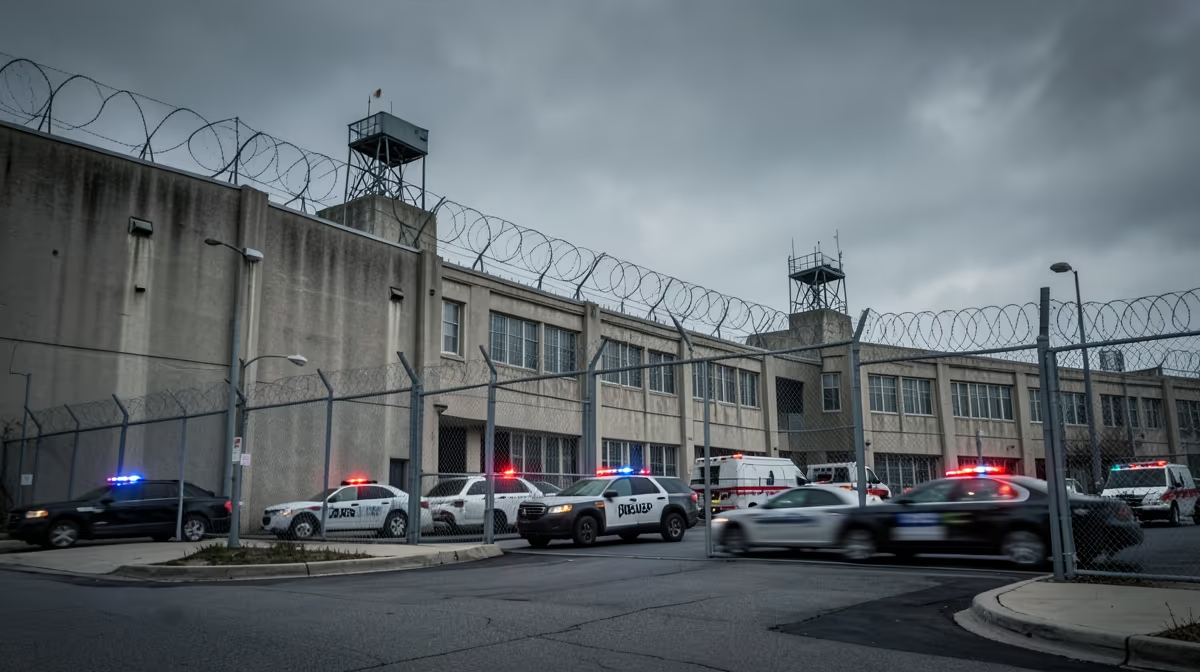
The silence within the Tennessee Department of Correction has been replaced by a flurry of medical and legal inquiries that challenge the very mechanics of the American justice system. Nearly a week after an attempt to carry out a death sentence, the world is learning that the only woman on the state’s death row has not only survived but has achieved a level of stabilization that few thought possible. Recent developments surrounding the Christa Pike execution have sparked widespread attention as sources confirm the Tennessee death row inmate is currently conscious and speaking.
The survival of Christa Pike following a botched execution attempt has created a medically unprecedented scenario that forces an immediate and transparent re-evaluation of Tennessee’s capital punishment protocols.
This rare event thrusts the ongoing debate surrounding capital punishment procedures, inmate rights, and medical ethics back into the national spotlight. It raises serious questions about state protocols and legal accountability that extend far beyond the borders of Tennessee. As the inmate remains under observation, the legal and medical communities are grappling with the implications of a procedure that failed to achieve its primary objective, leaving a condemned individual in a state of unexpected recovery.
The Medically Unprecedented Recovery
Attorneys representing Christa Pike announced that the death-row inmate is conscious and speaking nearly a week after the failed attempt. Her legal representatives have gone on record to describe her current recovery as medically unprecedented following the botched procedure. This development has stunned observers who expected a different outcome following the application of state-sanctioned lethal protocols.
According to verified reports, the stabilization of her condition allows for verbal communication, which has enabled her legal team to provide updates on her status. While the specifics of her medical treatment remain closely guarded, the fact that she has regained consciousness and the ability to speak suggests a level of physical resilience that complicates the state’s next steps. The incident leaves the death-row inmate alive amidst an ongoing legal saga that has already spanned several decades.
Current Medical Observations
The stabilization process for a survivor of a botched execution is complex and carries significant ethical weight. Medical professionals are currently tasked with monitoring Pike’s vital signs and neurological functions. Because her recovery is described as unprecedented, there is no established medical roadmap for her care. Her ability to remain conscious nearly seven days after the event has become the focal point for both her defense team and state health officials.
Chronology of a Failed Procedure
The events leading up to this moment are rooted in a long-standing legal battle. To understand how Pike reached this point, it is necessary to examine the timeline of her incarceration and the eventual failure of the state's execution protocol.
| Phase | Description |
|---|---|
| Incarceration | Decades spent on Tennessee's death row following a high-profile murder conviction. |
| Execution Preparation | Intensive legal saga and state preparation leading up to the scheduled date. |
| The Procedure | Botched execution event in October 2026, which failed to result in death. |
| Post-Event Recovery | Attorneys announce the inmate is conscious and speaking nearly a week later. |
| Current Status | Subject of medically unprecedented stabilization and renewed legal scrutiny. |
The root cause of this survival is being attributed by analysts to systemic failures and procedural breakdowns in carrying out state-sanctioned capital punishment. These breakdowns led to an outcome that forces a total re-examination of how the state manages its most severe judicial mandates.
Legal and Constitutional Implications
The survival of an inmate after a botched execution attempt is not entirely without historical parallel, though it remains exceptionally rare. Analysts have pointed to the 1946 case of Willie Francis in Louisiana, which eventually led to a historic Supreme Court ruling regarding the constitutional limits of repeating an execution. The case of Christa Pike may follow a similar trajectory, as her legal team prepares to challenge the constitutionality of any future attempts to carry out her sentence.
Scrutiny of State Protocols
This incident has placed intense scrutiny on Tennessee's state administration, judicial oversight, and the Department of Correction. The botched execution has amplified polarized political debates between death penalty abolitionists and proponents. There is an expectation that this failure will catalyze a broader legal challenge regarding the mechanics of lethal injection and whether the current protocols constitute "cruel and unusual punishment" under the Eighth Amendment.
- Renewed legal challenges regarding the constitutionality of execution mechanics.
- Heightened scrutiny of the Tennessee Department of Correction's training and drug sourcing.
- Potential for immediate stays on other scheduled executions within the state.
- Focus on the transparency of correctional officials regarding procedural failures.
Economic and Political Dimensions
The fallout of this event extends into the economic and political spheres. There is significant potential for massive civil rights litigation, which could result in escalating state costs. Managing a death row survivor requires not only heightened security but also specialized medical care, adding to the financial burden of the correctional system.
The unprecedented medical recovery may catalyze a broader psychological and ethical crisis within medical associations regarding the involvement of healthcare professionals in post-execution life support.
The political angle is equally fraught. State authorities are facing pressure to provide a full accounting of what went wrong during the procedure. At the same time, defense attorneys are likely to seek increased expenditures for Pike’s legal defense as the case moves into uncharted territory. The geopolitical angle is also shifting, as international human rights bodies and foreign allies often view the United States' continued use of capital punishment—and especially its procedural reliability—with a critical eye.
Expert Predictions and the Path Forward
Looking ahead, the next 24 to 72 hours are expected to be dominated by continued medical evaluations and high-level legal discussions. Experts suggest that the state will likely face a wave of litigation aimed at preventing any further execution attempts.
- Next 24 Hours: Continued medical monitoring and internal state reviews of the botched procedure.
- Next 72 Hours: Anticipated statements from Tennessee state authorities and formal filings from Pike's defense team.
- Long-Term Impact: Analysts expect heightened scrutiny on state execution protocols and renewed legal challenges regarding the mechanics of the procedure.
In the best-case scenario, the state will provide transparent medical updates and swift legal clarity regarding the inmate's status. However, a worst-case scenario involves extended legal battles, a lack of transparency from correctional officials, and an intensified public debate that could further polarize the community.
Who is Affected
The impact of this botched execution reaches several key groups. Legal and medical professionals are navigating the ethical complexities of treating an execution survivor. State correctional authorities are under pressure to justify their protocols. Perhaps most significantly, other death row inmates and their families are watching the case closely, as it may set a precedent for future capital punishment cases in Tennessee and across the nation.
Frequently Asked Questions
What happened to Tennessee death-row inmate Christa Pike?
Christa Pike survived a botched execution in Tennessee, leaving her alive following a complex legal saga. Her attorneys recently revealed that she is currently conscious and speaking after the failed procedure.
Why is Christa Pike's recovery drawing widespread attention?
Her survival and subsequent recovery have been described by legal representation as medically unprecedented. Coming nearly a week after the botched execution, her ability to remain conscious and communicate has sparked significant public and legal interest.
Who is representing Christa Pike regarding her botched execution?
Christa Pike's legal team has been actively providing updates regarding her medical status following the failed procedure. They are the primary source of information confirming that she is conscious and speaking.
What are the broader implications for Tennessee's death penalty practices?
The survival of an inmate following a botched execution brings renewed scrutiny to capital punishment methods and legal protocols in Tennessee. It raises critical questions about state procedures and the constitutional implications of failed executions.
What is the background of Christa Pike's case on death row?
Christa Pike has spent decades on Tennessee's death row following her conviction in a high-profile murder case. Her recent botched execution marks a dramatic and unexpected turn in her long-standing legal saga.
What specific condition is Christa Pike in nearly a week after the procedure?
Nearly a week after the botched execution, legal representatives confirmed that Pike is both conscious and speaking. Experts and attorneys have characterized her stabilization and recovery process as medically extraordinary.
Conclusion
The confirmed reports that Christa Pike is conscious and speaking nearly a week after a failed execution mark a turning point in Tennessee’s judicial history. This medically unprecedented recovery has not only saved the life of a death row inmate for the time being but has also opened a Pandora’s box of legal, ethical, and political challenges for the state. As legal teams prepare for what is likely to be a historic court battle, the Tennessee Department of Correction faces immense pressure to provide answers regarding the systemic failures that led to this outcome. Realistic next steps involve a series of stays and injunctions as the court system determines whether the state can—or should—ever attempt to carry out the sentence again. For now, the situation remains a stark reminder of the complexities and potential for error within the capital punishment system.
Sources
- Christa Pike conscious and speaking after botched execution: Attorneys — ABC News - Breaking News, Latest News and Videos
- Botched execution leaves Tennessee death-row inmate Christa Pike alive after legal saga — The Hill
- Christa Pike is conscious and speaking after failed execution, her attorneys say — NBC 5 Dallas-Fort Worth
- Christa Pike ‘conscious, speaking’ nearly a week after botched execution: ‘Her recovery is medically unprecedented’ — WSMV
- Tennessee execution survivor Christa Pike is conscious and speaking, lawyers say — Reuters
- Failed execution survivor Christa Pike is conscious and speaking, her attorneys say — NBC 5 Chicago


.webp)
